Key performance
Technical specifications
Engine
- Displacement
- 890 cc
- Power
- 119.0 ch @ 10000 tr/min (87.5 kW)
- Torque
- 93.2 Nm @ 7000 tr/min
- Cooling
- liquide
- Compression ratio
- 11.5 : 1
- Bore × stroke
- 78 x 62.1 mm
- Valves/cylinder
- 4
- Camshafts
- 2 ACT
- Fuel system
- Injection
- Starter
- électrique
- Euro standard
- Euro 5+
Chassis
- Frame
- périmétrique Deltabox en aluminium
- Gearbox
- boîte à 6 rapports
- Final drive
- Chaîne
- Front suspension
- Fourche téléhydraulique inversée Ø 41 mm, déb : 130 mm
- Rear suspension
- Mono-amortisseur, déb : 131 mm
Brakes
- Front brakes
- Freinage 2 disques Sumitomo Ø 298 mm, fixation radiale, étrier 4 pistons
- Rear brakes
- Freinage 1 disque Sumitomo Ø 267 mm, étrier simple piston
- Front tyre
- 120/70-17
- Rear tyre
- 180/55-17
Dimensions
- Seat height
- 845.00 mm
- Seat type
- Selle biplaces
- Fuel capacity
- 19.00 L
- Weight
- 232.00 kg
- New price
- 18 999 €
Overview
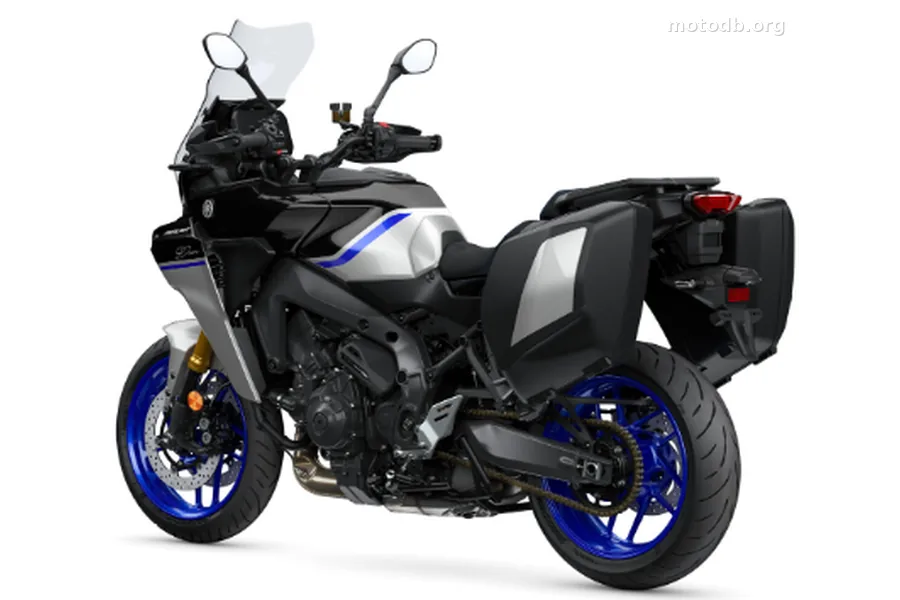
The Tracer 9 GT+ is not just the most upscale of the Tracers; it's also Yamaha’s most technologically advanced motorcycle for the road. The R1 is out of the picture, now reserved for track use. A crossover that has become the flagship of the touring range, with an amazing abundance of equipment.
A GT+ costs 50% more than a base Tracer 9. But does it offer as much in terms of practicality, comfort, and technology? Is that quantifiable on an emotional level? If we can’t answer that last question, let’s try to discover the others.
Let’s start by listing what the GT+ includes in addition to the standard and GT models.
With this technology, Yamaha "grafts" a technical suite onto the engine to achieve automated transmission. The selector and clutch lever are removed. As a result, the rider can: - Either shift gears manually with a set of controls on the left handlebar-mounted switchgear - Or opt for automatic management at two levels. Mode D shifts smoothly; D+ is more sporty, and holds gears longer.
The Y-AMT is not a transmission like Honda’s Dual Clutch system but a technical addition to an existing gearbox. This gives it more modularity. The proof is that it’s found as an option on the MT-07, MT-09, and Tracer 7. It’s being installed on other models and could be offered on most of the range in the medium term.
The Tracer 9 GT+ is therefore heavily equipped with driver assistance systems. We’ve seen its specifics, let’s find what it borrows from the GT:
This gives us two generous panniers. Which are added to the original equipment of the Tracer 9. A vaguely trail-capable touring machine, whose 2025 revision pushes it even further towards long-distance touring. Its CP3 three-cylinder engine knows how to adapt to the exercise, with its typical rumble, its enchanting behavior since its debut, and its 119 horsepower always available.
The onboard electronics allow the rider to choose 5 Riding Modes to motivate them. Three are programmed in the factory, to quickly select a Sport, Street, or Rain character; and two are customizable. It’s up to you to adjust the power delivery (PWR), the intervention of the traction control (TCS), the permissiveness level for wheelies (LIF), the slide control (SCS), the suspension laws (SUS), the braking regulation (BC), and the shifter (QS) intervention.
Fortunately, there’s a large screen to handle all of that. Yamaha has removed (hooray) the twin screen of the previous Tracer 9 and GT to install a 7-inch panel on all versions, as on the previous GT+. Three display themes are offered.
This version of the Tracer receives Spinforged wheels, lighter and heralding more agility, as well as specific Bridgstone T32 tires. Life on board is enhanced by a small glove box with a USB socket, a longer rear frame to give more space for the riders, a revised ergonomics, a redesigned fairing for more protection, and reinforced nighttime visibility thanks to cornering lights on all models.
With so much equipment, you can guess that the Yamaha Tracer 9 GT+ will hit the bank hard. Not far from the price of an R1 and much more than the 2024 version. 2000 euros of difference which include the lightweight wheels, the robotic gearbox, the keyless system, an additional Riding Mode, and the matrix headlights. The machine also accepts 9 kilos more (232 kg fully fueled) and a seat height going from 820 / 835 mm to 845 / 860 mm.
M.B- photos constructeur
KADS: This semi-active system is integrated into the motorcycle’s electronics and automatically adjusts the damping by using real-time data detected by the six-axis IMU, such as the tilt angle, load, acceleration, amplitude, and speed of the suspension travel, thus offering sporty riding without compromising comfort.
Standard equipment
- Assistance au freinage : ABS
- Nombre de mode de conduite : 5
- Volume de rangement : 60 litres
- Taille de l'écran TFT couleur : 17,78 cm / 7 pouces
- ABS Cornering
- Jantes aluminium
- Shifter
- Béquille centrale
- Indicateur de vitesse engagée
- Régulateur de vitesse
- Boîte automatique
- Freinage combiné
- Bluetooth
- GPS
- Prise USB
- Aide au démarrage en côte (Hill Hold Control)
- Démarrage sans clé
- Contrôle de traction
- Poignées chauffantes
- Pare brise réglable électriquement
- Suspensions réglables électroniquement
- Contrôle anti wheeling
- Valises
- Jantes forgées
- Système radar
- Contrôle de glisse
- Embrayage anti-dribble
- Selle réglable
- Repose-pieds réglables
- Centrale inertielle
- Commodes rétro-éclairés
- Phares adaptatifs en virage
- Contrôle du frein moteur
- Surveillance de la pression des pneus
- Avertisseur freinage d'urgence
Practical info
- La moto est accessible aux permis : A
Indicators & positioning
Similar bikes
Multistrada V2 890
Multistrada V2 S 890
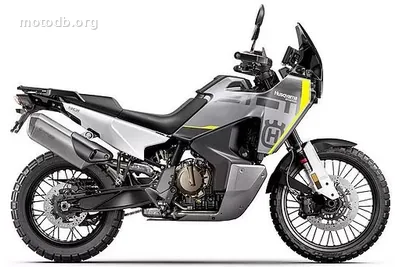
Norden 901
Reviews & comments
No reviews yet. Be the first to share your opinion!