Key performance
Technical specifications
Engine
- Displacement
- 599 cc
- Power
- 118.4 ch @ 14500 tr/min (87.1 kW)
- Torque
- 61.7 Nm @ 10500 tr/min
- Engine type
- 4 cylindres en ligne, 4 temps
- Cooling
- liquide
- Compression ratio
- 13.1 : 1
- Bore × stroke
- 67 x 42,5 mm
- Valves/cylinder
- 4
- Camshafts
- 2 ACT
- Fuel system
- injection
- Starter
- électrique
Chassis
- Frame
- deltabox double poutre en alu
- Gearbox
- boîte à 6 rapports
- Final drive
- Chaîne
- Front suspension
- Fourche téléhydraulique inversée Ø 43 mm, déb : 120 mm
- Rear suspension
- Mono-amortisseur, déb : 120 mm
Brakes
- Front brakes
- Freinage 2 disques Ø 320 mm, fixation radiale, étrier 4 pistons
- Rear brakes
- Freinage 1 disque Ø 220 mm, étrier 2 pistons
- Front tyre
- 120/70-17
- Rear tyre
- 180/55-17
Dimensions
- Seat height
- 850.00 mm
- Fuel capacity
- 17.00 L
- Weight
- 185.00 kg
- New price
- 13 999 €
Overview
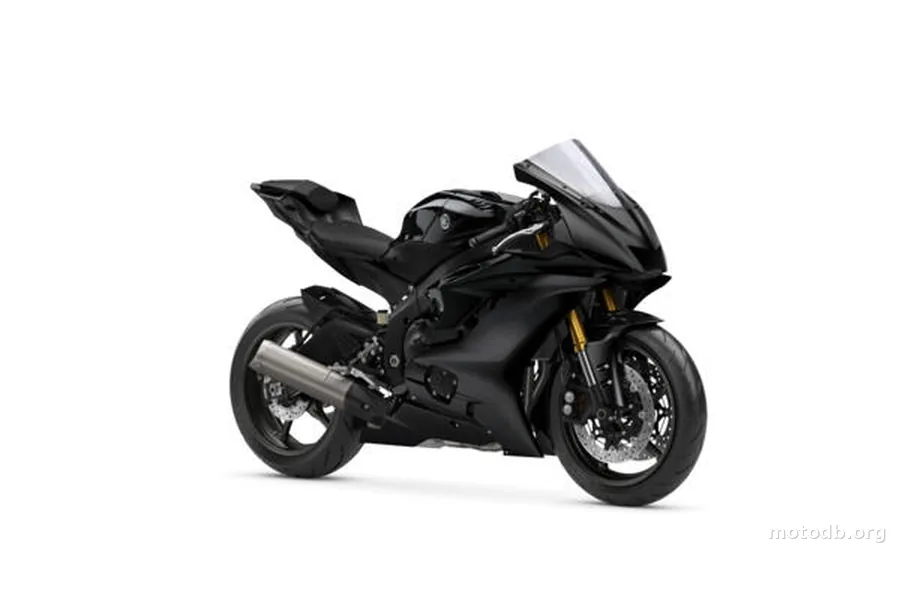
The R6 has been around for so long and is such an integral part of the sporting sacrament that one can scarcely imagine the Yamaha lineup without it. It continues its career… exclusively on the track. After all, that’s where it truly feels at home. Yamaha continues to market its track bike, in a Race version.
The Supersports category is no longer experiencing success. A few still believe in it, like the R6, the CBR 600 RR from Honda, and the ZX-6R 636 from Kawasaki. The latter two still design to occasionally dabble on the road, but the Iwata track bike can only express itself on the track. The last time it was updated was in 2017 – with enough to give the competition a hard time:
A true genetic transfer was operated from its big sister, the R1. Starting with its bodywork. From a distance, they seem to be twins. The two share almost the same rear section, making it difficult to differentiate them from behind. The front end is also part of its genetic heritage. Like its ancestor, it inherits the look of Valentino Rossi’s MotoGP Yamaha M1. Its chromosomes, carriers of performance, offer a central air intake around which the entire design harmonizes. The same goes for the tank, marked by four iconic striae.
Nerve Endings
The flattering genes of its descendant obviously impact its behavior. It gains a few neurons with the welcome traction control offering 6 levels of intervention. Its cockpit welcomes the instrumentation from the old R1, 2009–2014 version. With a large needle-type tachometer, a polygon digital window, and... ah, no, no handlebar controls. Only road functions and the Traction Control command activate from the commodos. Added to the electronic throttle and variable intake, already present on the previous model year, its synapses will also manage the “QSS” shifter system (a system strictly similar to that of the R1 allowing gear changes without clutching).
This track bike is equipped with a trio of injection maps. By inheriting D-Mode, the R6 benefits from direct and aggressive engine management in mode A, more supple to get acquainted with Std, and calm in B. Enough to adapt to the day's outing.
That’s not all, the supersport has also recovered the braking system from its elder! Namely, its four-piston aluminum radial calipers, biting 320 mm diameter discs. The previous generation was already exempt from any criticism regarding braking, even though its pistons were enjoying 310 mm discs. ABS is also on board.
The R6 has always been considered a very well-suspended motorcycle. But to hell with thriftiness! The rear shock is of a new design, and the fork comes directly from the R1. In addition to an enlarged fork tube diameter from 41 mm to 43 mm, this latest-generation Kayaba offers all top-of-the-line adjustments. The wheelbase and width of the track bike lose 5 small mm each, a trifle. The weight has dropped as the headlights and other trinkets disappeared: - 5 kilos on the scale.
The emphasis has clearly been placed on electronic equipment and front-end optimization. On the engine side, the gains are maintained. The bike retains its silencer and no upheaval has been operated on the engine side, except for adaptation to Euro4 standards. Which cost it a handful of horsepower. The R6 lost almost 6 horses in the operation, now displaying 118.4 horsepower at 14,500 rpm. The torque also unwound, with almost half a mkg less. The 4-cylinder block does not inherit the R1 and M1 cross-plane timing, and retains its personality and delicious sound.
As with any sportbike, the R6 needs racing elements to fully express itself. Yamaha already has everything in stock via the GYTR kit. Enough to bring it a choice of exclusive performance improvements. It includes an electronic GYTR kit integrating a lightweight wiring harness and a programmable ECU that allows you to configure the motorcycle to optimize engine performance. The AIS (Air Intake System) allows the R6 RACE to benefit from optimal air intake that boosts its power. Its Akrapovic titanium exhaust line is specially designed to optimize engine power and significantly reduce the weight of the machine.
The race fairing reduces drag and improves top speed and handling. To meet the increase in power, the brakes have also been improved and benefit from new stainless steel hoses offering better feel at the handlebar and a better sensation when decelerating. The GYTR ABS emulator allows you to remove the ABS pump for additional weight reduction.
Other parts required by the FIM are mounted, such as the front brake lever protectors and the rear sprocket protector, while the rear stand hooks simplify wheel removal.
The GYTR developed for the R6 RACE includes the following racing parts:
- Complete GYTR fairing - Complete Akrapovic exhaust line - GYTR ECU kit - GYTR wiring harness kit - GYTR on/off switch - GYTR interface USB cable - GYTR AIS spark plug kit - GYTR ABS emulator - GYTR keyless fuel cap - GYTR seat cover - GYTR stainless steel brake hose kit for front and rear - Front brake lever protector - Recessed GYTR controls with optional reverse selection kit - Shark fin-shaped chain protector - 14-tooth front sprocket, for 520 chain conversion - 45-tooth rear sprocket, for 520 chain conversion - Sprocket nut set for 520 conversion - DID gold set for 520 chain conversion - Rear stand hooks - Rear stand
M.B - RémimaConstructeur Media
Standard equipment
- Assistance au freinage : ABS
- Nombre de mode de conduite : 3
- Jantes aluminium
- Shifter
- Indicateur de vitesse engagée
- Contrôle de traction
- Embrayage anti-dribble
Practical info
- La moto est accessible aux permis : A
- Pays de fabrication : Japon
Indicators & positioning
Similar bikes
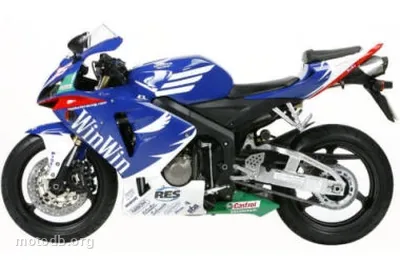
CBR 600 RR édition HANNspree Ten Kate
CBR 600 RR Replica MOVISTAR
Reviews & comments
No reviews yet. Be the first to share your opinion!