Key performance
Technical specifications
Engine
- Displacement
- 847 cc
- Power
- 115.0 ch @ 10000 tr/min (84.6 kW)
- Torque
- 87.3 Nm @ 8500 tr/min
- Cooling
- liquide
- Compression ratio
- 11.5 : 1
- Bore × stroke
- 78 x 59.1 mm
- Valves/cylinder
- 4
- Camshafts
- 2 ACT
- Fuel system
- Injection
Chassis
- Frame
- type diamant
- Gearbox
- boîte à 6 rapports
- Final drive
- Chaîne
- Front suspension
- Système multi-essieux avec double fourche inversée LMW
- Rear suspension
- Mono-amortisseur, déb : 125 mm
Brakes
- Front brakes
- Freinage 2 disques Ø 298 mm, fixation radiale, étrier 4 pistons
- Rear brakes
- Freinage 1 disque Ø 282 mm, étrier simple piston
- Front tyre
- 120/70-15
- Front tyre pressure
- 2.25 bar
- Rear tyre
- 190/55-17
- Rear tyre pressure
- 2.90 bar
Dimensions
- Fuel capacity
- 18.00 L
- Weight
- 263.00 kg
Overview
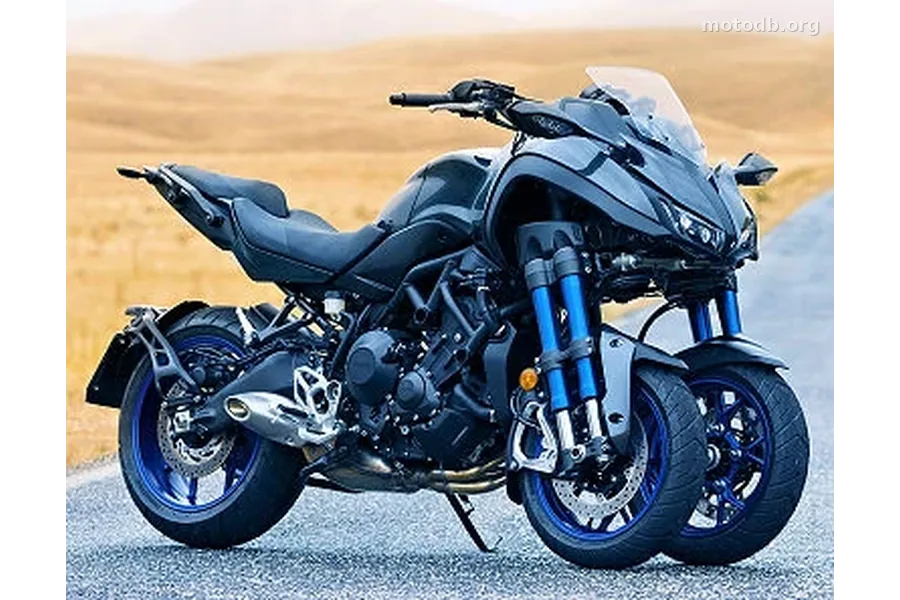
What happens when Yamaha decides to graft an extra wheel onto the front of a punchy roadster? You get the Yamaha Niken 900, a machine that divides opinion as much as it fascinates. Since 2018, this three-wheeled leaning vehicle has been shaking up the convictions of traditional motorcyclists. Where the Piaggio MP3 and Peugeot Metropolis paved the way with dual-front-wheel scooters, Yamaha crossed a line nobody dared to cross: transplanting that concept onto a real motorcycle, with a real engine, real sport suspension, and a genuine touring vocation.
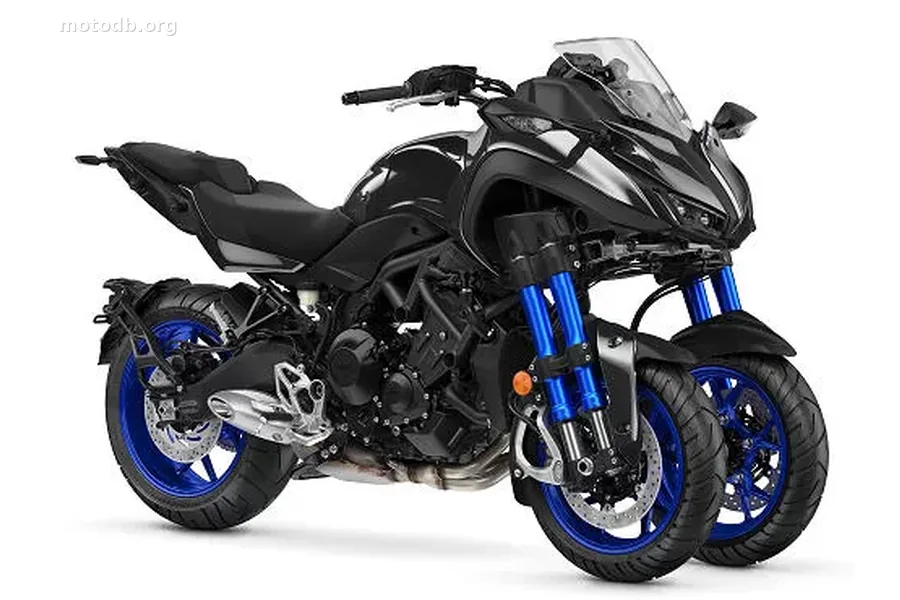
The heart of the beast is the 847 cc CP3 triple, the same block found in the MT-09, the Tracer 900, and the XSR 900. How much horsepower does the Yamaha Niken 900 have? The answer hits like a blip of the throttle: 115 hp at 10,000 rpm, backed by 87.3 Nm of torque at 8,500 rpm. Enough to push the whole package to a top speed of 200 km/h. Because yes, there's serious weight to haul. The Yamaha Niken 900 tips the scales at 263 kg wet, including its 18-liter tank. That's substantial — far more than an MT-09 — but the overall width remains surprisingly contained: barely 8 cm wider than the roadster it borrows its mechanicals from, hardly more than a BMW R 1200 R. Filtering through city traffic isn't the ordeal you'd expect from looking at that massive silhouette.
But the real show is up front. The Leaning Multi-Wheel system, unveiled as a concept at the Tokyo Motor Show in 2015, relies on a dual set of inverted forks mounted on a multi-axle mechanism. Each arm carries a 15-inch wheel and a radial 4-piston caliper biting a 298 mm disc. The rear stays conventional with a single 282 mm disc and a mono-shock offering 125 mm of travel. The diamond frame and swingarm are purpose-built components, designed to handle the stresses of this unprecedented architecture. The promised result: enhanced stability at lean, reassuring grip on broken or wet surfaces, and an ability to absorb road irregularities that two forks handle better than one.
The Yamaha Niken 900 targets a very specific rider profile. The kind of motorcyclist drawn to riding pleasure, attracted by lean angles and active riding, but held back by the precarious balance of a conventional motorcycle. A standard motorcycle license is all you need for the Yamaha Niken 900 — A-license in your pocket and you're good to go. The instrumentation borrowed from the MT-10, cruise control, and riding modes reinforce the machine's touring credentials. For those wanting to push long-distance comfort further, the GT version also exists, and on the used market you can find a 2021 Yamaha Niken 900 GT with 2,500 km on the clock for a price hovering around €10,500. What does a new Yamaha Niken 900 cost? Yamaha never quoted a modest price tag, and initial distribution went through an online reservation system, much like the R1-M. The pricing remains high, consistent with the level of onboard technology.
Enthusiasts who love upgrades aren't forgotten either: braided brake lines for the Yamaha Niken 900 rank among the first popular modifications, a sign that the machine also attracts riders who are demanding when it comes to braking. The Niken is neither a gimmick nor a mere marketing stunt. It's a sincere proposition for those who want to ride differently, with a mechanical safety net beneath the front wheels. It will never replace the purity of a twin in a lightweight roadster, but it opens a door that nobody else had the guts to push open. And at Yamaha, that's a habit.
Standard equipment
- Assistance au freinage : ABS
Practical info
- La moto est accessible aux permis : A
Indicators & positioning
Similar bikes
Tiger 900 GT Pro Aragon Edition
Tiger 900 GT Pro
Norden 901
Reviews & comments
No reviews yet. Be the first to share your opinion!