Key performance
Technical specifications
Engine
- Displacement
- 998 cc
- Power
- 150.0 ch @ 11000 tr/min (110.3 kW)
- Torque
- 105.9 Nm @ 8000 tr/min
- Engine type
- 4 cylindres en ligne, 4 temps
- Cooling
- liquide
- Compression ratio
- 11.5:1
- Bore × stroke
- 77 x 53,6 mm
- Valves/cylinder
- 5
- Camshafts
- 2 ACT
- Fuel system
- Injection
Chassis
- Frame
- en alu coulé sous pression
- Gearbox
- boîte à 6 rapports
- Final drive
- Chaîne
- Front suspension
- Fourche téléhydraulique inversée Ø nc, déb : 130 mm
- Rear suspension
- Mono-amortisseur, déb : 130 mm
Brakes
- Front brakes
- Freinage 2 disques Ø 320 mm, étrier 4 pistons
- Rear brakes
- Freinage 1 disque Ø 245 mm, étrier 2 pistons
- Front tyre
- 120/70-17
- Front tyre pressure
- 2.50 bar
- Rear tyre
- 190/50-17
- Rear tyre pressure
- 2.90 bar
Dimensions
- Seat height
- 815.00 mm
- Fuel capacity
- 18.00 L
- Weight
- 220.00 kg
- Dry weight
- 199.00 kg
- New price
- 9 499 €
Overview
When a motorcycle receives only a single color option in the catalog, the message is crystal clear. The Yamaha FZ1 1000 Fazer arrives in 2015 at the end of the road, after nearly a decade of service in this form. Yet reducing this machine to an end-of-life model would be doing it a disservice. Since the first Fazer 1000 appeared in 2001, Yamaha has evolved the concept of the large semi-faired roadster with rare consistency. The 2015 model year remains a solid proposition for anyone seeking a versatile four-cylinder without breaking the bank, with a price tag of 9,499 euros placing it in direct competition with the Suzuki Bandit 1250 or Kawasaki Z1000SX of the era.
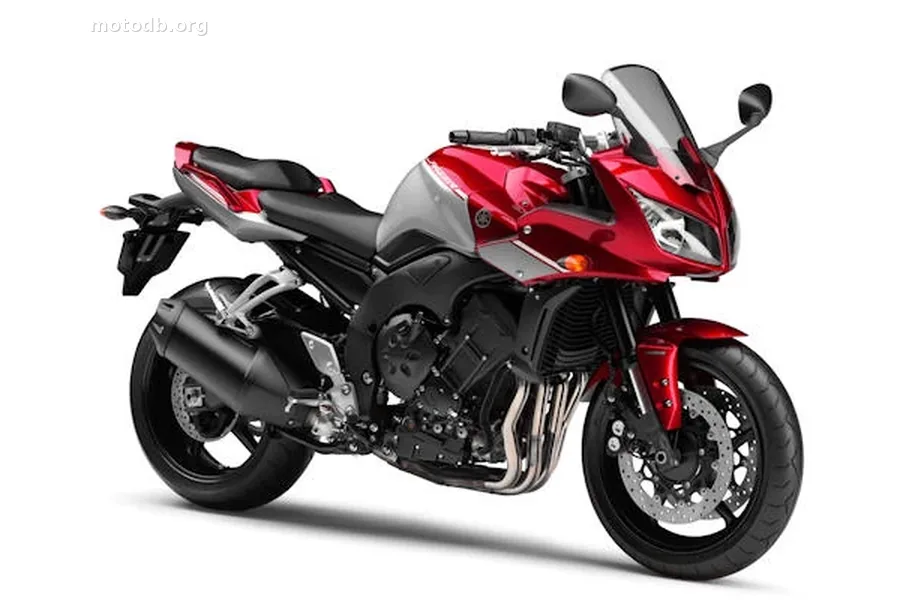
Beneath the 18-liter fuel tank beats an inline four-cylinder displacing 998 cc, directly derived from the 2004-2005 R1. Yamaha recalibrated it for road use, but the figures speak for themselves: 150 horsepower at 11,000 rpm and 105.9 Nm of torque at 8,000 rpm. That's generous. The engine, fed by electronic fuel injection (unlike the older FZS 1000 with its carburetors), features five valves per cylinder — a technical signature that is quintessentially Yamaha. With a compression ratio of 11.5:1 and a bore/stroke of 77 x 53.6 mm, this is a powerplant that loves to rev while still delivering strong response from the midrange onward. The six-speed gearbox and chain drive do their job without fuss.
The chassis is equally well sorted. The die-cast aluminum frame, inspired by the older FZ6's but resized to handle the extra power, houses a telehydraulic inverted fork up front and a single rear shock, both offering 130 mm of travel. Braking relies on two 320 mm discs gripped by four-piston calipers at the front, complemented by a 245 mm disc at the rear. Tires in 120/70-17 and 190/50-17 sizes provide a solid level of grip. On paper, it's a coherent and well-proportioned package for a sport-touring machine weighing 220 kg wet.
The Fazer's design retains that half-fairing which gives it its identity compared to the naked version. Wind protection remains adequate for devouring main roads, and the silhouette keeps that aggressive look typical of large-displacement Yamahas from this period. The distinctively shaped exhaust is a love-it-or-leave-it affair. Ergonomically, the seat perched at 815 mm and the leg spread dictated by the width of the four-cylinder can prove awkward for smaller riders. Urban agility isn't its strong suit either, especially compared to the naked FZ1, which feels lighter in practice. This is clearly a motorcycle built for spirited rides on country roads and longer daily commutes rather than city traffic weaving.
Finding a brand-new Yamaha FZ1 1000 Fazer today is a tall order, as the model left the catalog shortly after 2015. The used market, however, is brimming with fine examples, with the 2006, 2007, and 2013 model years being particularly well represented. Reliable and mechanically proven thanks to its R1 foundation, the Fazer 1000 ages gracefully. It appeals to riders who want character without the extremes of a hypersport, genuine versatility, and a manageable budget. Compared to today's electronics-laden standards, it comes across as an old-school machine — and that's also part of its charm.
Standard equipment
- Assistance au freinage : ABS en option
Practical info
- La moto est accessible aux permis : A

Reviews & comments
No reviews yet. Be the first to share your opinion!