Key performance
Technical specifications
Engine
- Displacement
- 1043 cc
- Power
- 120.0 ch @ 9000 tr/min (88.3 kW)
- Torque
- 102.0 Nm @ 7500 tr/min
- Engine type
- 4 cylindres en ligne, 4 temps
- Cooling
- liquide
- Compression ratio
- 10.3 : 1
- Bore × stroke
- 77 x 56 mm
- Valves/cylinder
- 4
- Camshafts
- 2 ACT
- Fuel system
- Injection Ø 38 mm
Chassis
- Frame
- Double poutre en aluminium
- Gearbox
- boîte à 6 rapports
- Final drive
- Chaîne
- Front suspension
- Fourche téléhydraulique inversée Ø 43 mm KECS, déb : 150 mm
- Rear suspension
- Mono-amortisseur KECS, déb : 152 mm
Brakes
- Front brakes
- Freinage 2 disques Ø 310 mm, étrier 4 pistons
- Rear brakes
- Freinage 1 disque Ø 250 mm, étrier simple piston
- Front tyre
- 120/70-17
- Front tyre pressure
- 2.50 bar
- Rear tyre
- 180/55-17
- Rear tyre pressure
- 2.90 bar
Dimensions
- Seat height
- 840.00 mm
- Fuel capacity
- 21.00 L
- Weight
- 257.00 kg
- New price
- 17 749 €
Overview
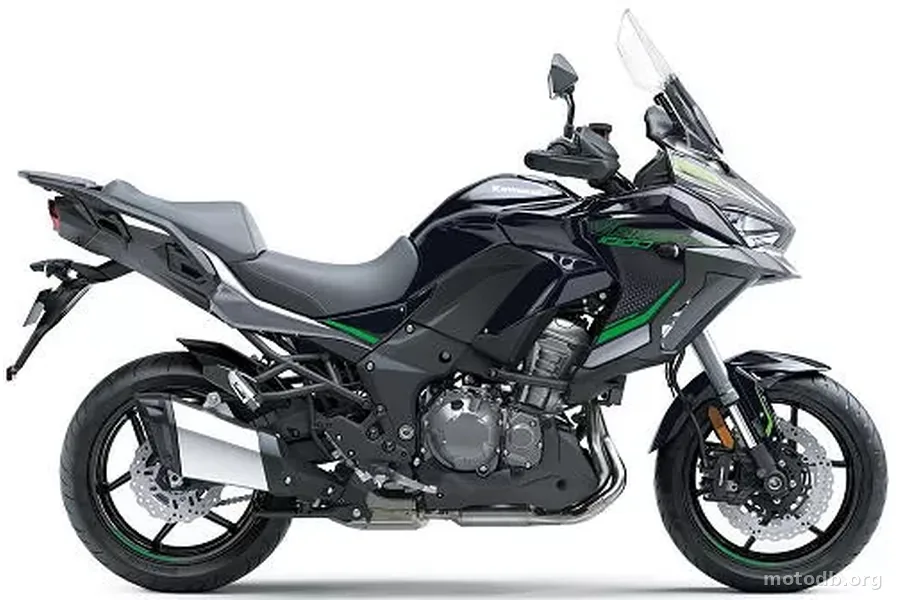
With the arrival of the S in the lineup, the Versys 1000 SE might have worried about its place at Kawasaki. Fortunately, it retains the privilege of its electronically controlled suspension. Manufactured by Showa, it benefits from an evolution and allows the Kawasaki to increase comfort.
Today, if you want to maintain a tactical positioning in the trail-GT market, you have no choice: you need electronics, a lot of them, and offer a premium touch to take care of the fork and the shock absorber.
Since 2019, that’s been the job of the KECS system. The time has come to upgrade its cognitive abilities by grafting the Skyhook EERA software onto it. Basically, the damping force is better controlled to keep the motorcycle’s attitude as stable as possible. The suspension eats up bumps and dips to reduce pitching.
This offers more smoothness while retaining the basic technique. Thanks to the information transmitted by the sensors mounted on the fork and shock, via the IMU and by the engine management unit, the Kawasaki Electronic Control Suspension adapts the damping in real time. The adjustment solenoid valves react in milliseconds and then adjust the suspension to the road while taking into account the type of "reaction" desired by the rider. The road feel via the KECS can be firm, normal, or soft. The load on board can also be adjusted, in three possibilities: rider / rider with luggage / rider with passenger and luggage.
Here is the added value of this SE. And which allows it to fully assume its vocation of a large touring machine with a trail face. Over-equipped, the Versys 1000 SE should not be called Special Edition but Special Voyage. It must be said that the manufacturer has put almost everything he had in stock in this machine, except for the luggage which remains an option.
From the appreciated windscreen to the handguards, the equipment differs in nothing from the S. This does not prevent it from being generous. We count the cruise control, the self-healing paint - on the tank, the internal sides of the fairing and the underside of the saddle -, the lateral headlights for cornering lighting, the Riding Modes, a 12V socket, the Up&Down shifter, heated grips, and a Sport-GT riding position. The large tachometer is paired with a beautiful, high-quality color TFT screen brimming with information. A block not unknown, borrowed without restraint from the H2 and its H2 SX SE (and SE+) cousin. It must be said that many functions must be displayed...and parameterized. Let's start by pairing the smartphone with the Rideology app to visualize a series of information about the motorcycle (maintenance, trips, fuel, angles taken, average speed, etc.), to personalize the dashboard display, the ability to manage calls and music, and to adjust all driving aids.
And to comfort. Ready to go? First, let the 120 hp engine warm up a bit while you choose a riding mode. There are four, the first three with their characteristics defined in the factory and the fourth customizable to do your own fine-tuning. Sport: traction control KTRC is set to 1, the least intrusive, the Power Mode is in full to deliver all the power and the KECS is set in Hard. Road: with a road-oriented feel, it increases the KTRC to 2, leaves all the power and softens the KECS in Normal. Rain: much more docile with the KTRC locked (3), the power reduced, and the KECS in Soft. Rider: allows the rider to set the KTRC on 1/2/3/off, the Power Mode on Full or Low, and the KECS in Hard/Normal/Soft with an additional appreciation of + 5 and - 5 clicks on the compression and rebound of the suspension.
With the IMU on board, the ABS is in cornering version. The KIBS, the intelligent anti-lock braking system that knows how to modulate the braking pressure according to the motorcycle's dynamics, thus receives the reinforcement of the adaptive cornering system. The braking management works in concert with the pilot suspension. A system that can reassure when you have 257 kilos of motorcycle between your grips and the weather is playing tricks on you.
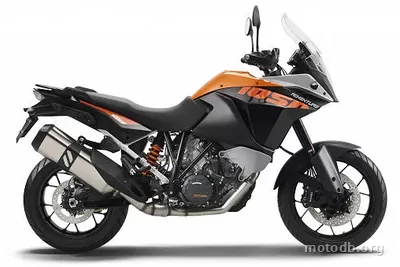
The SE definition at Kawasaki becomes the answer to competitors loaded with electronics, always more abundant each year. Pushing the maximum capabilities of the manufacturer, the large Versys clearly wants to go and put its kickstand in the corner of the European models. The price has also crossed a threshold, far less democratic than the trail philosophy. However, it can still remain below the average of Ducatis, Triumphs and BMWs with an equivalent level of equipment. On the other hand, it will be difficult to compete with the KTM Super Adventure, which is much more powerful, lighter, and more typical.
M.B - media constructor
Standard equipment
- Assistance au freinage : ABS en curvas
- Nombre de mode de conduite : 4
- Jantes aluminium
- Shifter
- Béquille centrale
- Indicateur de vitesse engagée
- Régulateur de vitesse
- Bluetooth
- Contrôle de traction
- Poignées chauffantes
- Pare brise réglable
- Suspensions réglables électroniquement
- Embrayage anti-dribble
- Phares adaptatifs en virage
- Contrôle du frein moteur
Practical info
- La moto est accessible aux permis : A
Reviews & comments
No reviews yet. Be the first to share your opinion!