Key performance
Technical specifications
Engine
- Displacement
- 1043 cc
- Power
- 120.0 ch @ 9000 tr/min (88.3 kW)
- Torque
- 102.0 Nm @ 7500 tr/min
- Engine type
- 4 cylindres en ligne, 4 temps
- Cooling
- liquide
- Compression ratio
- 10.3 : 1
- Bore × stroke
- 77 x 56 mm
- Valves/cylinder
- 4
- Camshafts
- 2 ACT
- Fuel system
- Injection Ø 38 mm
Chassis
- Frame
- Double poutre en aluminium
- Gearbox
- boîte à 6 rapports
- Final drive
- Chaîne
- Front suspension
- Fourche téléhydraulique inversée Ø 43 mm, déb : 150 mm
- Rear suspension
- Mono-amortisseur, déb : 152 mm
Brakes
- Front brakes
- Freinage 2 disques Ø 310 mm, étrier 4 pistons
- Rear brakes
- Freinage 1 disque Ø 250 mm, étrier simple piston
- Front tyre
- 120/70-17
- Front tyre pressure
- 2.50 bar
- Rear tyre
- 180/55-17
- Rear tyre pressure
- 2.90 bar
Dimensions
- Seat height
- 840.00 mm
- Fuel capacity
- 21.00 L
- Weight
- 253.00 kg
- New price
- 12 949 €
Overview
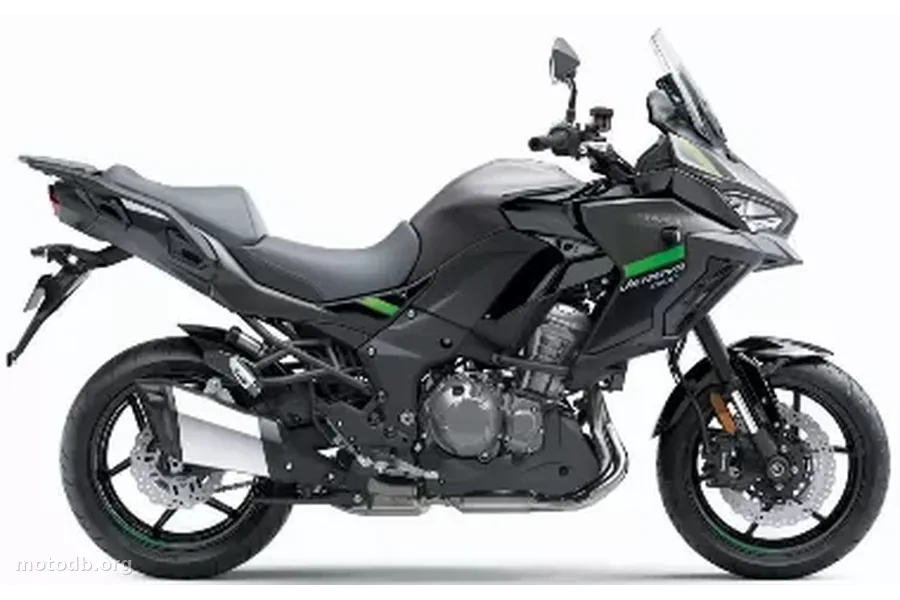
The Kawasaki Versys 1000 (2024)
It seems the absence of the 1000 Versys (without S or SE) was keenly felt in the 2021 Kawasaki lineup. It disappeared to make way for the S model. It seems the public took notice, as the large trail bike returned in 2022 in this simplified version. But no less interesting, as the machine retains the essentials. Its niche is to offer a large SUV at an affordable price – indeed, with fewer euros since the 2020 tariff.
In the absence of a large touring model from Kawasaki, the trail-GT occupies the role of long-distance traveler. A case that is far from being an exception. One might have almost thought it was a fad until it became almost a norm. KTM, Triumph, Suzuki, Ducati (to name a few) are chartering this type of motorcycle to head out on long journeys. With the abundance of technology also taking up residence in Akashi, the Versys 1000 receives numerous improvements under a new face.
The time when the Versys had a face of a vacationing minion returning from Chernobyl is long gone. Redesigned in 2015 with hints of H2, the trail bike goes further in this experimentation by adding pieces of the Ninja 400 and 636. With a more mature look, broad shoulders, and a loaded jaw replacing the mandibles, it seems the time has come to assert a stature of deference. Kawasaki took the opportunity to revise the skid plate, add some trim pieces on the rear to make it a little more substantial, modify the shape of the turn signals... and impose strange hatches on the sides.
This is where the additional headlights intended for the SE version’s corner lighting are installed. But rather than offering specific panels, the manufacturer persists in the same approach as for the H2 SX (only the H2 SX SE is available with us) by plugging the locations with covers that spoil the design. These spaces would be the size of a tangerine; we would make fun of them – but here, the integration is as successful as duct tape on porcelain. Let’s not pay it any more attention. We won’t see them while riding, and this new trim combined with a modified bubble should improve protection on board; although it is now adjustable by only 65 mm, which is 10 mm less than before.
If Kawasaki wanted to give its touring trail bike a new face, it seems more satisfied with its technical design. From the frame to the wheels, including the engine, many elements are taken from the previous version. Not all, because some subjects appreciate being brought up to date. Ride-by-wire control now allows you to enjoy cruise control. The injection is retouched to offer a little more consistency in the usual ranges. That will be all engine-side. The 1043 cm3 four-cylinder engine from the Z 1000 still offers 120 hp at 9000 rpm and 10.4 mkg of torque at 7500 rpm. It does not want to get involved in the mastodon battle of the sector, displaying 30 to 40 hp more. The exhaust benefits from a new profile for the collector’s intertubes, a new three-way catalyst and a retouched silencer. Not much smaller but more shrill. Quite velvety when releasing more than when exploding its power, the block will be insensitive to the 3 kilos of additional weight of the motorcycle.
Also, few changes on the chassis side, except for a recalibrated suspension setting for better shock absorption. The 43 mm inverted fork and the mono-shock working on 150 mm of travel should distill more comfort. Oops, let’s go back a bit to the front. This is where we see the change. The brake calipers become radial and monoblock, and will be assisted by a more efficient ABS. We will see this in the next chapter. Because let’s take a moment on this cockpit before probing the electronic entrails of the Versys 1000 III, where a large part of the evolutions nest.
Voilà! We feel like we’re on the saddle. Which allows us to note that the brake reservoir is now of the sport type. A 12V socket is now part of the standard equipment. The instrumentation comes directly from the H2, offering a more illustrious side. The commodos have changed, are much more complete, and herald new assistance systems. Cruise control, as mentioned earlier, and with the presence of a Bosch IMU, the large Versys can afford the cornering monitoring system KCMF. It supervises the KIBS, the intelligent brake anti-lock system inherited from the H2 and the ZX-10R. We find the 3-mode traction control KTRC, ABS, the two power modes, and a quickshifter is available as an option. Lighting is LED all around.
Constant monitoring can save you from quite a few surprises. We almost forget the little things that make your daily life easier. It’s not new but it’s always appreciated, this carrier to take a large item that you never know where to put. Still no shaft; the presence of a center stand is therefore very useful for chain lubrication. No small brackets for the tow ropes but a system for anchoring luggage racks, discreet and efficient.
The Versys 1000, is it a bit of a road or is it still road-biased? With 17-inch wheels and Bridgestone T31 tires, there is no doubt about its orientation. If Kawasaki had wanted to create an illusion, we would find A41 and a 19-inch front wheel. No, the machine perfectly assumes its role as a crossover. For its third chapter, it has recovered all sorts of technologies premiered by the most tactical models in the catalog. But the standard version is entitled to only a few, in order to maintain an entry price while preserving the essentials. As with the H2 SX, the large Versys only reveals the extent of its virtues in the SE version. With semi-active suspension, reinforced electronics, quickshifter as standard, corner lighting, increased comfort, and European pricing. The S version positions itself as an intermediate, especially for those who do not attach much importance to electronic suspensions.
M.B - media constructor
Standard equipment
- Assistance au freinage : ABS de série
- Béquille centrale
- Indicateur de vitesse engagée
- Régulateur de vitesse
- Contrôle de traction
- Pare brise réglable
- Embrayage anti-dribble
Practical info
- La moto est accessible aux permis : A
Reviews & comments
No reviews yet. Be the first to share your opinion!