Key performance
Technical specifications
- Compression ratio
- 12 : 1 → 12:1
- Fuel system
- Injection Ø nc → Injection électronique Bosch
- Euro standard
- — → Euro 5+
- Frame
- tubulaire en acier → Tubulaire en acier, sous-châssis arrière boulonné
- Front suspension
- Fourche telescopique inversée Ø 43 mm, déb : 135 mm → Fourche téléhydraulique inversée Ø 43mm, déb : 135 mm
- Rear suspension
- Mono-amortisseur, déb : 130 mm → mono amortisseur à gaz, déb : 130 mm
- Front brakes
- Freinage 1 disque Bybre Ø 300 mm, fixation radiale, étrier 4 pistons → Freinage 2 disques Bybre Ø 300 mm, fixation radiale, étrier 4 pistons
- Weight
- 183.00 kg → 176.00 kg
- New price
- — → 6 495 €
Engine
- Displacement
- 398 cc
- Power
- 42.0 ch @ 9000 tr/min (30.9 kW)
- Torque
- 37.5 Nm @ 7500 tr/min
- Engine type
- Monocylindre, 4 temps
- Cooling
- liquide
- Compression ratio
- 12:1
- Bore × stroke
- 89 x 64 mm
- Valves/cylinder
- 4
- Camshafts
- 2 ACT
- Fuel system
- Injection électronique Bosch
- Starter
- électrique
- Euro standard
- Euro 5+
Chassis
- Frame
- Tubulaire en acier, sous-châssis arrière boulonné
- Gearbox
- boîte à 6 rapports
- Final drive
- Chaîne
- Front suspension
- Fourche téléhydraulique inversée Ø 43mm, déb : 135 mm
- Rear suspension
- mono amortisseur à gaz, déb : 130 mm
Brakes
- Front brakes
- Freinage 2 disques Bybre Ø 300 mm, fixation radiale, étrier 4 pistons
- Rear brakes
- Freinage 1 disque Bybre Ø 230 mm, étrier simple piston
- Front tyre
- 110/70-17
- Rear tyre
- 150/60-17
Dimensions
- Seat height
- 795.00 mm
- Seat type
- Selle biplaces
- Fuel capacity
- 13.00 L
- Weight
- 176.00 kg
- New price
- 6 495 €
Overview
It all started in Hampshire, near a village of just a few hundred souls: Thruxton. There's not much to do there; London is 75 miles away... But there was a RAF airfield during World War II, where a circuit was created in the late 1940s. Triumph left its mark on the “500 Miles of Thruxton” race in 1969, placing three Bonnies on the podium.
For the younger among us, the Thruxton was a 1200 cm3 café racer, superb and exhilarating. For the older, it’s a Bonneville transformed into a cafra since 2004, with an 865 cm3 engine producing 70 horsepower. We’re not going to retrace the entire lineage; just a bit of background to introduce a new chapter in the saga. Surely the most modest and perhaps the most revealing of an era.
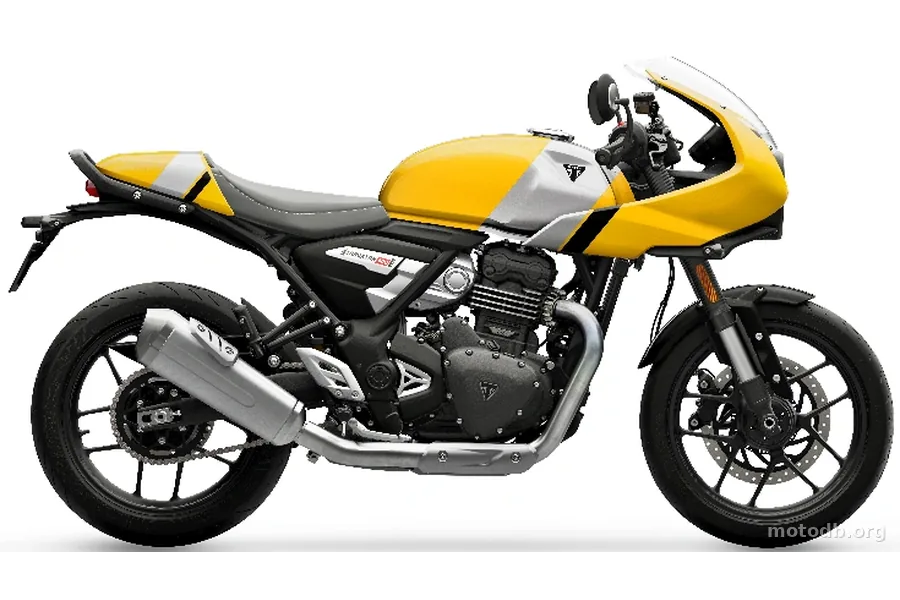
141 words later, we can appreciate the all-new 400 Thruxton. A neo-retro sportbike directly derived from the Tracker 400 (it works the other way around too). Triumph presented it back in the summer of 2025, leaving doubt about its commercialization in Europe. Now, it’s setting its wheels on the old continent. Beautifully designed, presenting a very characteristic sporty look with its fork head modeled after the Speed Triple 1200 RR, it immediately provokes dynamic sympathy. Its low handlebars call to you, suggesting an imminent wheelie. Inevitable in spirit but of a different breed on the road.
Having fun, twisting the throttle, wheeling around, no problem... in a shiver worthy of its 42 horsepower. We are not in a Supersport situation but in an A2 expression. The TR single-cylinder engine with a displacement of 398 cm3 differs slightly from the Speed and Scrambler 400. A bit of mechanical engineering (camshafts, injection, and other things) has brought it 2 horsepower, or 5% more punch. Torque doesn't benefit and retains its 37.5 Nm. Both will seek their maximum power, 1,000 RPM higher. It should be noted that a slip clutch is present.
Side by side, Triumph didn’t “Thruxtonize” the Speed 400 with just a race-inspired snout, a matching seat cowl, redesigned covers (airbox and injection bodies), a Monza-style gas cap, a modified seat, a gas tank with specific cutouts, and a lifted rear light (from the Tracker). It's also a matter of posture: the rider leans forward to reach the low handlebars, positioned 246 mm lower than the Speed's handlebar. Their feet follow the ergonomic triangle, settling on raised and 86 mm rearward commands.
Now, it’s between the grips that the 43 mm big-piston inverted fork will act. It and its mono-gas shock absorber buddy have been re-tuned for a more sporty use. With a wet weight of 173 kg, the machine weighs 3 kg more than its roadster brother, a negligible detriment to handling. However, its reduced wheelbase and more reduced steering rake (0.2°) will bring a benefit to agility. Slight, but the difference is technically measurable. The Pirelli Diablo Rosso IV tires are fitted to the small Thruxton. On the braking side, Triumph (and Bajaj) sources from Bybre, with a radial 4-piston caliper at the front. A disc for each wheel, 300 mm at the front and 230 mm at the rear.
On the electronic technology side, we find the normality of the 400 range, namely a switchable traction control, ABS, ride-by-wire, a USB-C port, and a meter mixing a tachometer needle with an LCD display.
Let’s glorify it! This 400 Thruxton is one of the most powerful sportbikes in the Triumph range. What!? Yes, because there are only two – and still... the 660 Daytona didn’t have the radicality of the 765 and 675 of yesteryear. Which Hinckley has long since abandoned. As for the beautiful displacements... The 1200 Thruxtons breathed their last with Euro5+ and the Speed Triple 1200 RR has been quietly eclipsed. The sporty segment is now (and very well) ensured by the roadsters. Triumph therefore offers a compact café racer, a tad more powerful than the Speed 400, to play distinction. It doesn’t promise the big time, but a little more than eating and drinking.
M.B - Photos constructeur
Standard equipment
- Assistance au freinage : ABS
- Contrôle de traction
- Indicateur de vitesse engagée
Practical info
- La moto est accessible aux permis : A, A2
- Pays de fabrication : Inde
Reviews & comments
No reviews yet. Be the first to share your opinion!