Key performance
Technical specifications
Engine
- Displacement
- 399 cc
- Power
- 45.0 ch @ 10000 tr/min (33.1 kW)
- Torque
- 37.3 Nm @ 8000 tr/min
- Engine type
- Bicylindre parallèle, 4 temps
- Cooling
- liquide
- Compression ratio
- 11.5 : 1
- Bore × stroke
- 70 x 51.8 mm
- Valves/cylinder
- 4
- Camshafts
- 2 ACT
- Fuel system
- Injection Ø 32 mm
Chassis
- Frame
- Structure en tubes d'acier
- Gearbox
- boîte à 6 rapports
- Final drive
- Chaîne
- Front suspension
- Fourche telescopique Ø 41 mm, déb : 120 mm
- Rear suspension
- Mono-amortisseur, déb : 130 mm
Brakes
- Front brakes
- Freinage 1 disque Ø 310 mm, étrier 2 pistons
- Rear brakes
- Freinage 1 disque Ø 220 mm, étrier 2 pistons
- Front tyre
- 110/70-17
- Front tyre pressure
- 2.00 bar
- Rear tyre
- 150/60-17
- Rear tyre pressure
- 2.25 bar
Dimensions
- Seat height
- 785.00 mm
- Seat type
- Selle biplaces
- Fuel capacity
- 14.00 L
- Weight
- 167.00 kg
- New price
- 5 099 €
Overview
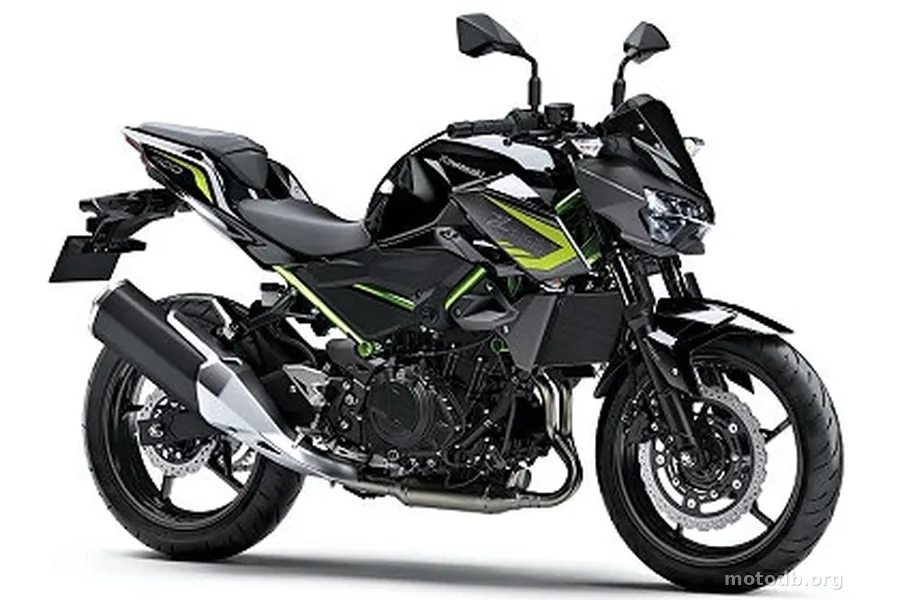
The Kawasaki Z 400 is a bit like the Honda CB 500: an engine almost perfectly sized for the A2 category, with a playful stance and accessible performance. However, it suffers from a somewhat limited displacement in our markets. Is that why the manufacturer removed it from the catalog after 2020? Who knows... Kawasaki is giving it another chance by reintroducing it to the market with the 2023 model year (available from the fall of 2022).
Few things have changed. The colors, the prices, and especially the engine’s expiration. The 399 cm³ twin cylinder has undergone the necessary revisions to meet Euro5 standards. It only loses 0.1 mkg of torque as a result. Otherwise, the motorcycle is retained in all its attributes. It can therefore resume its role as a young Z, a worthy descendant of the Z 300.
Or rather, like the naked version of the Ninja 400. Remove its fairing and you’ve got all the underpinnings of the little sportbike. A simple, easy, and not at all jarring technical choice. Everything is there to enjoy yourself gently within the limits imposed by the "young" rider's license. Powered by its twin, the Z produces 45 horsepower at 10,000 rpm. That’s 6 hp more than the 300. Torque is the big winner of the operation, with more than 1 mkg of additional output. No surprises or disappointments are expected in terms of performance: the roadster only weighs a kilo less than the sportbike. Only the top speed will need to be revised downwards, the absence of protection playing its role as an aerodynamic brake.
Even before delving into the internals of other roadsters in its segment, the 400 has managed to integrate into the Z family. It bears the name, it wants the style. The rear features a sporty look with a taillight modeled after the ZX-10R. It's a shame the engine guard disappeared; the 300 hid things better than it wanted to show.
Kawasaki has worked hard enough for us to forget the origin of its underpinnings. Primarily through its silhouette, and through the onboard welcome. A handlebar replaces the two bracelets and should offer a slightly more relaxed position; although the Ninja’s position is already very livable. The speedometer is almost identical to that of the older 650/900 models. Reasonable seat height of 785 mm, 167 kg ready to ride, overall slimness, ultra-flexible clutch, the mid-range Z offers a good welcome. Mid-range? Yes, we can’t say small anymore since the 125 has joined the catalog. Hmmm, we would have liked a 12V outlet or at least a USB port. Most buyers will always have a phone to charge or an mp3 to plug in.
We expect this machine to offer everyday versatility and dynamics that are both light and reassuring. The chassis is in line with this. The steel tubular section frame is anchored to the engine, with a simple and sufficient scheme for the expected performance. No enthusiasm on the braking side, with a single disc per wheel – 310 mm for the front and 220 at the rear, each pinched by a 2-piston caliper. These values are the same caliber as on the Ninja, but a significant increase from the Z 300, which was equipped with a 290 mm front disc and a 37 mm diameter fork. The 400's is 41 mm.
Kawasaki has completed the Z family from end to end. Almost. We wouldn’t be against a descendant of the Z 1300. For now, one of the priorities is to make the 300 / 400 category more attractive. The A2 requirement helps this job, while the Z 400 roadster makes the effort to find its place there. Derived from the Ninja, more powerful and refined than the ex-Z-300, it is also one of the most generously powered, even sniffing the CB 500. Nothing is won in the category but the machine will benefit from the spirit and image Z. A not insignificant asset in the balance.
M.B - Photos constructeur
Standard equipment
- Assistance au freinage : ABS
Practical info
- La moto est accessible aux permis : A
Reviews & comments
No reviews yet. Be the first to share your opinion!