Key performance
Technical specifications
Engine
- Displacement
- 765 cc
- Power
- 130.0 ch @ 12000 tr/min (95.6 kW)
- Torque
- 80.0 Nm @ 9500 tr/min
- Cooling
- liquide
- Compression ratio
- 13,25 : 1
- Bore × stroke
- 77.99 x 53.4 mm
- Valves/cylinder
- 4
- Camshafts
- 2 ACT
- Fuel system
- Injection
- Starter
- électrique
- Euro standard
- Euro 5+
Chassis
- Frame
- périmétrique en aluminium
- Gearbox
- boîte à 6 rapports
- Final drive
- Chaîne
- Front suspension
- Fourche téléhydraulique inversée Ø 41 mm, déb : 115 mm
- Rear suspension
- Mono-amortisseur Öhlins STX40, déb : 131 mm
Brakes
- Front brakes
- Freinage 2 disques Brembo Ø 310 mm, fixation radiale, étrier 4 pistons (monobloc Stylema)
- Rear brakes
- Freinage 1 disque Brembo Ø 220 mm, étrier simple piston
- Front tyre
- 120/70-17
- Rear tyre
- 180/55-17
Dimensions
- Seat height
- 836.00 mm
- Seat type
- Selle biplaces
- Fuel capacity
- 15.00 L
- Weight
- 188.00 kg
- New price
- 13 095 €
Overview
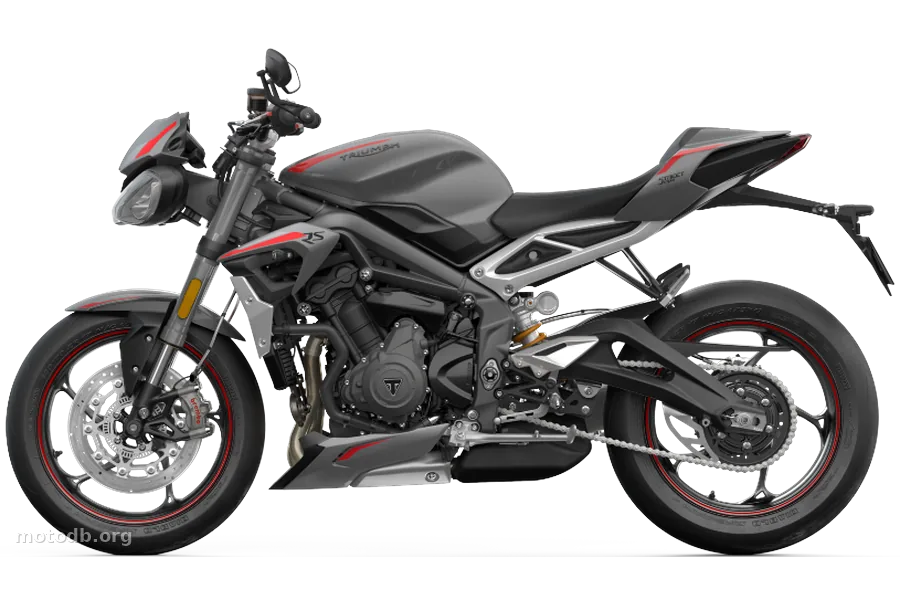
Triumph isn’t stopping its progress… The Street Triple RS already developed around 123 hp at 11,750 rpm in the current model year! It now boasts a peak power of 80 hp at 12,000 rpm in its RS version and in its very potent Moto2 Edition.
The exclusive supplier of engines for the Moto2 Grand Prix platform since 2018, Triumph is riding the wave of competition and performance. With 80 hp, the latest models unveiled by the Hinckley firm are getting closer and closer to the 140 hp available in race bikes thanks to the English three-cylinder engine.
This power allowed the Moto2 to break the 186 mph barrier for the first time in 2021, with a top speed of 188.2 mph achieved on the Philip Island circuit in Australia.
Therefore, the Street Triple RS raises the bar even further, gaining 7 hp at peak power. The three-cylinder benefits from all the refinement and expertise acquired by the manufacturer in Grand Prix racing to establish itself as the ultimate engine for mid-displacement roadsters. The compression ratio increases from 12.65:1 to 13.25:1, an increase of 4.7%. A considerable amount of internal work has also been carried out, with the pistons, connecting rods, and bolts being revised and paired with new combustion chambers. The valves and camshafts are also new, offering increased valve lift to optimize all phases of the combustion cycle.
The Triple RS’s responsiveness and acceleration capability are further enhanced by work performed on shortened gear ratios and the optimization of the final drive that results from it. Thanks to the quick gear selection permitted by the Triumph Shift Assist up-and-down system, efficiency is key and no time is lost during gear changes.
The new ABS, along with traction control and the anti-wheelie system, are constantly evolving to optimize their intervention. To increase the rider’s control, the ergonomics have also been improved with a 12 mm wider handlebar and revised geometry, with a raised rear section to increase agility in corners. Braking is entrusted to the ultimate in technology, with Brembo Stylema four-piston calipers at the front and a single-piston Brembo floating caliper at the rear. Finally, the suspension is fully adjustable, the RS being equipped with a 41 mm Showa inverted fork at the front and a single Öhlins monoshock at the rear. This is paired with a “gullwing” swingarm that optimizes torsional rigidity and lateral flex. Stability is thus increased at very high speeds.
The electronic package is up to the performance of this flavorful bundle of nerve, as it features an ABS and a configurable traction control, as well as five riding modes (Road, Rain, Sport, personal and Track). All of this is controlled from the switches and the 5-inch TFT dashboard. Cherry on top: a stopwatch is included on the RS version (and on the Moto2 Edition).
Compared to the R model, the technical differences are more than noticeable. Less expensive, the R is also 10 horsepower less powerful, has a less advanced shock absorber and the 660 Trident’s instrument cluster, and carries a kilo more.
Triumph didn’t want to surprise the fans of the Street or the curious. Therefore, it changes very little between generations. Same look, same silhouette, same visual tension; only a sharp eye will notice the revised radiator cowls and belly pan, the modified exhaust, and the new 15-liter fuel tank. Style accompanies function: a little more refined.
A little imp increasingly sexy and diabolical: irresistible!
by Michaël Levivier - Photos manufacturer
Standard equipment
- Assistance au freinage : ABS
- Nombre de mode de conduite : 5
- Taille de l'écran TFT couleur : 12,70 cm / 5 pouces
- ABS Cornering
- Jantes aluminium
- Shifter
- Indicateur de vitesse engagée
- Contrôle de traction
- Embrayage anti-dribble
Practical info
- La moto est accessible aux permis : A
- Pays de fabrication : Thailande
Reviews & comments
No reviews yet. Be the first to share your opinion!