Key performance
Technical specifications
Engine
- Displacement
- 776 cc
- Power
- 83.0 ch @ 8500 tr/min (61.0 kW)
- Torque
- 78.0 Nm @ 6800 tr/min
- Engine type
- Bicylindre parallèle, 4 temps, calé à 270°
- Cooling
- liquide
- Compression ratio
- 12.8 : 1
- Bore × stroke
- 84 x 70 mm
- Valves/cylinder
- 4
- Camshafts
- 2 ACT
- Fuel system
- Injection Ø 42 mm
- Starter
- électrique
Chassis
- Frame
- structure en tubes d'acier
- Gearbox
- boîte à 6 rapports
- Final drive
- Chaîne
- Front suspension
- Fourche téléhydraulique inversée Ø nc, déb : 130 mm
- Rear suspension
- Monoamortisseur
Brakes
- Front brakes
- Freinage 2 disques Ø 310 mm, fixation radiale, étrier 4 pistons
- Rear brakes
- Freinage 1 disque Ø 240 mm, étrier simple piston
- Front tyre
- 120/70-17
- Rear tyre
- 180/55-17
Dimensions
- Seat height
- 810.00 mm
- Seat type
- Selle biplaces
- Fuel capacity
- 14.00 L
- Weight
- 202.00 kg
- New price
- 7 999 €
Overview
Although the Suzuki lineup is gradually regaining consistency, it remains far from the former glory. A bitter observation for a brand with a fascinating past. In 1909, Michio Suzuki founded, near the city of Hamamatsu, located 200 km from Tokyo in the heart of Japan, the first Suzuki factory. Initially dedicated to the textile industry, it became Suzuki Motors in 1954 with the launch two years earlier of the brand’s first motorcycle, the Power Free, powered by a small 36 cm3 two-stroke single-cylinder engine.
History is underway. Suzuki soon began to compete on the international stage by entering three riders in the Tourist Trophy on the Isle of Man in 1960. From its first victory in 1962 at the TT, thanks to the East German rider Ernst Degner, to the last victory in MotoGP, achieved by the Spaniard Alex Rins during the 2022 championship final in Valencia, Spain, Suzuki’s trajectory in motorcycle competition, whether in speed, endurance, or off-road, has been marked by numerous successes.
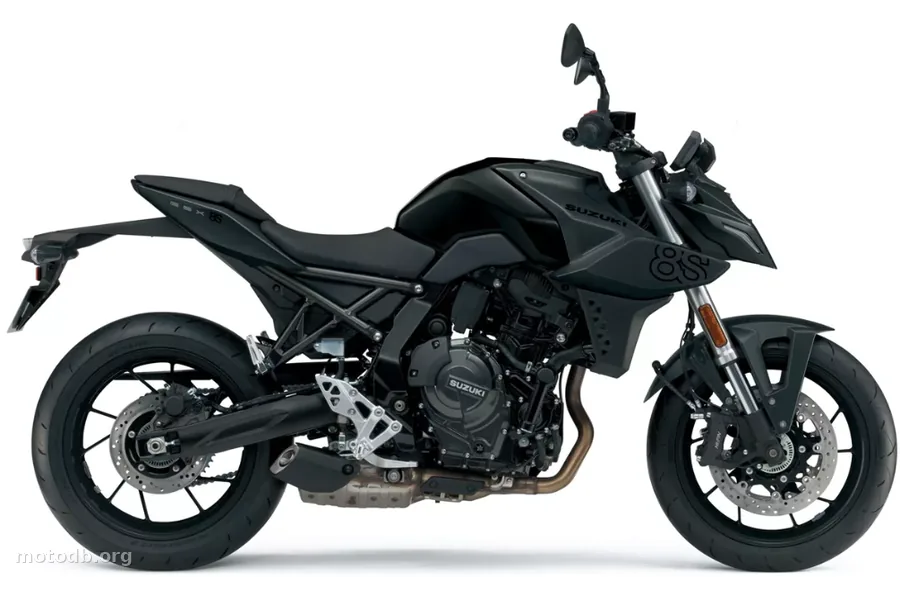
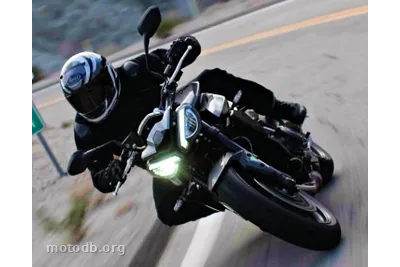
When it came to roadsters, Suzuki started from a blank sheet of paper for this GSX-8S: new engine, new chassis, new design, new name! With its sharp lines and particularly aggressive design, notably the housing of its water radiator pointing forward like a pointed arrow, and its piercing gaze with its superimposed two LED lights, the 8S imposes a sharp style like a scalpel. Ready to cut through the road with a twist of the throttle, it has a plumage worthy of its plumage. Suzuki emphasizes the stacked headlight design – first the 1000 and 950 GSX-S; now this "super-SV." This strange look wants to take root with the manufacturer.
Let's start with its engine, unprecedented at Suzuki. The 8S receives a brand-new 776 cm3 inline twin-cylinder engine, compliant with Euro 5 standards. This powerhouse develops 82.9 hp at 8,500 rpm, a power output that sits right between that of the Yamaha MT 07, the queen of the category displaying 73.4 hp at 8,750 rpm, and the horsepower of the 750 Hornet, whose vertical twin offers a full 92 hp at 9,500 rpm! The new Suzuki makes up for lost ground in terms of torque thanks to its higher displacement. With its 776 cm3, it also delivers approximately 7.95 mkg to the rear wheel from 6,800 rpm against 6.8 mkg at 6,500 rpm for the Yam (whose cube twin is 689 cm) and 7.7 mkg at 7,250 rpm for the Honda (which is 450 rpm higher). Now, we know that power isn't everything: while the influx of thoroughbreds is appreciable in moments of madness when you mash the throttle, three-quarters of the time – or more – we mainly use torque to roll along quietly or effectively, whether in urban traffic or on country roads. In this little game of everyday pleasantness, the Suzuki 8S could well draw its own pin from the game, even if, by the way, the mechanical architecture is identical.
We are indeed witnessing a real standardization of engine types offered on the motorcycle market for technical and pragmatic reasons: the inline twin, whether parallel, in-line, or vertical, reigns supreme today. Compact, lightweight, efficient, it meets all logical and financial criteria to which manufacturers are subject. From the smallest displacements to the largest, the in-line twin is imposing. It's not that it's a bad mechanical architecture or that its character and the mechanical sensations associated with it are unpleasant, better the performance it offers are often pleasing, but the fact is that the choice of engine type is now limited. The days when inline four-cylinder engines dictated their law (Hornet, Fazer, Bandit, etc.) are long gone; the same goes for V-twins, which had their moment of glory (SV, V-Strom, VTR, TLR). The Japanese have joined the cause defended by BMW since 2008 with the F 800 GSet, and later by KTM with the Duke and other Adventure 790.
The 8S’s vertical twin receives two balance shafts, placed at 90° from the axis of rotation of the crankshaft. This system, called Suzuki Cross Balancer, aims to minimize vibrations induced by the 270° ignition timing. Thus, the 8S should offer a round and pleasant character, without subjecting its rider to too marked mechanical operation. Of course, the 8S is equipped with the Suzuki Intelligent Ride System, meaning it receives a host of electronic driving assistance features. Coupled with its Ride-by-Wire throttle control, the 8S offers the Suzuki Drive Mode Selector, which offers the possibility of choosing between three driving modes: A being the most dynamic, B offering a more linear response to throttle opening at equivalent power, and C proving best suited to a supple and comfortable riding style, ideal for delicate road conditions.
The 8S also has the Suzuki Traction Control System, allowing you to adjust rear wheel traction control on three modes, adding the possibility of disconnecting it completely. It benefits from a slipper clutch as well as an Up&Down shifter, to change gears, in one direction or another, without cutting the throttle. To further enhance ease of use and handling, it is equipped with the Low RPM assist system, which accompanies evolutions at low speeds. Finally, the Suzuki Easy Start System allows the motorcycle to start with a simple push of the starter button, without having to insist, and also on the menu.
You’re going to understand: if the 8S is equipped with a mechanical system that will surely be sparkling, it also wants to be reassuring in order to suit all profiles of female and male riders, whatever their level of experience. Especially since its power of 82.9 hp allows it to be eligible for the A2 license, subject to the adoption of a kit reducing its power by half.
On the chassis side, the new Suz’ receives a steel tube frame aiming for both excellent straight-line stability and beautiful handling in curves. It is equipped with KYB inverted forks and a mono-shock of the same brand at the rear.
With a curb weight of 202 kg, it presents itself with a few more than the competition (184 kg for the MT-07 and 190 for the Hornet). A handicap on paper that its chassis geometry and riding position triangle will have to make up for.
Finally, let’s finish with what every rider has under their eyes when they ride their machine: the dashboard. Here, the instrumentation is entrusted to a 5-inch TFT multifunction screen, grouping a quantity of settings and information. The screen can display speed, tachometer, fuel gauge, gear ratio, rear wheel traction control level, consumption, SDMS mode selected, shifter activation (or not), pop-up notifications, etc. in two graphic themes (day or night).
Cherry on the cake, the 8S receives the shortest exhaust silencer ever produced by Suzuki.
A nice roadster that, we hope, will allow Suzuki to return to the place that is rightfully theirs in the motorcycle market.
Michaël Levivier - Photos constructeur
Standard equipment
- Assistance au freinage : ABS
- Nombre de mode de conduite : 3
- Taille de l'écran TFT couleur : 12,70 cm / 5 pouces
- Jantes aluminium
- Shifter
- Indicateur de vitesse engagée
- Aide au démarrage
- Aide à la manoeuvre
- Contrôle de traction
- Embrayage anti-dribble
Practical info
- Véhicule accessible au permis A2 ou bridable à 47.5ch / 35 Kw
- La moto est accessible aux permis : A, A2
- Pays de fabrication : Japon
Indicators & positioning
Similar bikes
765 Street Triple RX
Reviews & comments
No reviews yet. Be the first to share your opinion!