Key performance
Technical specifications
Engine
- Displacement
- 1250 cc
- Power
- 180.0 ch @ 9100 tr/min (132.4 kW)
- Torque
- 155.9 Nm @ 7600 tr/min
- Engine type
- Bicylindre en V à 60°, 4 temps
- Cooling
- liquide
- Compression ratio
- 11.3 : 1
- Bore × stroke
- 105 x 72 mm
- Valves/cylinder
- 4
- Camshafts
- 2 ACT
- Fuel system
- Injection
Chassis
- Frame
- Douple poutre périmétrique au chrome-molybdène relié à des platines en alu
- Gearbox
- boîte à 5 rapports
- Final drive
- Chaîne
- Front suspension
- Fourche téléhydraulique inversée Öhlins Ø 43 mm, déb : 119 mm
- Rear suspension
- Monobras et mono-amortisseur Öhlins, déb : 114 mm
Brakes
- Front brakes
- Freinage Brembo
- Rear brakes
- Freinage 1 disque Brembo
- Front tyre
- 120/70-17
- Rear tyre
- 190/55-17
Dimensions
- Fuel capacity
- 12.00 L
- Weight
- 222.00 kg
- Dry weight
- 196.00 kg
- New price
- 34 211 €
Overview
Imagine a workshop somewhere in Wisconsin, a handful of obsessive engineers, and the crazy ambition to build what the American industry has never really known how to produce: a true hypersport. Not a chromed custom for Sturgis weekends, not a muscle roadster for the flat Midwest highways. A real track bike, shaped to bite into the asphalt at full lean. This is the Roehr project, and the 1250 SC is its culmination.
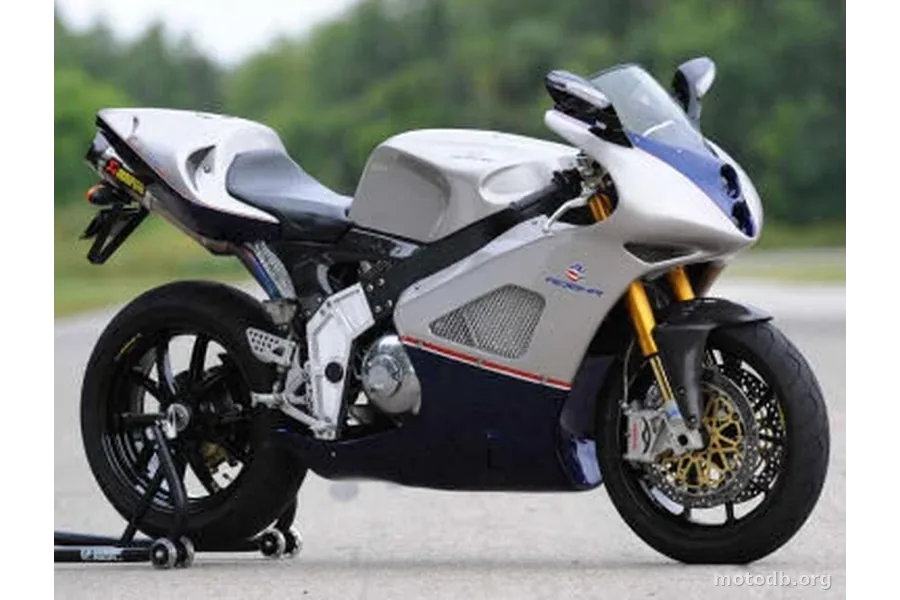
The manufacturing philosophy immediately recalls Bimota in its prime: a custom chassis paired with an engine sourced elsewhere. Here, the heart comes from Milwaukee, this 60-degree V-twin from the V-Rod, with its 105 mm bore for 72 mm stroke, its 4 valves per cylinder and its overhead camshaft timing. In its native configuration, this engine was not enough to impress a GSX-R1000 or a ZX-10R. Roehr therefore fitted it with a supercharger. Raw result: 180 horsepower at 9,100 rpm and 155.9 Nm at 7,600 rpm, with a mapping that can exceed 200 hp for those who like round numbers. It’s a completely different register, and above all, the supercharger brings this fullness of torque over a wide range of engine speeds that atmospheric competitors do not offer. The muscle is there, dense, available, without the characteristic dip at high RPMs of the Japanese engines.
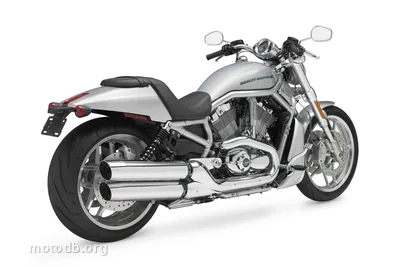
The chassis deserves attention. Perimeter double beam in chrome-molybdenum, bolted to aluminum side plates with footrest height adjustment. 43 mm Öhlins inverted fork at the front, Öhlins monoshock with a single-sided swingarm at the rear. Radial Brembo calipers at both wheels. Marchesini rims. Akrapovic silencer. This is far from a garage hack job; it’s a race catalog without apparent compromise. Visually, the whole is consistent without being striking. The multiplex front with its stacked headlights evokes an R1, the carbon fiber rear fairing recalls an MV-Agusta F4, the monoshock signifies an obvious Italian lineage. The 1250 SC looks like a compilation of good ideas rather than a distinctive stylistic signature, which is its real weakness.
The problem doesn’t come from the raw performance or the quality of the components. It comes from the weight. With 196 kg dry, the V-Roehr weighs about twenty kilograms too much compared to the best Japanese or Italian sportbikes of comparable displacement. In a sector where every kilogram counts in the corners, this gap is felt. The announced top speed of 280 km/h is consistent with the power, but the power-to-weight ratio remains below that of the best Superbikes. The other limitation is practical: 12 liters of fuel is a top-up on a motorcycle of this level. Two or three track sessions and you’re looking for a gas station.
Who rides this machine, then? Not for the serious competitor: SBK regulations limit twin-cylinder engines to 1,200 cc, and the 1250 SC is outside the classic homologated categories. For the passionate collector, the amateur circuit rider, the one who wants something rare and technically interesting to take out on the weekend. It will be built in a few dozen copies per year, as Borile or Vertemati did in their time. The price of 34,211 euros, already considerable on paper, increases further with import, homologation and transport costs. It is an out-of-the-ordinary machine, in the literal sense, and that comes at a price. If you are looking for a profitable and accessible hypersport, look elsewhere. If you are looking to own one of the few serious attempts by the American industry in this segment, the Roehr deserves a closer look.
Practical info
- La moto est accessible aux permis : A
Indicators & positioning
Similar bikes
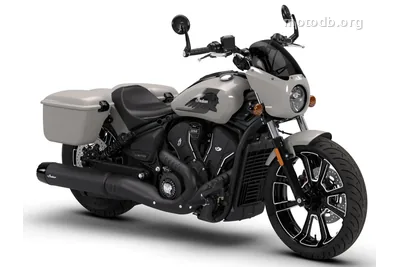
1250 Sport Scout RT
Reviews & comments
No reviews yet. Be the first to share your opinion!