Key performance
Technical specifications
Engine
- Displacement
- 1250 cc
- Power
- 180.0 ch @ 9100 tr/min (132.4 kW)
- Torque
- 155.9 Nm @ 7600 tr/min
- Engine type
- Bicylindre en V à 60°, 4 temps
- Cooling
- liquide
- Compression ratio
- 11.3 : 1
- Bore × stroke
- 105 x 72 mm
- Valves/cylinder
- 4
- Camshafts
- 2 ACT
- Fuel system
- Injection
Chassis
- Frame
- Douple poutre périmétrique au chrome-molybdène relié à des platines en alu
- Gearbox
- boîte à 5 rapports
- Final drive
- Chaîne
- Front suspension
- Fourche téléhydraulique inversée Öhlins Ø 43 mm, déb : 119 mm
- Rear suspension
- Monobras et mono-amortisseur Öhlins, déb : 114 mm
Brakes
- Front brakes
- Freinage Brembo
- Rear brakes
- Freinage 1 disque Brembo
- Front tyre
- 120/70-17
- Rear tyre
- 190/55-17
Dimensions
- Fuel capacity
- 12.00 L
- Weight
- 222.00 kg
- Dry weight
- 196.00 kg
- New price
- 34 211 €
Overview
Imagine a workshop somewhere in Wisconsin, a handful of obsessive engineers, a V-twin engine derived from the V-Rod, and an outsized ambition: to build the first true American hypersport. Not a chromed custom, not a muscular Buell-style roadster, but a machine tailored for the scorching asphalt of a racetrack. This is the Roehr project, and the 1250 SC is its most radical realization.
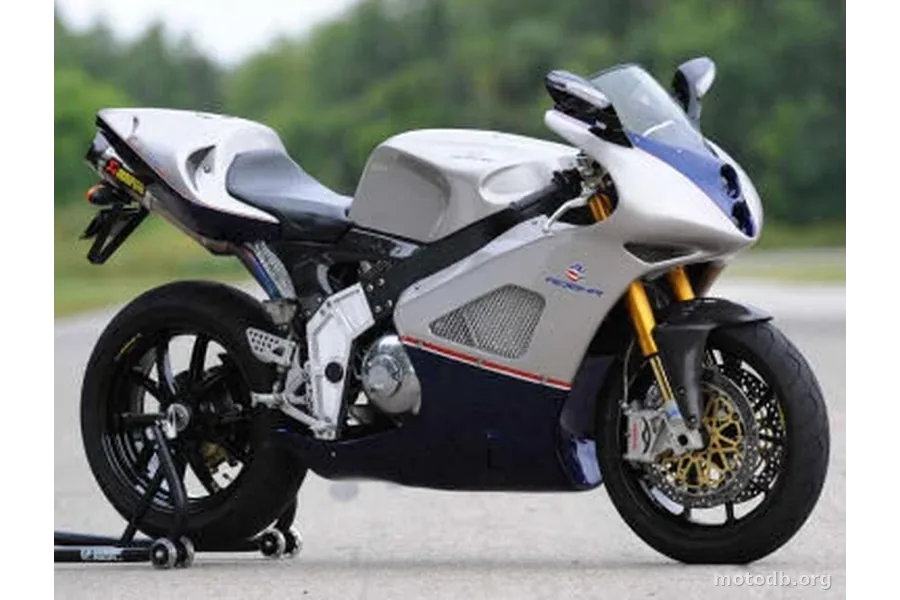
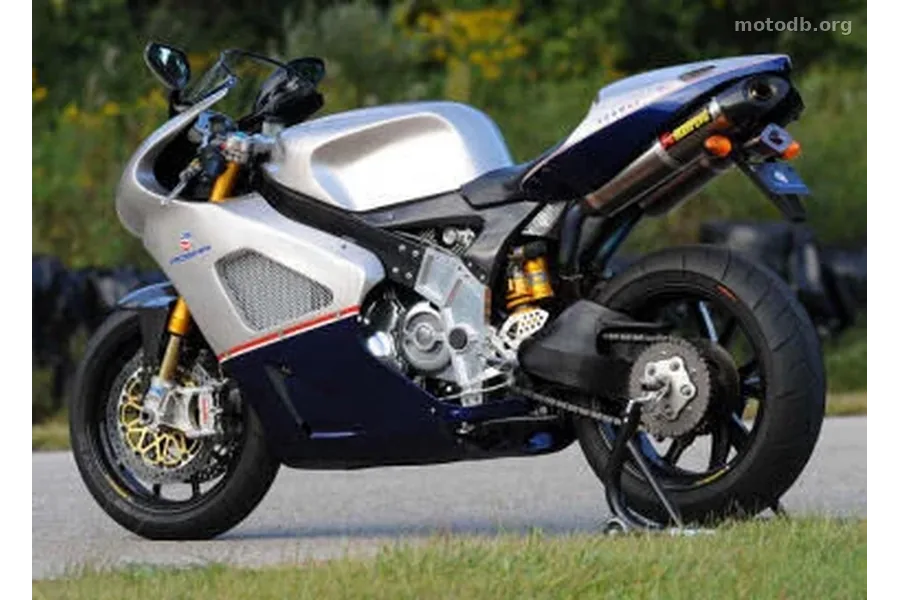
Visually, the machine lacks nothing in class, but struggles to assert a distinct identity. The headlight assembly with its stacked optics and air intakes evokes a Yamaha R1 from a certain angle, the monobras and carbon fiber rear fairing recall an MV Agusta F4 or a contemporary R1. One also thinks of the spars of a Bimota SB8K when examining the chrome-molybdenum double-beam frame connected to lateral aluminum plates. The references are good, the result is refined, but one searches in vain for the visual signature that would make one say "that's a Roehr" at first glance. As if the design studio had aggregated the best influences without daring to make a decisive choice.
While Bimota or the former Mondial built their own frames sourcing engines from Suzuki, Honda, or Ducati, Roehr did the opposite in its own way: the chassis is produced locally, and the mechanical heart is American down to the last valve. The 60° V-twin of 1,250 cc comes directly from the V-Rod. Four valves per cylinder, very square bore and stroke of 105 x 72 mm, compression ratio of 11.3:1, we know this base. Except that the engineers didn't just slip it into a sporty frame. They grafted a supercharger onto it, which radically changes the equation. The official output climbs to 180 horsepower at 9,100 rpm, with a torque of 155.9 Nm available at 7,600 rpm. Even better, the supercharger widens the engine's usable range: the muscle is present earlier, more consistently, less linearly dependent on the revs. For number enthusiasts, a reprogramming of the mapping allows one to exceed the 200 horsepower mark. The announced top speed of 280 km/h then becomes nothing surprising.
The cycle parts follow the displayed level of ambition. Öhlins 43 mm inverted fork at the front, Öhlins mono-shock at the rear, Brembo radial calipers, Marchesini wheels, Akrapovic silencer: the equipment is that of a high-end competition machine, with no apparent compromises. The footrests are adjustable in several positions, a sign that Roehr also thought about ergonomics on the track. On paper, all of this is difficult to criticize. In reality, one black mark remains: the weight. With 196 kg dry, or approximately 222 kg fully fueled, the 1250 SC is at a deficit of about twenty kilograms compared to Japanese or Italian superbikes of the same era. On a GSX-R1000 or a CBR1000RR, those twenty kilograms represent a significant factor in rapid direction changes. The power compensates in part, but the dynamic balance remains an open question for anyone who has not had the opportunity to really push it.
The 1250 SC is aimed at a very specific audience: wealthy enthusiasts, attracted by the rarity and character of a machine built in just a few dozen examples per year, without the industrial constraints of a major manufacturer. Its 12-liter tank summarizes the philosophy well: autonomy is not the subject. Immediate pleasure, exclusivity, motorized collector's item, this is what Roehr offers. At €34,211 in France after homologation, transport, and taxes, the bill is salty. But no one buys a machine as confidential as this looking for value for money. One buys it because no other is like it, because the supercharged twin roars differently, and because the idea of an American hypersport from a small workshop has something stubbornly seductive.
Practical info
- La moto est accessible aux permis : A
Indicators & positioning
Similar bikes
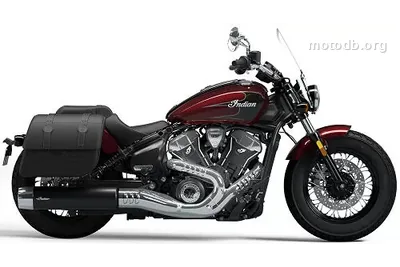
1250 Sport Scout RT
Reviews & comments
No reviews yet. Be the first to share your opinion!