Key performance
Technical specifications
Engine
- Displacement
- 1064 cc
- Power
- 91.0 ch @ 7800 tr/min (67.2 kW)
- Torque
- 94.0 Nm @ 6000 tr/min
- Engine type
- V2, four-stroke
- Cooling
- Air
- Compression ratio
- 9.5:1
- Bore × stroke
- 92.0 x 80.0 mm (3.6 x 3.1 inches)
- Valves/cylinder
- 2
- Fuel system
- Injection Ø 45 mm
- Starter
- Electric
Chassis
- Frame
- poutre et double berceau interrompu en acier
- Gearbox
- 6-speed
- Final drive
- Shaft drive (cardan) (final drive)
- Front suspension
- Fourche téléhydraulique inversée Ø 43 mm, déb : 120 mm
- Rear suspension
- Mono-amortisseur, déb : 128 mm
Brakes
- Front brakes
- Dual disc
- Rear brakes
- Single disc
- Front tyre
- 120/70-17
- Front tyre pressure
- 2.20 bar
- Rear tyre
- 180/55-17
- Rear tyre pressure
- 2.40 bar
Dimensions
- Seat height
- 800.00 mm
- Wheelbase
- 1490.00 mm
- Length
- 2150.00 mm
- Width
- 785.00 mm
- Height
- 1210.00 mm
- Fuel capacity
- 22.00 L
- Weight
- 243.00 kg
- Dry weight
- 226.00 kg
- New price
- 11 890 €
Overview
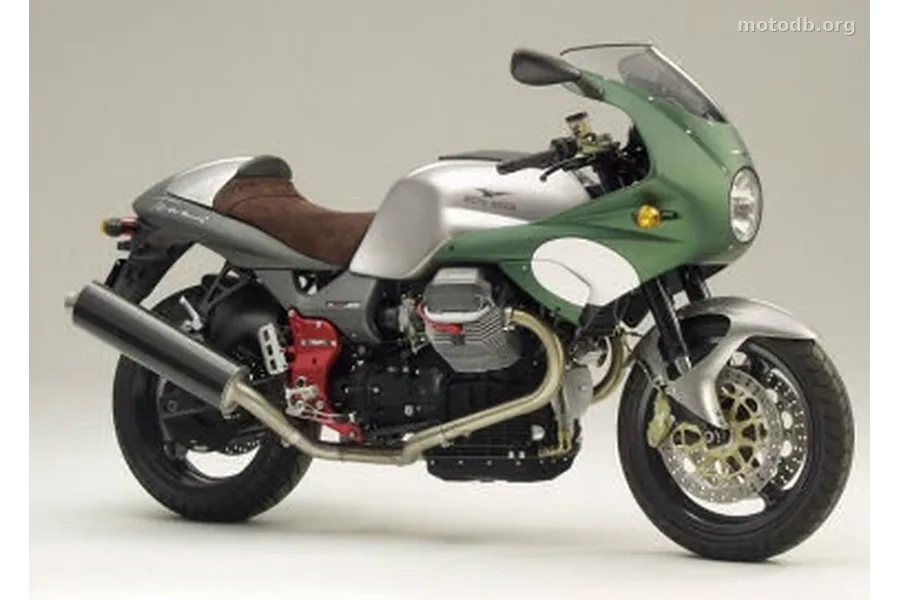
Who remembers Omobono Tenni? In 1937, this Italian rider made history by becoming the first non-British winner at the Tourist Trophy, riding a Moto Guzzi. Victorious as early as 1924, barely twenty years old, Tenni embodied an era when races were won as much through courage as through talent. In 2002, the Mandello del Lario factory chose to engrave his name on a limited edition of the V11 Le Mans, produced in just 170 units. A tribute that goes beyond a mere marketing exercise.
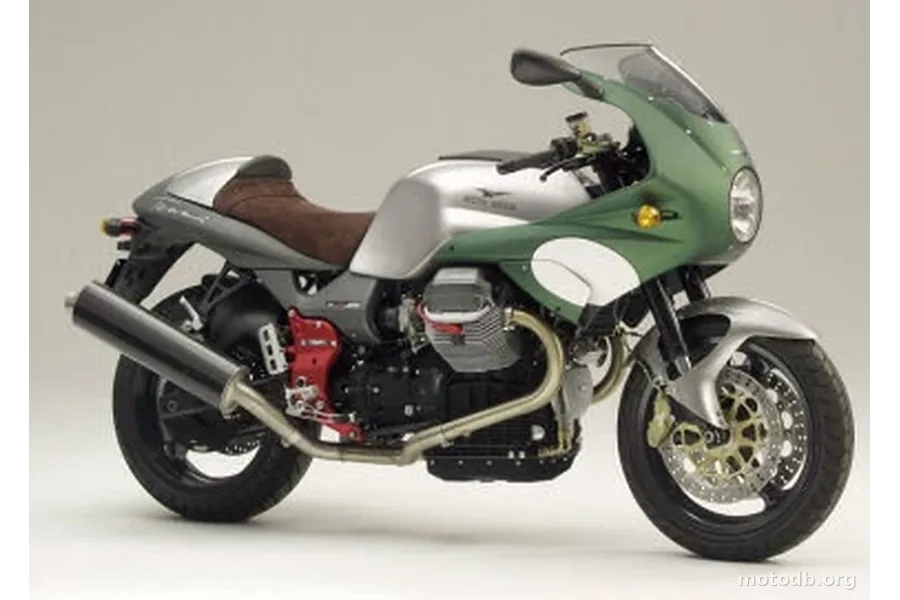
The foundation remains that of the V11 Le Mans, an unconventional sportbike in a world dominated by Japanese four-cylinders. Its longitudinal 1064 cc air-cooled V-twin produces 91 horsepower at 7,800 rpm and 94 Nm of torque at 6,000 rpm. Modest figures compared to a Ducati 996 or a Honda VTR 1000 SP from the same era. But reducing this Guzzi to its raw performance figures means missing the point entirely. The transverse twin delivers its power with a smoothness and character that few engines can claim. The shaft drive and six-speed gearbox prioritize long-distance reliability over outright sportiness. At 243 kg wet and with a 22-liter tank, the Tenni positions itself more as a sporty GT capable of devouring mountain passes than as a track weapon.
What sets this special edition apart is in the details. The single-plate dry clutch replaces the wet multi-plate unit of the standard version, offering a more direct engagement. The 43 mm inverted fork features a titanium nitride coating, a refinement typically found on far more expensive machinery. The seat, covered in a suede-effect material, adds a touch of raw elegance. On the chassis side, the steel twin-spar interrupted cradle frame and the 1,490 mm wheelbase provide reassuring stability, while the 800 mm seat height remains accessible to most riders.
The livery delivers the real visual punch. Grey across the tank, front fender, and seat cowl, with side medallions evoking the number plates of vintage Grand Prix machines. A direct nod to the mythical racing V8 of the nineteen-fifties. The choice is bold, far removed from flamboyant reds or predictable blacks. You have to embrace this offbeat aesthetic to appreciate it, but it gives the Tenni a personality its competitors simply don't have. At €11,890 in 2002, the price sat at the upper end of the segment, justified by the rarity and the specific equipment.
This V11 Le Mans Tenni is aimed at a very specific audience: the rider who values character over raw performance, who knows the history of European racing, and who seeks a machine capable of daily use while remaining a collector's piece. Twenty years on, the 170 units produced command a healthy premium on the used market. Proof that Mandello got it right by betting on heritage rather than lap times.
Practical info
- La moto est accessible aux permis : A
Reviews & comments
No reviews yet. Be the first to share your opinion!