Key performance
Technical specifications
Engine
- Displacement
- 1043 cc
- Power
- 142.0 ch @ 10000 tr/min (104.4 kW)
- Torque
- 110.8 Nm @ 7300 tr/min
- Engine type
- 4 cylindres en ligne, 4 temps
- Cooling
- liquide
- Compression ratio
- 11.8 : 1
- Bore × stroke
- 77 x 56 mm
- Valves/cylinder
- 4
- Camshafts
- 2 ACT
- Fuel system
- Injection ø 38 mm
Chassis
- Frame
- Double poutre en aluminium
- Gearbox
- boîte à 6 rapports
- Final drive
- Chaîne
- Front suspension
- Fourche téléhydraulique inversée Ø 41 mm, déb : 120 mm
- Rear suspension
- Mono-amortisseur, déb : 135 mm
Brakes
- Front brakes
- Freinage 2 disques Ø 300 mm, fixation radiale, étrier 4 pistons
- Rear brakes
- Freinage 1 disque Ø 250 mm, étrier simple piston
- Front tyre
- 120/70-17
- Front tyre pressure
- 2.50 bar
- Rear tyre
- 190/50-17
- Rear tyre pressure
- 2.90 bar
Dimensions
- Seat height
- 815.00 mm
- Fuel capacity
- 19.00 L
- Weight
- 231.00 kg
- New price
- 13 599 €
Overview
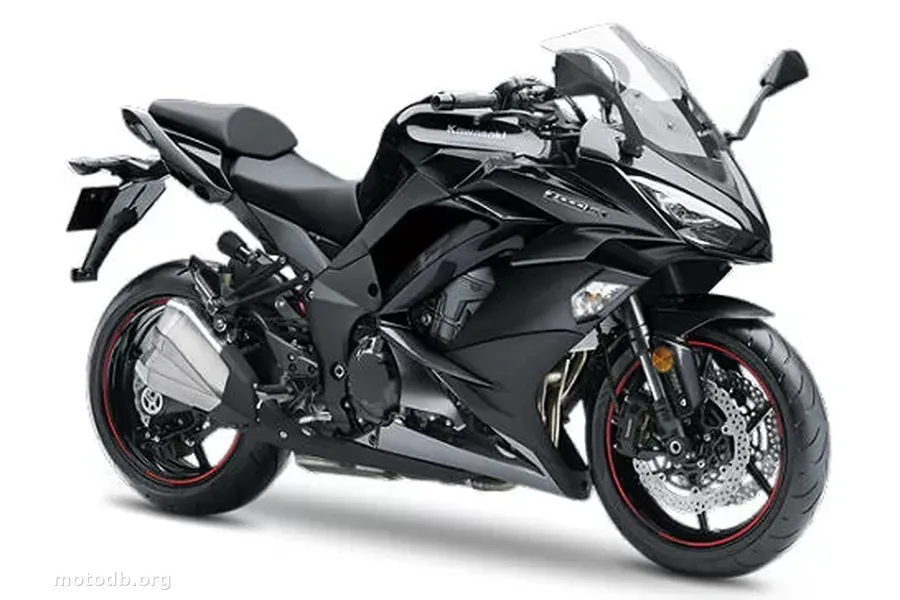
Like a pair of sneakers, the Z 1000 SX brilliantly combines two seemingly contradictory virtues: comfort and sporty feel. Thanks to this, it leaves its mark on the sport-GT market and helps the most undecided find the right fit. Forget blisters. It now boasts dazzling LED lights, highlighting the sportiness of its new silhouette. Athletic lines, which trace its tangent at several points, offering increased comfort. In short, it is even sportier and even more comfortable.
If, in use, the SX is halfway between the former GTR 1400 and the sister ZX-10R, when it comes to style, it has clearly chosen its camp. It has adopted the "racing" fashion and dresses in a trendy robe signed Ninja. Its features are streamlined, ultra-piercing. Not aggressive, but downright belligerent. Its prow takes on the appearance of arrows, sharpened by a multitude of reliefs that accentuate its cutting gaze. Enough to blunt the desires of the most timid... Kawasaki has chosen to radicalize its range, and it demonstrates this again after the adoption of the Ninja 650 name by its small roadster ER6-F.
With age, it has also matured. Already because it has gotten rid of those unsightly pimple-like protrusions that served as turn signals, but also because these clothes offer it better protection and comfort than before. This is made possible thanks to a 3 mm longer and thicker saddle, a 15 mm higher bubble, and 28mm wider fairings. It therefore puts on a nice bib, ready to heat its boiler to cut pigsty trajectories.
Because fortunately, the engine's boil is still as pleasant! The power remains similar: 142 horsepower. Its bursts are still as sporty, but a bit less rough. They have been polished by an injection adjustment. Mechanically, whether it is the chassis or the engine, no other major developments are to be counted. In any case, this engine was already top-notch and the chassis incisive and precise as desired, without fault. It is composed of sporty peripherals including a large inverted fork and well-proportioned radial brakes.
That being said, there is one element that really changes the game. It comes directly from the one who borrows its robe, the ZX-10R. Under its skin, it hides not new legs, but the latest generation of nerve endings, more precisely a Bosch inertial unit. For the Kawa fighter jet, it allows it to defeat competitors between two chicanes, for the SX, this equipment allows to strengthen safety and stability. Through traction control (KTRC) and supersport anti-lock braking (KIBS), the "corner management" system (KCMF) monitors, coordinates and modulates all parameters of the engine and chassis.
Other refinements serve the comfort on board. Namely the arrival of more ergonomic passenger wrist rests and original adaptations for luggage mounting (on the previous generation, they required drilling) as well as a slightly softer-tuned damper. To conclude, the SX is equipped with a more sophisticated and reorganized LCD screen dashboard. It originally offers a gear indicator.
Standard equipment
- Assistance au freinage : ABS
Practical info
- La moto est accessible aux permis : A
Indicators & positioning
Similar bikes
V11 Le Mans Tenni
Reviews & comments
No reviews yet. Be the first to share your opinion!