Key performance
Technical specifications
Engine
- Displacement
- 853 cc
- Power
- 67.3 ch @ 6900 tr/min (49.5 kW)
- Torque
- 79.4 Nm @ 4400 tr/min
- Engine type
- Bicylindre en L à 90°, 4 temps
- Cooling
- par air
- Bore × stroke
- 84 x 77 mm
- Valves/cylinder
- 2
- Fuel system
- Injection Ø 52 mm
Chassis
- Frame
- double berceau tubulaire en acier
- Gearbox
- boîte à 6 rapports
- Final drive
- Cardan
- Front suspension
- Fourche téléhydraulique inversée Ø 41 mm
- Rear suspension
- 2 amortisseurs latéraux
Brakes
- Front brakes
- Freinage 2 disques Brembo Ø 320 mm, fixation radiale, étrier 4 pistons
- Rear brakes
- Freinage 1 disque Ø 260 mm, étrier 2 pistons
- Front tyre
- 100/90-18
- Front tyre pressure
- 2.50 bar
- Rear tyre
- 150/70-17
- Rear tyre pressure
- 2.50 bar
Dimensions
- Seat height
- 780.00 mm
- Fuel capacity
- 21.00 L
- Weight
- 220.00 kg
- Dry weight
- 200.00 kg
- New price
- 10 999 €
Overview
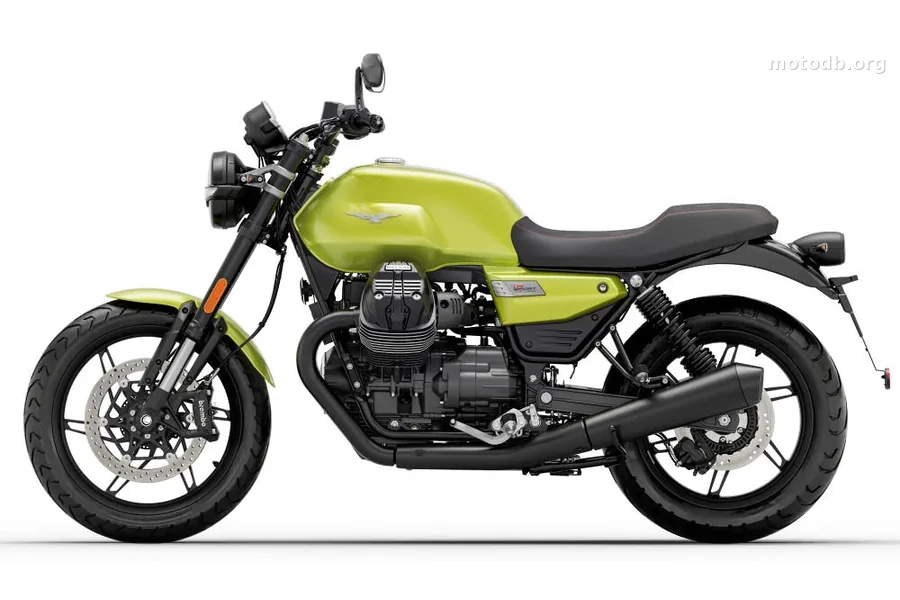
Fifty years after laying the foundations of two-wheeled neo-retro sport, Mandello del Lario sets the record straight. The 2025 V7 Sport doesn't merely play on the nostalgia of the Verde Legnano livery inherited from the legendary 1972 750; it pushes the technical envelope far beyond what this lineage had accustomed us to. Too far, some will say. Not far enough, others will reply. The debate is open.
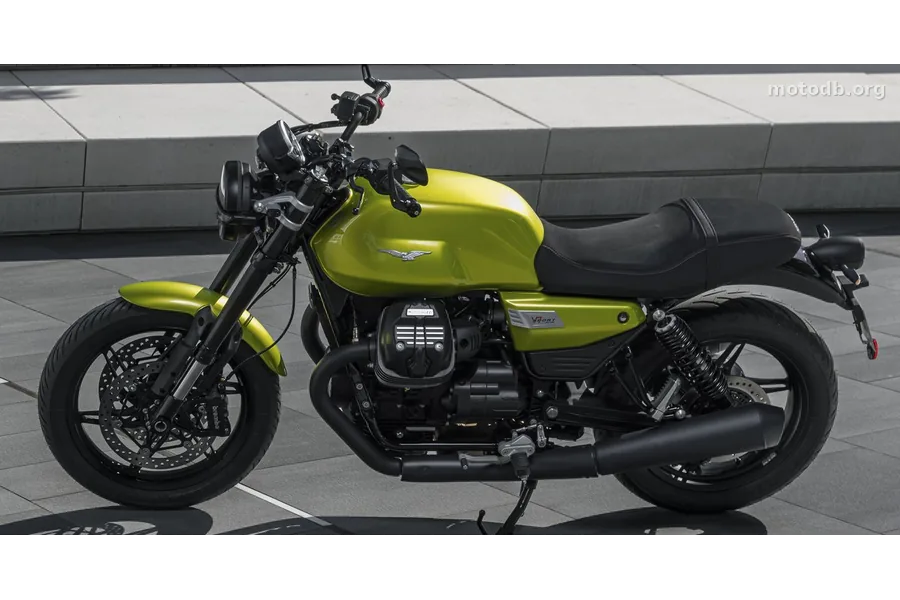
Let's start with what immediately catches the eye beneath the bodywork: an adjustable 41 mm inverted fork with preload adjustment, a pair of 320 mm Brembo front discs gripped by four-piston radial calipers, and lightened wheels that save 1.8 kg compared to the Stone. On paper, it's the equipment list of a serious sports roadster, not a Sunday café-racer-styled leisure ride. Moto Guzzi even added a six-axis inertial measurement unit to refine lean-angle traction control and optimize ABS under braking. Except that the 90-degree L-twin thumping beneath the double-cradle frame produces 67.3 horsepower at 6,900 rpm and 79.4 Nm at 4,400 rpm. These are honest figures — they are not terrifying ones. A six-axis IMU is the kind of equipment found on machines twice as powerful, twice as fast. Here, it feels a bit like a collision radar on a Fiat 500. Relevant in principle, oversized in practice.
That's not to say the work done on the engine should be dismissed. Meeting Euro 5+ standards was achieved without gutting the character, which is never a given. Ride-by-wire, a revised intake, a third lambda sensor and a wider throttle body were enough to scratch out an additional 4% in power. The transverse V-twin retains its deep rumble and its low-rpm torque, which is the entire appeal of these machines: you ride in third gear through town, forget to downshift, and the engine obliges without complaint. The six-speed gearbox with shaft drive remains faithful to its post, along with that characteristic light engine braking you either love or hate. The claimed top speed of 170 km/h is more than sufficient for everything this motorcycle is meant to do.
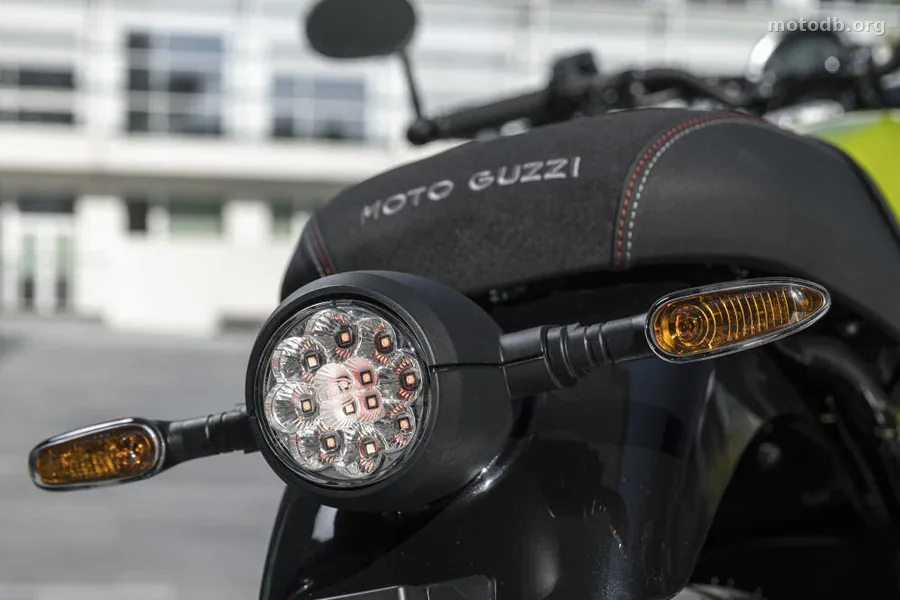
Because the V7 Sport targets a specific rider: the experienced motorcyclist who wants style without sacrificing all dynamic engagement, who appreciates historical references without veering into museum territory, and who accepts paying €10,999 for a motorcycle with strong character rather than a numbers-driven sportbike. Against a Triumph Street Twin or a Royal Enfield Interceptor 650, the Italian machine plays in a different category, with a mechanical nobility and social rarity its English competitors cannot claim. The red-stitched seat, bar-end mirrors, aluminum inserts on the flanks and machined headlight brackets give this V7 genuine visual coherence. This isn't glitter added at the end of the production line to justify the price tag; it's an artistic direction fully owned from start to finish.
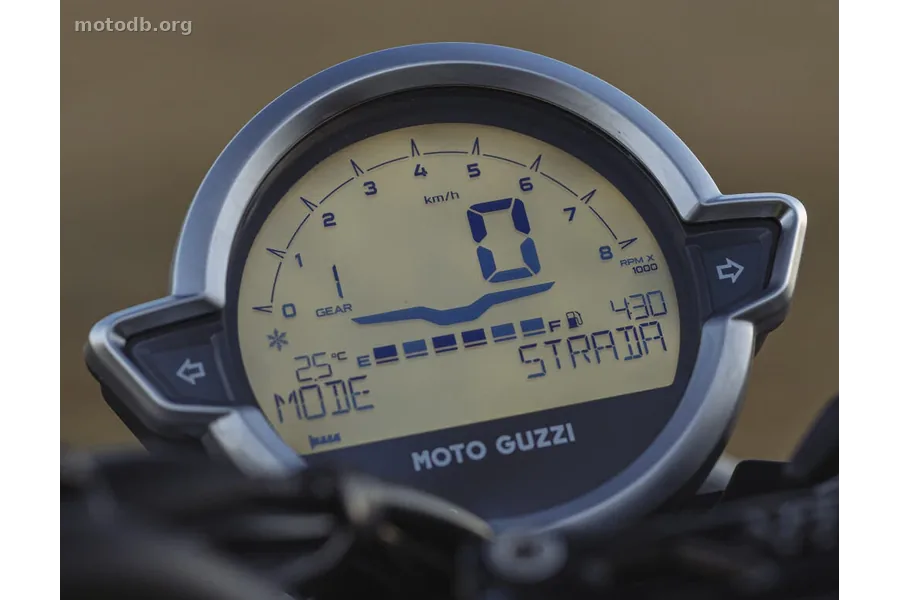
The main criticism remains this electronic overlay that feels grafted onto a fundamentally analog machine. Sport mode, which relaxes traction control on an 853 cc twin weighing 220 kg fully fueled, is an option that will rarely — if ever — be activated. But if you look past that particular gimmick, what you have is a mechanically transformed V7 in concrete terms: more engaging at the front wheel, better braked, better suspended. For a lover of fine Italian machines who wants to ride rather than display, the argument holds up.
Standard equipment
- Assistance au freinage : ABS
- Nombre de mode de conduite : 3
- ABS Cornering
- Jantes aluminium
- Indicateur de vitesse engagée
- Régulateur de vitesse
- Contrôle de traction
- Centrale inertielle
Practical info
- Véhicule accessible au permis A2 ou bridable à 47.5ch / 35 Kw
- La moto est accessible aux permis : A, A2
Reviews & comments
No reviews yet. Be the first to share your opinion!