Key performance
Technical specifications
Engine
- Displacement
- 773 cc
- Power
- 48.0 ch @ 6000 tr/min (35.3 kW)
- Torque
- 62.8 Nm @ 4800 tr/min
- Engine type
- Bicylindre Vertical, 4 temps
- Cooling
- par air
- Compression ratio
- 8.4 : 1
- Bore × stroke
- 77 x 83 mm
- Valves/cylinder
- 4
- Camshafts
- 1 ACT
- Fuel system
- Injection Ø 34 mm
Chassis
- Frame
- Double berceau acier
- Gearbox
- boîte à 5 rapports
- Final drive
- Chaîne
- Front suspension
- Fourche téléhydraulique Ø 41 mm, déb : 130 mm
- Rear suspension
- 2 amortisseurs latéraux, déb : 107 mm
Brakes
- Front brakes
- Freinage 1 disque Ø 320 mm, étrier 2 pistons
- Rear brakes
- Freinage 1 disque Ø 270 mm, étrier 2 pistons
- Front tyre
- 100/90-19
- Front tyre pressure
- 2.00 bar
- Rear tyre
- 130/80-18
- Rear tyre pressure
- 2.25 bar
Dimensions
- Seat height
- 790.00 mm
- Fuel capacity
- 15.00 L
- Weight
- 222.00 kg
- New price
- 10 300 €
Overview
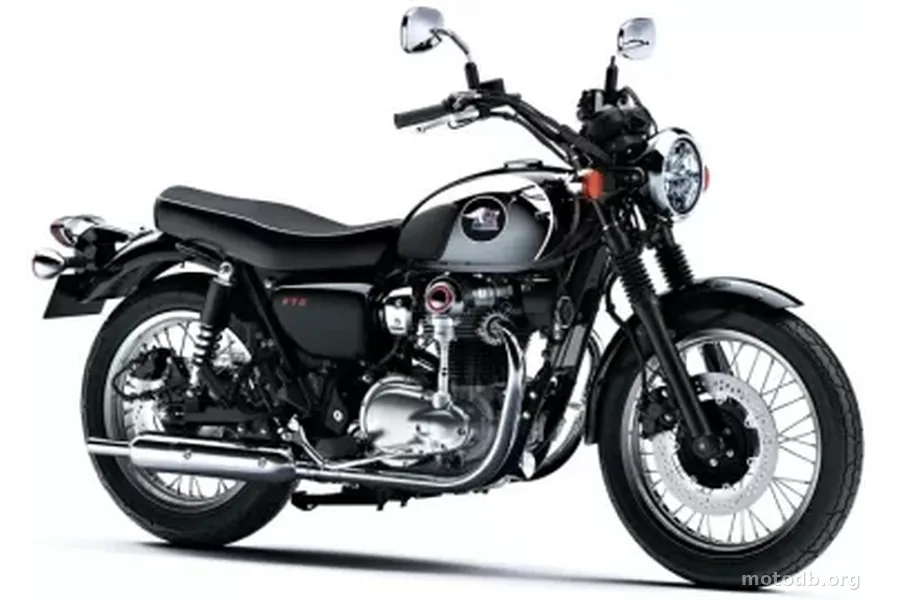
If the W800, the W650, and going back further, the initiator W1, provoke in you a feeling of temporal electrification, the machine that follows will provoke a big heartbeat. A brand resurges from the fractures of the past with this MEGURO K3.
Attention. Don’t immediately search for the 88 miles per hour. This revival is piloted by Kawasaki, which pays homage to its past in this way. This motorcycle is a W800 decorated in a celebration style. It’s a return to Japan in the 1930s, when Meguro launched into the motorcycle industry with a 500. Kawasaki will quickly approach its compatriot to ultimately absorb it completely in 1963.
Let’s delve a little more into the past to understand why this Kawa-Meguro is called K3. In the 1960s, the brand developed a motorcycle based on the English BSA A7. It was called K1, and following a series of modifications, it became K2. The denomination stops there because once it passed under the wing of Kawasaki, the name changed and became W1. Which will serve as inspiration for the W650 until the W800 takes over the torch. The loop is closed. From that point on, continuing this story logically involves a K3.
OK. But we still don’t know much about this Meguro. Except that the essential elements are those of a W800, with its parallel-twin engine producing 48 horsepower, its retro look, its bevel gear distribution, and its unwavering appearance of an old English motorcycle. Everything is played at the level of the finish. The K3 has a specific color scheme and the new self-healing paint, which is found on certain premium Kawasaki models. The emblem on the tank is the first Meguro logo. It will be hand-painted by artisans. Small commemorative red inscriptions are placed in the speedometer and on the airbox covers.
This special series of W800 will be equipped with heated grips, elements painted black instead of being chrome-plated (mudguards, forks, handlebars, injection covers, the headlight bracket, etc.), a wide handlebar, protection on the top of the shock absorbers, and a specific seat with white piping. Sadly, this patriotic parabola will remain entirely Japanese, as it is reserved for the local market.
Meguro and Kawasaki merge again with this K3. A moment of the past conditioned by the future of a memory. All of this symbolized by the almost centenary badge placed on the tank. The small manufacturer was founded in 1937. Subsequently, the brand's logo will evolve from a double winged rhombus to a hope of a mini labyrinth – Doesn’t this remind you of anything!?! It’s the Ridermark that we find on the compressed H2 models (and H2R-Z H2–H2 SX), representing the entire Kawasaki conglomerate. With its motorcycles, boats, construction equipment, railway activities, steel industry, aerospace... even its submarines at one time. With its origins in this young merchant embarking on maritime transport at 17 years old: Shozo Kawasaki.
M.B - Photos manufacturer
Standard equipment
- Assistance au freinage : ABS
- Poignées chauffantes
Practical info
- La moto est accessible aux permis : A
Indicators & positioning
Similar bikes
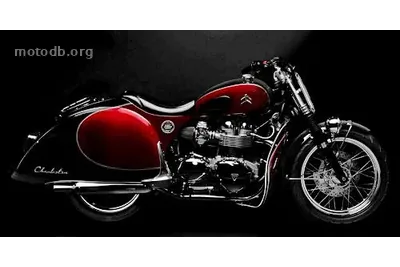
Bonneville Citroen Charleston par South Garage
Reviews & comments
No reviews yet. Be the first to share your opinion!