Key performance
Technical specifications
Engine
- Displacement
- 773 cc
- Power
- 48.0 ch @ 6000 tr/min (35.3 kW)
- Torque
- 62.8 Nm @ 4800 tr/min
- Engine type
- Bicylindre Vertical, 4 temps, calé à 360°
- Cooling
- par air
- Compression ratio
- 8.4 : 1
- Bore × stroke
- 77 x 83 mm
- Valves/cylinder
- 4
- Camshafts
- 1 ACT
- Fuel system
- Injection Ø 34 mm
Chassis
- Frame
- Double berceau acier
- Gearbox
- boîte à 5 rapports
- Final drive
- Chaîne
- Front suspension
- Fourche téléhydraulique Ø 41 mm, déb : 130 mm
- Rear suspension
- 2 amortisseurs latéraux, déb : 107 mm
Brakes
- Front brakes
- Freinage 1 disque Ø 320 mm, étrier 2 pistons
- Rear brakes
- Freinage 1 disque Ø 270 mm, étrier 2 pistons
- Front tyre
- 100/90-19
- Rear tyre
- 130/80-18
Dimensions
- Seat height
- 790.00 mm
- Fuel capacity
- 15.00 L
- Weight
- 221.00 kg
- New price
- 10 999 €
Overview
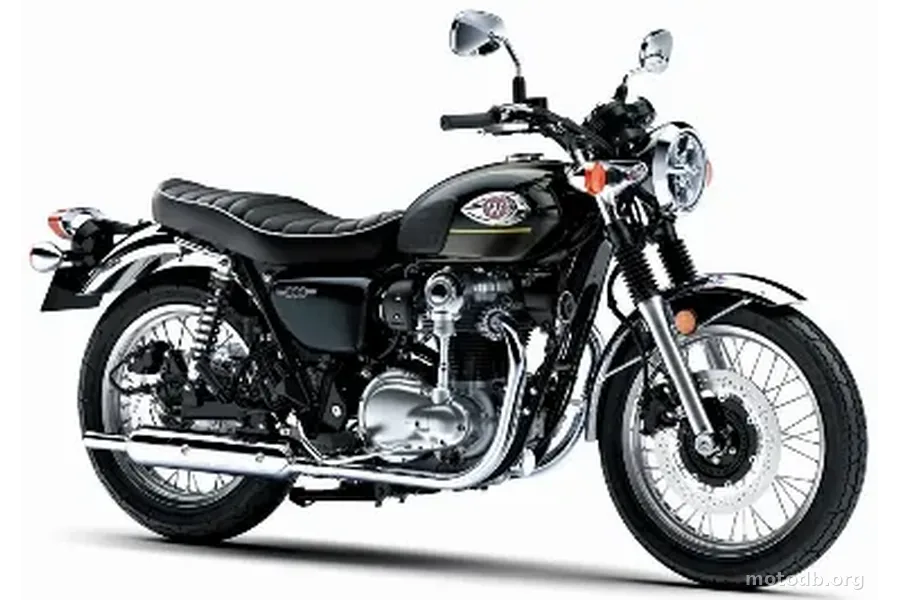
The W 800 is the archetype of retro style. It was there before this trend... It is the mimetic descendant of the W 650 from the late 90s, vintage itself... And the years pass over it without aging it. A bit of renewal was offered to it in 2019, first through two versions carrying evolutions: the W 800 Street and the W 800 Café. But not enough to fully satisfy enthusiasts. Here is one of the gambles of this dyad - Each proposed its (typed) vision of the W 800 but none fully took up the recipe that the previous one had left under the pillow in 2016.
But 2020 reset the clock with a third version (the only one in the catalog today). Let's call it Standard, or Classic, or W 800 simply. All the small differences that the Street and Café display disappear to rediscover the equipment of a not-so-distant past.
Main points? The front wheel. We find its 19-inch diameter. Then, the center stand is once again installed as standard. A slight increase in the size of the turn signals to give them a diameter as imposing as in the good old days. Then we face an equivocal element, the handlebar. An element of the roadster type, to offer a natural riding position and the vein of this machine. This is also how the other versions of the W family differ: with its Upright handlebar, the Street proposed a more cruising profile; the Café played Clubman, simili-sport and strained wrists. Let's not end this inspection without noting the front fender, which is more present than the minimalist element of the other Ws.
Of the three, the “Classic” is undeniably the most attractive. Or the most tempting... We don't even need to start it to rediscover that side of passion, retro, refined and joyfulness. Chrome everywhere, a beautiful British-style paint job, a tank with badges of higher quality than the stickers of the other versions, more sparkling mirrors, a diamond-stitched seat with a delicate white trim, and this engine full of the past use their assets to move from memory to the road.
This is the moment when the engine is revealed. The vertical twin cylinder Japanese reminds us of the one in the Triumph Bonneville – but it refers to the W 1650 from 1965. It has not evolved much since the old W 800. Kawa has mainly adapted it to E5 standards. Nothing has changed in terms of power, with a maximum of 48 horsepower. The torque is a slight improvement, going from 6.1 to 6.4 mkg; but its peak is perched much higher than before – at an almost twice-as-high regime. The manufacturer has also installed an “Assist & Slipper” clutch, easier to pull and anti-dribble to digest violent downshifts.
Forget Fast & Furious mode, switch to promenade category, charm of the eras and relaxed tempo. The W 800 is made for that, and not really for following a big pace. Although its chassis has been revised with a revisited frame, a larger diameter fork, the addition of a rear brake disc and the graft of an ABS, this “old-fashioned” roadster only claims to finely improve its performance and not transform it.
The W 800 possess a technical specificity that cannot leave any mechanical enthusiast indifferent: its bevel gear distribution. A set of gears that deserves to be stripped bare... or rather under a transparent bell to appreciate the work and the way.
It’s a pleasure to see the real W 800 return to the catalog. Its styling still charms as much as ever, while its price has suffered a prejudicial inflation. Facing a 900 Bonneville T100 or a Ducati 800 Scrambler, the battle is not won. But here, the W800 also tells a story, with the Meguro manufacturer hidden between the pages.
M.B - Photos manufacturer
Standard equipment
- Assistance au freinage : ABS
- Jantes à rayon
- Béquille centrale
- Embrayage anti-dribble
Practical info
- La moto est accessible aux permis : A
Indicators & positioning
Similar bikes
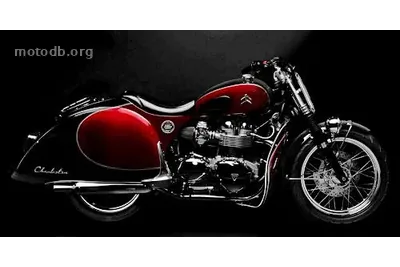
Bonneville Citroen Charleston par South Garage
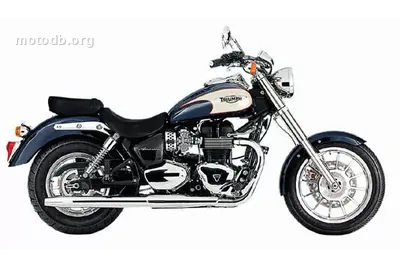
Bonneville America
Reviews & comments
No reviews yet. Be the first to share your opinion!