Key performance
Technical specifications
Engine
- Displacement
- 1099 cc
- Power
- 136.0 ch @ 9000 tr/min (100.0 kW)
- Torque
- 113.0 Nm @ 7600 tr/min
- Engine type
- 4 cylindres en ligne, 4 temps
- Cooling
- liquide
- Compression ratio
- 11.8 : 1
- Bore × stroke
- 77 x 59 mm
- Valves/cylinder
- 4
- Camshafts
- 2 ACT
- Fuel system
- Injection ø 38 mm
- Starter
- électrique
- Euro standard
- Euro 5+
Chassis
- Frame
- Double poutre en aluminium
- Gearbox
- boîte à 6 rapports
- Final drive
- Chaîne
- Front suspension
- Fourche téléhydraulique inversée Ø 41 mm, déb : 120 mm
- Rear suspension
- Mono-amortisseur, déb : 136 mm
Brakes
- Front brakes
- Freinage 2 disques Tokico Ø 310 mm, fixation radiale, étrier 4 pistons
- Rear brakes
- Freinage 1 disque Ø 260 mm, étrier simple piston
- Front tyre
- 120/70-17
- Rear tyre
- 190/50-17
Dimensions
- Seat height
- 815.00 mm
- Seat type
- Selle biplaces
- Fuel capacity
- 17.00 L
- Weight
- 201.00 kg
- Dry weight
- 201.00 kg
- New price
- 11 990 €
Overview
When the Z 1000 retired, Kawasaki found itself with a gap in its roadster lineup. There was nothing between the mid-size Z 900 and the powerful Z H2. Consequently, the difference was 76 horsepower – a significant step up to move into that category. Well, isn’t there a way to put a 150-160 horsepower bike between the two?
"– A 1100, would that work? – Yeah, perfect, send it!" It will support the 900, offer a big, mean beast but more reasonable than hyperfighters, and push the CB 1000 Hornet, which is grazing a little too close. After several years of inactivity, the big Z is back with more girth. Here is the new Z 1100.
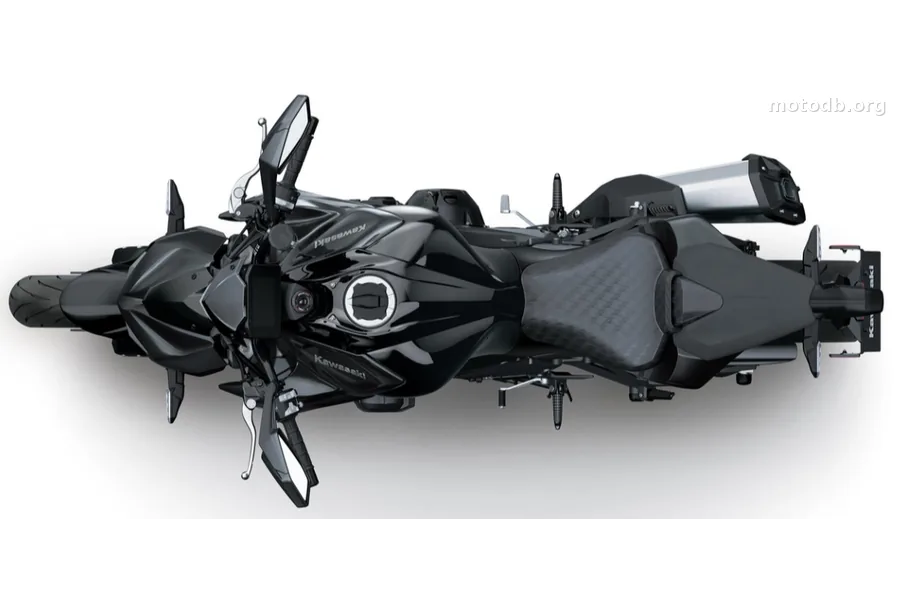
Not really new, though. Just like its Versys and Ninja SX cousins, the more boisterous cylinder capacity suffix is not attached to a new face. The Z 1100 almost identically retains the plastic of the previous model. Same upside-down fork ready to embrace the fender, same absolute look of menace, same stocky and wild body, same grumpy hump – the design office is absent.
Except for a stagiaire who happened to be around. This led to a redesign of the engine guard (more airy), a change of the brake reservoir for a more sporty model, the removal of the two exhaust canisters for a single, huge silencer, brake discs that are no longer radially mounted, and… ah no, no, no. They removed the iconic eccentric adjuster chain tensioner. Not cool!
So, in terms of surprises, the atmosphere is more of a reheated version than spectacular. But I’m going to put you on a track. When you reuse a design (and therefore molds) and proven solutions, you save on the budget. Plus, for all those who loved the Xénomorphe face of the Z 1000 IV, it’s a reunion, with a more substantial engine.
Speaking of which, should we get straight to the point or beat around the bush? Let’s go. Or rather, the Z 1100 hits… less hard than the 1000. It’s very surprising, but the fact is: 136 horsepower is credited to the 4-cylinder, 6 less. Not great for the ego. The increase in displacement was achieved with a 3 mm longer stroke, or 56 cc more. An operation that benefits a little the torque, which reaches 11.5 mkg (+ 0.2); and mainly allows to meet standards. The Z 1100 thus finds itself with the same block and the same power as the roadster-Sport-GT.
Since the 1043 cc, the engine specialists have revised the camshafts, valve springs, pistons and intake ducts, increased the mass of the flywheel, and lengthened the two last gears. But the Z 1100 is a streetfighter, a meanie, a rogue... Why not give it more growl and power than the other eleven-hundreds!? I’m putting you back on the track: no engine development to find horsepower, you save on the budget.
However, it is likely to face competition from its own family. The Z 900 only has 12 horsepower less (and 2000 euros less too). Is a family feud looming? Not really: the Z 1100 will have a more present low-end torque, a more marked velvety power delivery, a more present power at all engine speeds.
This new episode of the big Z will be accompanied by its electronics. This is where it sheds its black leather jacket to put on a suit. The Z 1000 had nothing, and was aimed at taming heavy-jawed riders. Its offspring has everything, gaining ride-by-wire, an Up&Down shifter, 3-level traction control, an IMU inertial unit, cornering control KCMF, intelligent braking KIBS, cruise control, two power modes and 4 Riding Modes (Sport / Road / Rain / and the customizable Rider). We’re going from a 205 to a Tesla.
The same is true for the dashboard. The small LCD counter, topped with a diode bar graph that is not very readable, has not survived and is replaced by a 5-inch TFT color screen. A beautiful slab from the Z 900 – so benefiting from the latest visual refinement developments from Kawasaki, with smartphone management included, voice command, turn-by-turn navigation, artificial horizon, trip saves, multiple display themes... A total dimensional change.
When taking place, the rider accustomed to the Z 1000 will feel a slight difference. This is due to the new handlebar: 22 mm wider and 13 mm further forward, it tilts the riding position slightly towards the front to give more control and reactivity. Afterwards, it’s also a reunion with the same chassis; to the elements and to the kilo near - the Z 1100 announces the same 221 kg as the 1000. Oops, there is a slight difference. The rear brake disc is 10 mm larger. The aluminum double-beam frame has not changed, firmly holding the engine, the Showa SFF-BP adjustable upside-down fork from everywhere and the horizontally mounted shock absorber (adjustable in preload and rebound) and the braking system. The 4-piston Tokico calipers bite into 310 mm discs. It would be perhaps time to move to something more premium, even if this equipment does the job. Well no; the Z 1100 SE is there for that, with Brembo on board, as well as Öhlins. The wheels take the opportunity to fit new shoes, Dunlop Sportmax Q5A.
The Kawasaki Z 1100 starts its career exactly where the 1000 left off in 2020: with a single color scheme. The manufacturer has decided to support its return with a placed price, just below 12,000 euros. A pleasant surprise in a strategy of reconquest. If the big Z had followed inflation on the same tariff base as the 1000, it would be displayed close to 15,000 euros.
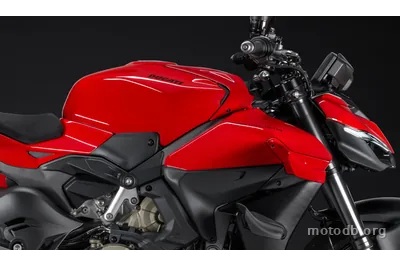
In our world, the big potato of the M 1000 R, Streetfighter V4, Speed Triple 1200, Tuono V4 or 1390 Superduke (to name a few) indoctrinates the big roadsters towards madness. The Japanese are more cautious, with another war where the Z 1100 (re)enters the fight of the GSX-S1000 and 1000 Hornet. A couple of tens of horsepower difference weighs down the Kawa against its compatriots – but the Z is not going to let go of its grip.
M.B - Photos manufacturer
Standard equipment
- Assistance au freinage : ABS de série
- Nombre de mode de conduite : 4
- Taille de l'écran TFT couleur : 12,70 cm / 5 pouces
- Jantes aluminium
- Contrôle de traction
- Centrale inertielle
- Shifter
- Bluetooth
- Embrayage anti-dribble
- Régulateur de vitesse
- Indicateur de vitesse engagée
Practical info
- La moto est accessible aux permis : A
Indicators & positioning
Similar bikes
Streetfighter V4 SP2
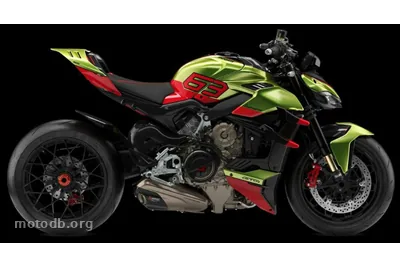
Streetfighter V4 Lamborghini
Reviews & comments
No reviews yet. Be the first to share your opinion!