Key performance
Technical specifications
Engine
- Displacement
- 1103 cc
- Power
- 214.0 ch @ 13500 tr/min (157.4 kW)
- Torque
- 120.0 Nm @ 11250 tr/min
- Engine type
- 4 cylindres en L à 90°, 4 temps, calage de type Twin Pulse - 0° - 90° - 290° - 380°
- Cooling
- liquide
- Compression ratio
- 14 : 1
- Bore × stroke
- 81 x 53.5 mm
- Valves/cylinder
- 4
- Camshafts
- 2 ACT
- Fuel system
- Injection
- Starter
- électrique
- Euro standard
- Euro 5+
Chassis
- Frame
- semi-périmétrique en aluminium
- Gearbox
- boîte à 6 rapports
- Final drive
- Chaîne
- Front suspension
- Fourche téléhydraulique inversée BPF Ø 43 mm, déb : 125 mm
- Rear suspension
- Mono-amortisseur, déb : 130 mm
Brakes
- Front brakes
- Freinage 2 disques Brembo Ø 330 mm, fixation radiale, étrier 4 pistons (Hypure monobloc)
- Rear brakes
- Freinage 1 disque Brembo Ø 245 mm, étrier 2 pistons
- Front tyre
- 120/70-17
- Front tyre pressure
- 2.40 bar
- Rear tyre
- 200/60-17
- Rear tyre pressure
- 2.50 bar
Dimensions
- Seat height
- 845.00 mm
- Seat type
- Selle biplaces
- Fuel capacity
- 16.00 L
- Weight
- 203.00 kg
- New price
- 25 290 €
Overview
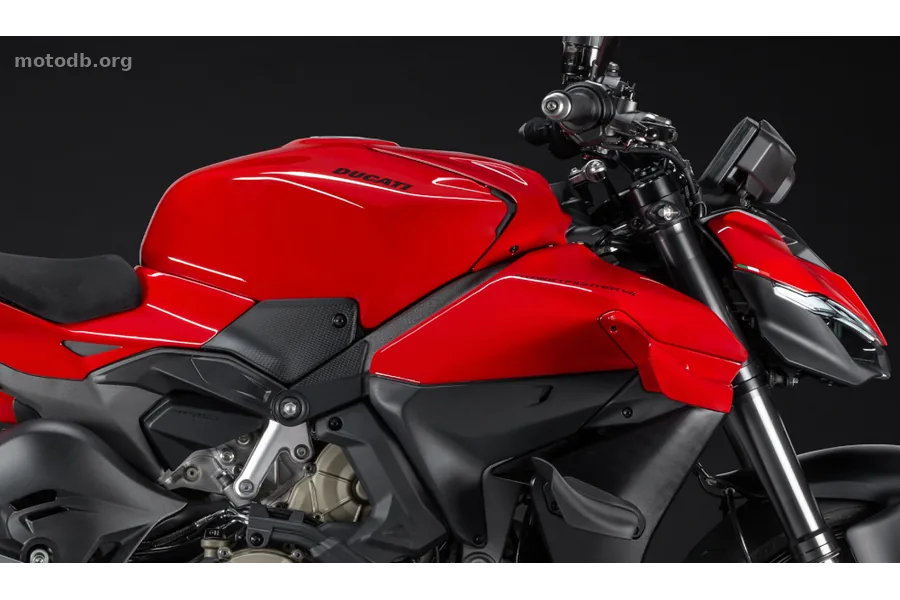
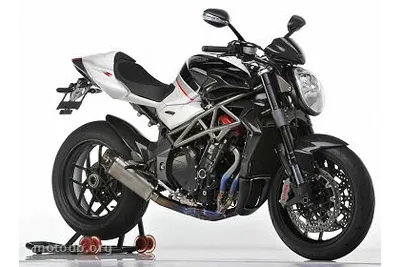
For explaining the Streetfighter V4, it must be known that its designers like to play with octanitrocubane. This rather barbaric word designates one of the most powerful explosives on the planet, making dynamite seem like child's play. Consequently, in Bologna, they have transposed the concept into the new version of their thoroughbred. The SF V4 was already in the top tier of fire-breathing machines; now it becomes even crazier.
Let's dispense with suspense and state the wild truth: 214 horsepower! A sick amount of power! The R1 and ZX-10Rs are left behind, most competitors are agonized, and reference points are falling apart. Ducati only thinks about maximum performance. Just as, the engine specialists are no longer holding back in exploiting the powerplant. Until now, all manufacturers would "soften" the mechanics when transferring them from a sportbike to a roadster, in order to make them a little more torquey and more full at mid-range. Ducati is no longer messing around: the V4 from the Panigale is directly transplanted without modification!
Consequently, the difference in power (2 hp) between the cousins is due only to a different intake. Moreover, the trumpets become variable in the 1100 Streetfighter V4 to boost power. If the heart doesn't beat fast enough, the Akrapovic racing exhaust graft can boost it to 226 horsepower. Nice, enough to go to Mars before Elon Musk. As if 214 hp at 13,500 rpm and 12.2 mkg at 11,250 rpm (slightly down from the previous SF) wasn't enough…
Between generations, the hyper-roadster thinks about shaking the nervous system more than the visual percussion. The style is retouched in the continuity, as if the design office had leaned over it with hesitation. Then you perceive that everything has been modified. Every part, every trim moment, the slightest dose of personality is revisited to mark a new stage without overturning the game. The new upper winglets emphasize their proximity to those of the Panigale. They are now painted, and add 17 kg of load at 270 km/h. The lower winglets are the only elements taken from the old SF.
As on the latter, the swingarm has not finished turning tongues. The monobras is no more! Place for the symmetrical element of the Panigale, very technically worked, less rigid laterally (-43%) and improving traction. Moreover, like the engine, the chassis comes directly from the Superbike; Ducati only modified the steering angle, increasing it by half a degree. Compared to that of the previous Streetfighter, the frame is lighter (3.47 kg instead of 4.42 kg) and laterally less rigid by 39%. The suspensions change little: the Showa upside-down fork with a large piston (BPF) gains 5 mm of travel (125 mm) to better hug the road, gain feeling on corner entry and stability under acceleration. Sachs takes care of the rear and steering damper. All elements are obviously adjustable in all directions.
As furious as it may be, this athlete thinks about better ergonomics for its rider. The tank (-1 liter) and the seat (thicker) are redesigned to anchor well during braking. You are better integrated into the bike, and you move more easily to get the body out in corners. The right hand will benefit from a better feel thanks to the throttle command borrowed from the Panigale V4 R. The handlebars have been brought closer to the rider by 10 mm while the footrests are lower and further forward by 10 mm.
The SF V4 has also worked on its transmission: the shifter works directly with the engaged gear sensor and the gear selection drum for a more direct sensation, with less of the "rubber band" effect encountered on most shifters. The first two gears are shorter, as is the final ratio – officially for easier road use. This will mainly make acceleration even more demonic. Hello? Elon Musk? Ducati is ahead.
New rims have appeared, shod with Pirelli Diablo Rosso IV Corsa tires. On the braking side, Ducati shows its fondness for the very best with the installation of the latest Brembo Hypure. Only the new Panigale V4 and Aprilia RSV4 have them. Lighter, these aluminum and silicon alloy calipers offer more consistent braking, dissipate heat better, and would stop a mammoth launched at full speed. Hello martyrdom for 330 mm discs. At the rear, the 245 mm disc loses a half-millimeter to gain a little weight. The whole thing is supervised by the very recent Race eCBS.
What's this? The quasi-unprecedented braking supervision system, which the Panigale V4 recently inaugurated. Race eCBS is a self-managed combined braking system. Basically, when the rider brakes on the front, the electronics apply a certain amount of braking on the rear for more stability and better adherence to the trajectory. It can be calibrated on 5 levels, to be more road or track oriented, with different intervention strategies.
Another transfer from the Panigale, the DVO. An algorithm developed by the racing department capable of estimating 70 physical data and better intervening on the electronic aids. Consequently, traction control, wheelie control, and launch control are much more precise. Let's take this opportunity to take stock of all the on-board piloting aids:
Four characters allow you to best appreciate the Streetfighter. Wet makes its appearance, a little calmer than the others. For example, its engine mapping limits power to 160 horsepower (just a little more than a CB 1000 Hornet SP). All Modes have been revised following the new engine configuration. Let's take a look at that.
If you feel like it, you can customize the Modes as you like and/or to your dose of efficiency.
There is also a full power mode that lets the engine's entire fury run without any filter, except on the first gear.
"What else could I borrow from the Panigale?" the Streetfighter exclaimed. Well then, its dashboard. A 6.9-inch large screen, very wide to better accommodate all the necessary piloting information. Two display themes are proposed. A Road mode with a large rev counter, the engaged gear in the middle, the settings and the info-entertainment on the left, the speed and the riding information on the right. The Track mode is more circuit-oriented (logical), with a rev counter in bar graph, an engaged gear more visible, chronographs on the left and the level of electronic aids on the right.
The 1100 Streetfighter V4 is also available in an S version, with Öhlins electronic suspensions, forged aluminum rims, Öhlins steering damper, lithium battery and 2 kg less.
Ducati and BMW are waging a fierce war in the sector of overactive motorcycles. If the Italian loses a round in the hyper-trails (Multistrada V4 RS vs M 1000 XR), it passes ahead of the M 1000 R with this evolution of the Streetfighter V4. Its machines evolve to such high levels that only a handful of riders can truly exploit them. Paradoxically, the electronics are such that the machine can surprisingly be approached. But if you completely disconnect it, you will glimpse the effects of nitroglycerin in full bloom.
M.B - Photo manufacturer
Standard equipment
- Assistance au freinage : ABS Race eCBS
- Nombre de mode de conduite : 4
- Taille de l'écran TFT couleur : 17,53 cm / 6.9 pouces
- ABS Cornering
- Jantes aluminium
- Shifter
- Amortisseur de direction
- Indicateur de vitesse engagée
- Freinage combiné
- Aide au départ arrêté (Launch Control)
- Contrôle de traction
- Contrôle anti wheeling
- Contrôle de glisse
- Embrayage anti-dribble
- Centrale inertielle
- Contrôle du frein moteur
- Limitateur de vitesse dans les stands
Practical info
- La moto est accessible aux permis : A
- Pays de fabrication : Italie
Reviews & comments
No reviews yet. Be the first to share your opinion!