Key performance
Technical specifications
Engine
- Displacement
- 498 cc
- Power
- 60.0 ch @ 9800 tr/min (43.8 kW)
- Torque
- 46.1 Nm @ 8500 tr/min
- Engine type
- Twin, four-stroke
- Cooling
- liquide
- Compression ratio
- 10.8:1
- Bore × stroke
- 74 x 58 mm
- Valves/cylinder
- 4
- Camshafts
- 2 ACT
Chassis
- Frame
- Double berceau tubulaire en acier
- Gearbox
- boîte à 6 rapports
- Final drive
- Chaîne
- Front suspension
- Fourche hydraulique Ø 37 mm, déb : 130 mm
- Rear suspension
- Mono-amortisseur, déb : 100 mm
Brakes
- Front brakes
- Freinage 2 disques Ø 270 mm, étrier 2 pistons
- Rear brakes
- Freinage 1 disque Ø 230 mm, étrier simple piston
- Front tyre
- 110/70-17
- Front tyre pressure
- 2.25 bar
- Rear tyre
- 130/70-17
- Rear tyre pressure
- 2.50 bar
Dimensions
- Seat height
- 775.00 mm
- Wheelbase
- 1435.00 mm
- Fuel capacity
- 18.00 L
- Weight
- 202.00 kg
- Dry weight
- 176.00 kg
- New price
- 5 599 €
Overview
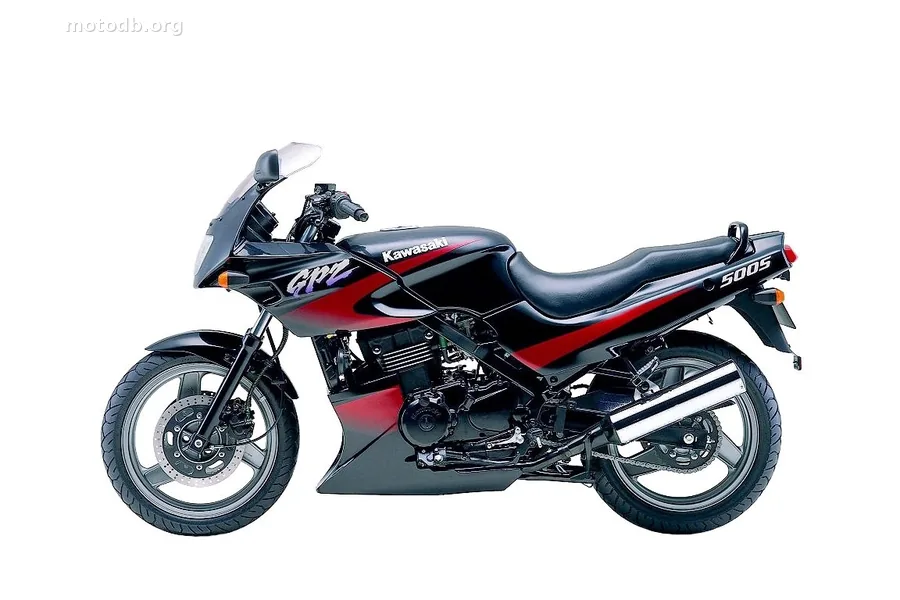
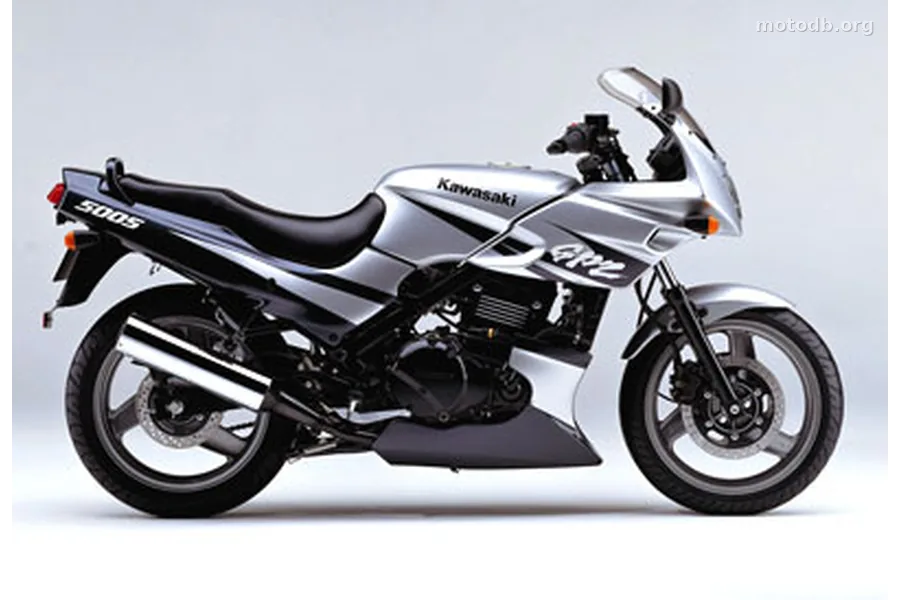
So, are we dusting off the old tomes? Because talking about the Kawasaki GPZ 500 S, especially in its final 2003 version, is a bit like opening a history book that still smells of hot oil and gasoline. This machine is a subtle legend, a model that has crossed the decades almost without a wrinkle, or almost without a weld. Launched in the late 1980s, this twin-cylinder engine has seen trends come and go without ever really changing its character. We had the Kawasaki GPZ 500 S 1989, the 1991, the 1992, and so on, until this ultimate 2003 version. Modifications were rare, but crucial: the adoption of a double front disc, then the abandonment of the rear drum in favor of a disc in 1994, and 17-inch rims. After that, only the decals evolved.
Its secret? An engine that summarizes the Kawasaki DNA of the time. A 498 cc twin that delivers 60 horsepower at 9800 rpm. The figures seem modest today, but don't be fooled. This engine is a real little panther, an engine that lives in the high revs, requiring the rider to play with the six-speed gearbox to keep it in its happy zone. Below 5000 rpm, it is a bit sleepy, lacking in flexibility. But once it revs up, it reveals itself to be fierce, linear, and provides a real sense of pull, capable of nearing 200 km/h. It’s typically the kind of mechanics that educate the wrist, perfect for an A2 license or a rider who wants to understand engine management without fear.
And that’s precisely where this Kawasaki GPZ 500 S finds its true meaning. With a wet weight of 202 kg and a seat height of 77.5 cm, it is accessible and reassuring. Its frame, a simple tubular steel cradle, is disarmingly honest. The 37 mm fork and mono-shock offer a perfect comfort-handling compromise for Sunday rides as well as longer journeys. It is agile, lightweight, and incredibly easy to ride. It’s a budding sportbike, a budget-friendly GT that lets you carve up the road without breaking the bank. For whom? For the demanding beginner, for the student who wants a first “real” reliable motorcycle, or for the nostalgic touring rider seeking simple mechanics. Searching for a used Kawasaki GPZ 500 S in France is also an excellent plan, given its solid reputation for robustness.
But it’s not all rosy in the land of the rising sun. While its chassis is pleasant, it eventually reveals the limitations of a braking system from another era. The two 270 mm front discs and the double piston caliper lack bite and progressiveness when you really start to demand something from them in tight corners. This is the weak point that reminds you that this sportbike was designed in the 1990s. Its look, however, is a successful gamble: almost timeless, it even lends itself to café racer transformations, a popular project for DIY enthusiasts.
So, what is the price of a Kawasaki GPZ 500 S today? New, it listed for 5600 euros in 2003. On the used market, it is a safe-haven investment, often found for a few thousand euros. Compared to more modern competitors, it loses in technology and pure performance. But it gains in soul, in pedagogy, and in that indefinable charm of mechanics that didn’t need electronics to exist. It’s not the most accomplished motorcycle, but it’s a sincere companion, a lesson in riding the old-fashioned way. And that’s priceless.
Practical info
- Moto bridable à 34 ch pour l'ancien permis A MTT1 - pas garanti pour le permis A2
- La moto est accessible aux permis : A, A (MTT1)
Reviews & comments
No reviews yet. Be the first to share your opinion!