Key performance
Technical specifications
Engine
- Displacement
- 499 cc
- Power
- 60.0 ch @ 9800 tr/min (29.2 kW)
- Torque
- 47.0 Nm @ 8500 tr/min
- Engine type
- In-line four, four-stroke
- Cooling
- liquide
- Compression ratio
- 10.8:1
- Bore × stroke
- 74 x 58 mm
- Valves/cylinder
- 4
- Camshafts
- 2 ACT
Chassis
- Frame
- Double berceau tubulaire en acier
- Gearbox
- 6-speed
- Final drive
- Chain (final drive)
- Front suspension
- Fourche hydraulique Ø 37 mm, déb : 130 mm
- Rear suspension
- Mono-amortisseur, déb : 100 mm
Brakes
- Front brakes
- Dual disc
- Rear brakes
- Single disc
- Front tyre
- 110/70-17
- Front tyre pressure
- 2.25 bar
- Rear tyre
- 130/70-17
- Rear tyre pressure
- 2.50 bar
Dimensions
- Seat height
- 775.00 mm
- Fuel capacity
- 18.00 L
- Weight
- 202.00 kg
- Dry weight
- 179.00 kg
- New price
- 5 599 €
Overview
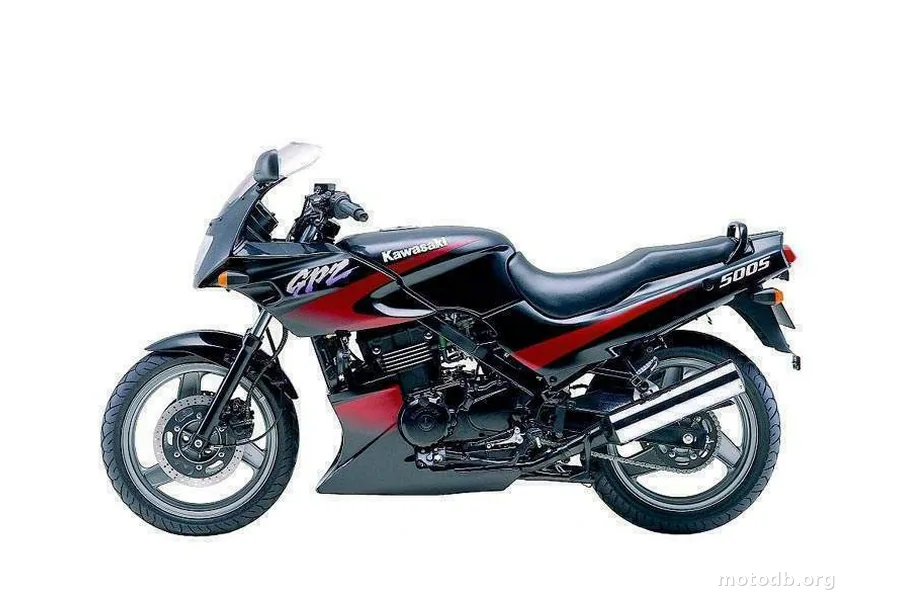
They called it the “Ninette” at riding schools. Not out of mockery, but out of affection tinged with respect. This Kawasaki GPZ 500 S, launched in 1987 and still produced in 2000 virtually unchanged, is a monument to consistency in a motorcycle world that changes its look every three years. Its history is simple. Following its debut in 1987, it received a second front disc and a more complete fairing in 1988, then underwent its last significant update in 1994 with a 17-inch rear wheel and a disc brake replacing the drum. Then what? Just color schemes. On paper, the technical specifications seem meager. On the road, it’s a completely different story.
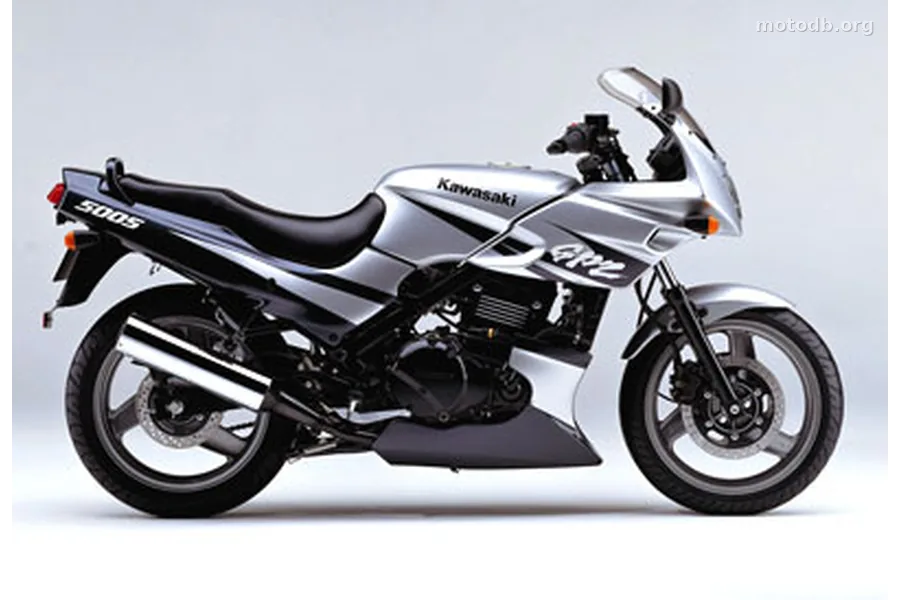
Its heart beats to the rhythm of an inline twin cylinder of 499 cm3, a signature architecture at Kawasaki at the time. It delivers 60 horsepower at 9800 rpm, figures that don’t rattle the spec sheets of super-sportives, but tell a more interesting truth. This engine is lively, a cheerful nervous type that asks to be ridden up in the rev range to express itself. Below 5000 rpm, it stutters, lacks suppleness, recalling that smoothness wasn't the priority. But once the tachometer is awakened, it transforms into a furious and sonorous mechanical device, pulling with a long stride to its redline. It is there, between 7000 and 10000 rpm, that the magic happens and that the small sport-GT reveals its true character.
With a wet weight of 202 kg, it sits in the lower-middle range for a machine in this category. This relative lightness, coupled with a well-stiffened double cradle frame through the years, gives an agile and intuitive motorcycle. The handling is serene, the steering light, making the GPZ 500 S an ideal companion for winding roads. The braking, with its two front discs and single rear disc, however, appears as a weak point. Correct for relaxed riding, it shows its limits as soon as you start to really play with the potential of the chassis. It is the Achilles' heel of a motorcycle that is otherwise surprisingly capable.
So, who is this Kawasaki GPZ 500 S for? It is the perfect first “real” sportbike, an A2 machine ideal for those who want to learn to manage the revs without the terror of excessive power. It is also a clever choice for the used market, as its reputation for foolproof reliability is deeply ingrained. Its look, clean and timeless, has also inspired many café racer transformations. At a used price that remains very accessible in France, it offers a rare cocktail of fun, mechanical simplicity, and versatility. It is not the most powerful, nor the most sophisticated, but it has that soul and that straightforwardness that is lacking in so many modern machines. A motorcycle that has built its legend, simply by remaining true to itself.
Practical info
- Moto bridable à 34 ch pour l'ancien permis A MTT1 - pas garanti pour le permis A2
- La moto est accessible aux permis : A, A (MTT1)
Reviews & comments
No reviews yet. Be the first to share your opinion!