Key performance
Technical specifications
Engine
- Displacement
- 1000 cc
- Power
- 217.6 ch @ 14000 tr/min (160.0 kW)
- Torque
- 113.0 Nm @ 12000 tr/min
- Engine type
- 4 cylindres en ligne, 4 temps
- Cooling
- liquide
- Compression ratio
- 13.6 : 1
- Bore × stroke
- 81 x 48.5 mm
- Valves/cylinder
- 4
- Camshafts
- 2 ACT
- Fuel system
- Injection Ø 52 mm
- Starter
- électrique
- Euro standard
- Euro 5+
Chassis
- Frame
- double poutre en aluminium
- Gearbox
- boîte à 6 rapports
- Final drive
- Chaîne
- Front suspension
- Fourche téléhydraulique inversée Öhlins NPX S-EC3.0 Ø 43 mm, déb : 125 mm
- Rear suspension
- Mono-amortisseur Öhlins TTX36 S-EC3.0, déb : 143 mm
Brakes
- Front brakes
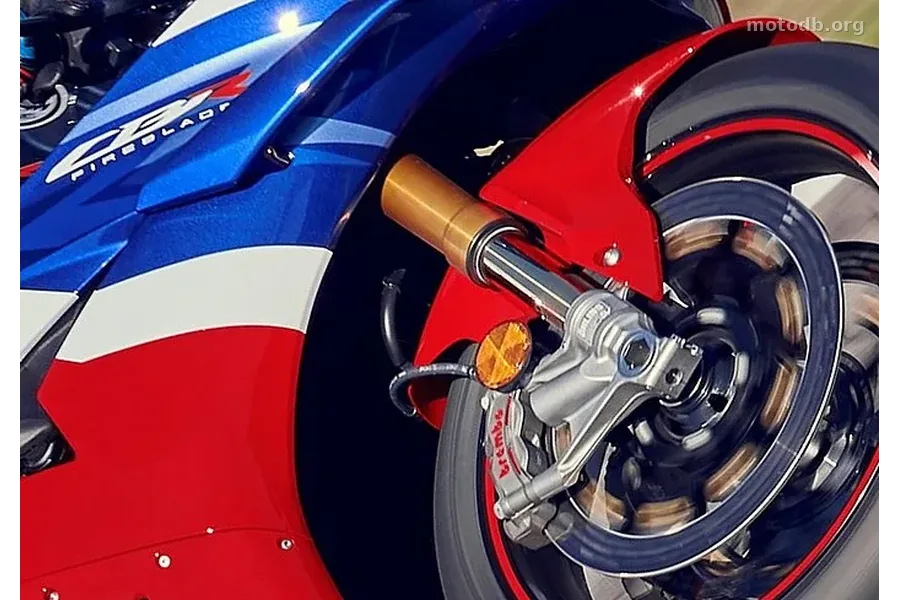
- Freinage 2 disques Brembo Ø 330 mm, fixation radiale, étrier 4 pistons (Stylema R)
- Rear brakes
- Freinage 1 disque Brembo Ø 220 mm, étrier 2 pistons
- Front tyre
- 120/70-17
- Rear tyre
- 200/55-17
Dimensions
- Seat height
- 830.00 mm
- Seat type
- Selle biplaces
- Fuel capacity
- 16.50 L
- Weight
- 201.00 kg
- New price
- 26 749 €
Overview
Over the generations, the Fireblade has continued to evolve and simultaneously been challenged by the competition. Despite being the most powerful hypersport on the market (boasting 217 horsepower), the Ducati Panigale doesn’t give it any breathing room, and the BMW S 1000 RR doesn’t hesitate to provoke it. However, Honda continues the development of its CBR 1000 RR-R. A revised version appeared in 2024, accompanied by the more lavish SP edition.
How many years has an SP been in the Honda lineup? A decade! No less, and since then, each chapter of the CBR 1000 has been accompanied by its premium version. The original recipe hasn’t changed: better suspension and brakes. It shows that Honda got it right from the start and continues to refine the formula.
Of course, the components have evolved considerably over 10 years. Today, a 43 mm inverted fork (still Öhlins) NPX is responsible for guiding the CBR 1000 SP. It and its TTX36 rear shock companion are controlled by the unprecedented 3rd generation electronic management system. The fork is held by specific forged aluminum tés.
The OBTi interface allows you to memorize 3 User Modes in addition to the preset Modes. Within this evolution of the Öhlins piloted damping system, the settings are more precise, and the instrumentation can guide the rider in adjusting preload based on their weight.
Honda revisited Brembo for braking, this time aiming higher. The previous version of the CBR 1000 RR-R SP was equipped with Stylema calipers. The new model receives Stylema R calipers, even more effective, especially in terms of cooling. The difference with the Nissin calipers on the standard model is even more pronounced. To complete the package, the master cylinder is also Brembo.
In terms of aesthetics, Honda hasn’t made much of an effort. The difference in appearance between the SP is just symbolic. A white front panel simulates a license plate and that’s it. The beautiful gold rim color disappeared between two model years. A pity. For enthusiasts and many others, the Fireblade is a beautiful motorcycle, with a bestial character hidden within the typical Honda seriousness. The Fireblade has also evolved in a targeted way: a little in the fairing, with redesigned winglets; much more in the technology. The engine doesn’t have more horsepower than before... but no less, while complying with Euro5+ and engineers have strengthened its mid-range power. How? With slightly higher compression, a modified distribution, lighter valves, new cylinder head springs, an optimized intake, a lighter 350 gr crankshaft, lighter titanium connecting rods, a larger Akrapovic silencer by a liter, and a new 2-motor Ribe by wire system – each controlling a pair of cylinders. To improve acceleration, the gear ratios have been shortened.
Honda also worked on the chassis to reduce rigidity and thus soften the riding sensations. A reconfiguration of the frame has allowed to shave off 960 gr from its weight and 140 gr from the engine mounting bolts. The rider slightly changes position with higher and closer-set handlebars and lower footrests. Less demanding, the CBR 1000? Apart from the new generation S-EC 3.0 suspension and the appearance of 3 ABS management Modes, the electronics do not receive updates. The large CBR benefits from a 5-inch color TFT screen, keyless start, an IMU inertial unit, HSTC traction control, 3 riding Modes, engine braking management, wheelie control, a launch assistant, HESD electronic steering damper; and a new function that shifts the redline lower until the engine is at an optimal temperature. And yes, cold engine, hold your horses! The quickshifter, available as an option on the standard model, is installed as standard here.
Does a CBR still have its place on the road? So well-executed, so track-focused, dedicated to performance with only a slight thought for off-circuit excursions... The question doesn't arise, as this SP version shows the aspirations and the journey accomplished by the generations of Fireblade. It has never been so unreasonable to buy such a sportbike; even less to ride it. But Honda must demonstrate its know-how in a category that it has long dominated, where the manufacturer has shown new paths, and where sport, speed, trajectory, and fantasy continue to fuel passion; and sometimes dreams beyond victory.
M.B - Photos constructeur
Standard equipment
- Assistance au freinage : ABS
- Nombre de mode de conduite : 3
- Taille de l'écran TFT couleur : 12,70 cm / 5 pouces
- ABS Cornering
- Jantes aluminium
- Amortisseur de direction
- Indicateur de vitesse engagée
- Aide au départ arrêté (Launch Control)
- Démarrage sans clé
- Suspensions réglables électroniquement
- Contrôle de couple
- Contrôle anti wheeling
- Centrale inertielle
- Contrôle du frein moteur
Practical info
- La moto est accessible aux permis : A
- Pays de fabrication : Japon
Reviews & comments
No reviews yet. Be the first to share your opinion!