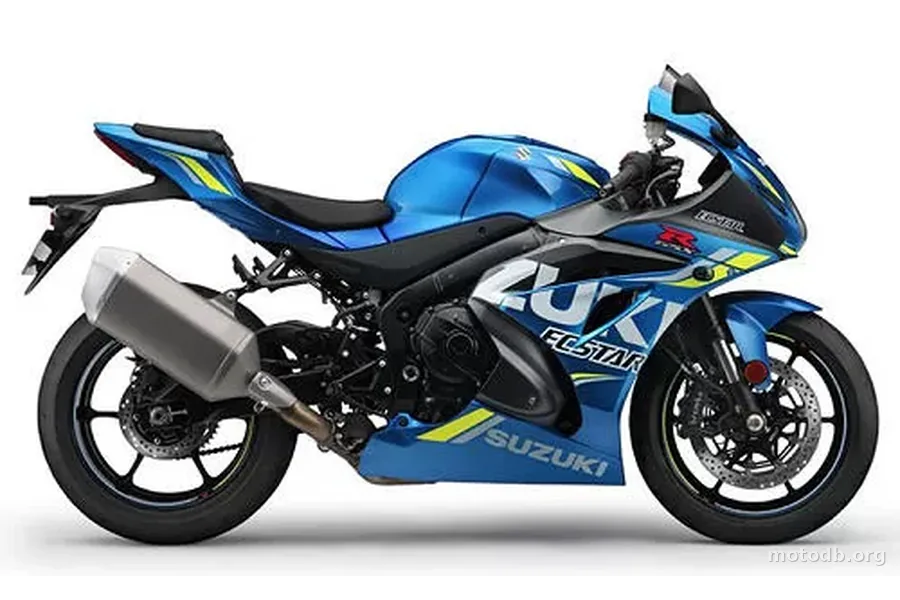
Key performance
Technical specifications
Engine
- Displacement
- 1000 cc
- Power
- 202.0 ch @ 13200 tr/min (148.6 kW)
- Torque
- 117.7 Nm @ 10800 tr/min
- Engine type
- 4 cylindres en ligne, 4 temps
- Cooling
- liquide
- Compression ratio
- 13.2 : 1
- Bore × stroke
- 76 x 55.1 mm
- Valves/cylinder
- 4
- Camshafts
- 2 ACT
- Fuel system
- Injection Ø 46 mm
Chassis
- Frame
- périmétrique en aluminium
- Gearbox
- boîte à 6 rapports
- Final drive
- Chaîne
- Front suspension
- Fourche téléhydraulique inversée Ø 43 mm
- Rear suspension
- Mono-amortisseur
Brakes
- Front brakes
- Freinage 2 disques Brembo Ø 320 mm, fixation radiale, étrier 4 pistons
- Rear brakes
- Freinage 1 disque Ø 220 mm, étrier simple piston
- Front tyre
- 120/70-17
- Rear tyre
- 190/55-17
Dimensions
- Seat height
- 825.00 mm
- Fuel capacity
- 16.00 L
- Weight
- 202.00 kg
- New price
- 16 999 €
Overview
For twenty years, the GSX-R 1000 has been a fixture in the premier class. For twenty years, Suzuki has nurtured this lineage with an unwavering dedication that commands respect, even as the competition accelerates faster than Hamamatsu’s development calendar. The 2021 Suzuki GSX-R 1000 isn't arriving on conquered ground: the Yamaha R1 retains its electronic advantage, the Ducati Panigale V4 crushes everyone with its V-twin cylinders, and the BMW S 1000 RR has definitively changed the standards of the segment. Yet, this Gex has solid arguments, and it would be reductive to summarize it as a faded glory.
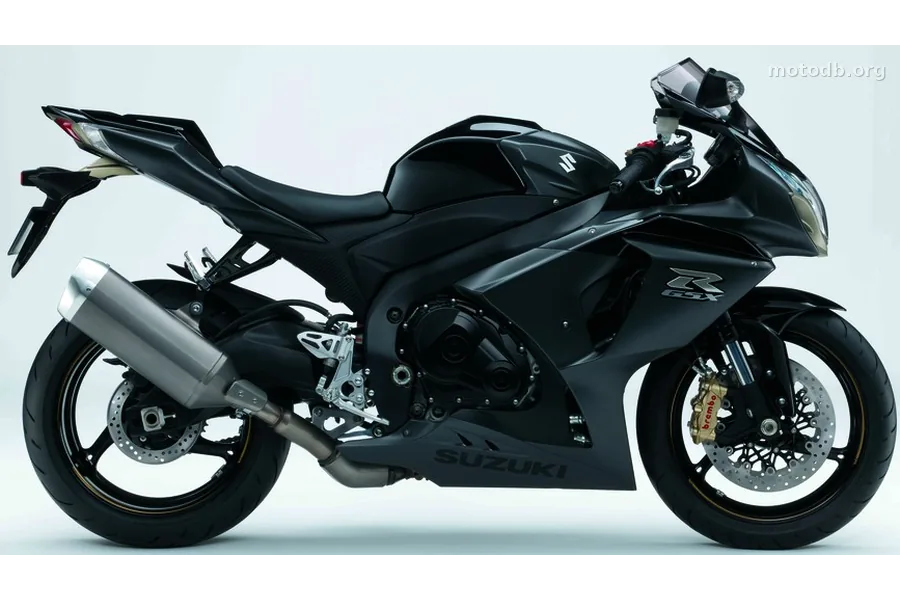
Let's start with what really matters on a hypersport: the engine. The 999.8 cc inline four-cylinder delivers 202 horsepower at 13,200 rpm and 117.7 Nm of torque at 10,800 rpm, for a contained wet weight of 202 kg. The power-to-weight ratio is mathematically undeniable. But what truly distinguishes this engine is the variable valve timing technology inherited directly from the MotoGP GSX-RR, a centrifugal ball system that modifies the inlet cam profile according to engine speed. The concrete result: power doesn't drop off sharply at mid-range before exploding at the top of the rev counter. It rises progressively, then crosses a brutal threshold above 10,000 rpm. The short stroke dimensions, 76 x 55.1 mm, push the engine towards high revs with a liveliness that demands attention. This isn't a 2003 or 2004 GSX-R 1000 model that forgave approximations; here, throttle control requires real riding precision.
The chassis follows the same logic of densification. The aluminum perimeter frame has gained compactness and lost 10% of its weight, the swingarm has its pivot axis advanced by 20 mm. The 43 mm Showa inverted fork does the job correctly without reaching the excellence of the cartridge upside-down design reserved for the R version. This is the only real source of frustration with this standard configuration: you can feel that there was better available in the Suzuki catalog, deliberately withheld to justify the R’s premium price. Brembo radial four-piston calipers bite on 320 mm discs, with a cornering ABS that adapts its intervention to the lean angle thanks to the Bosch IMU inertial unit. On the track and on wet roads, this system concretely changes the management of hard braking.
Electronics have caught up some of the brand’s historical lag. The ten-level traction control, the bidirectional quickshifter finally present on this standard version (after being reserved for the R for years), the three S-DMS engine maps, and the cornering ABS constitute an honest package. Honest, not exhaustive. The Kawasaki ZX-10R and the BMW S 1000 RR offer semi-active suspension systems or differentiated braking modes that the Gex lacks. For seasoned track riders who compare technical specifications in detail, this shortcoming weighs in the balance when shelling out 16,999 euros.
The 2021 Suzuki GSX-R 1000 is aimed at an experienced rider who wants a direct hypersport, without the sometimes oppressive electronic complexity of the German or Austrian competitors. The 825 mm seat height and the very sporty riding position immediately exclude beginners and touring riders. Its 16-liter fuel tank and the relative thermal moderation of its engine allow for a few hundred kilometers on the road without turning every leg into a torment, which remains a real advantage over a Panigale. For those who have followed the range's history since the K5, this 2021 version represents the culmination of a consistent evolution, never revolutionary, always effective. A motorcycle that doesn't try to be the most spectacular in the segment, but which remains, in its own methodical and Japanese way, a formidable machine.
Standard equipment
- Assistance au freinage : Carrera ABS
Practical info
- La moto est accessible aux permis : A
Indicators & positioning
Similar bikes
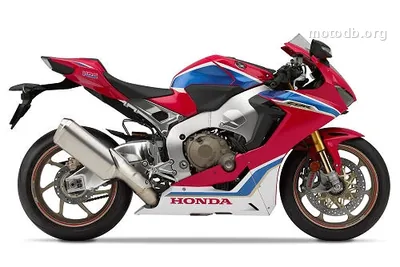
CBR 1000 RR Fireblade SP2
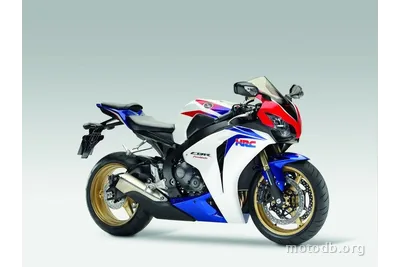
CBR 1000 RR PLAYBOY Replica
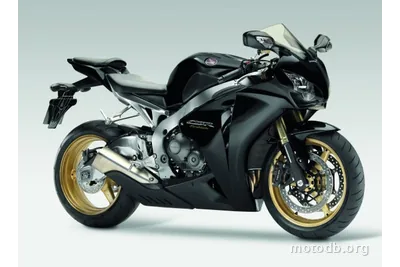
CBR 1000 RR Fireblade Limited Edition TT
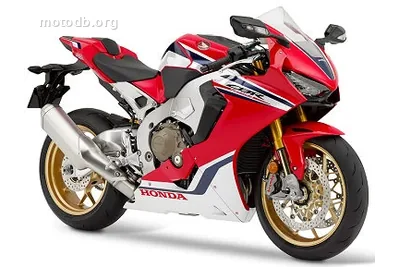
CBR 1000 RR Fireblade SP
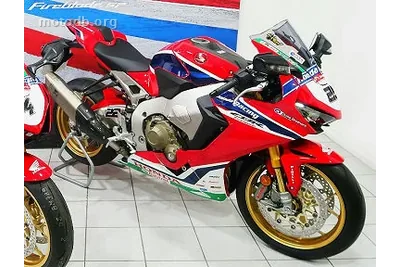
CBR 1000 RR Fireblade SP BSB replica
Reviews & comments
No reviews yet. Be the first to share your opinion!