Key performance
Technical specifications
Engine
- Displacement
- 1801 cc
- Power
- 97.0 ch @ 5250 tr/min (70.8 kW)
- Torque
- 156.0 Nm @ 3500 tr/min
- Engine type
- V2, four-stroke
- Cooling
- Air
- Compression ratio
- 9.2:1
- Bore × stroke
- 101.6 x 111.1 mm (4.0 x 4.4 inches)
- Fuel system
- Injection. ESPFI
- Lubrication
- Dry sump
- Starter
- Electric
Chassis
- Gearbox
- 6-speed
- Final drive
- Belt (final drive)
- Clutch
- Multi-plate with diaphragm spring in oil bath
- Front suspension
- Telescopic fork
- Rear suspension
- Twin shocks
Brakes
- Front brakes
- Single disc. ABS, 4-piston fixed.
- Rear brakes
- Single disc. ABS, 2-piston torque-free floating
- Front tyre
- 100/90-B19
- Rear tyre
- 160/70-B17
Dimensions
- Seat height
- 685.00 mm
- Wheelbase
- 1630.00 mm
- Ground clearance
- 125.00 mm
- Length
- 2390.00 mm
- Fuel capacity
- 18.90 L
- Weight
- 305.00 kg
- Dry weight
- 293.00 kg
Overview
Motorcycles don't need to explain their existence. The Dyna Low Rider is part of that rare breed: five years absent from the catalog, from 2009 to 2014, and it returns as if nothing had happened, bearing on its chrome flanks the weight of a history that began in 1977. Nearly fifty years of custom genetics, distilled into a steel tubular frame and powered by a twin that beats like a bison's heart.
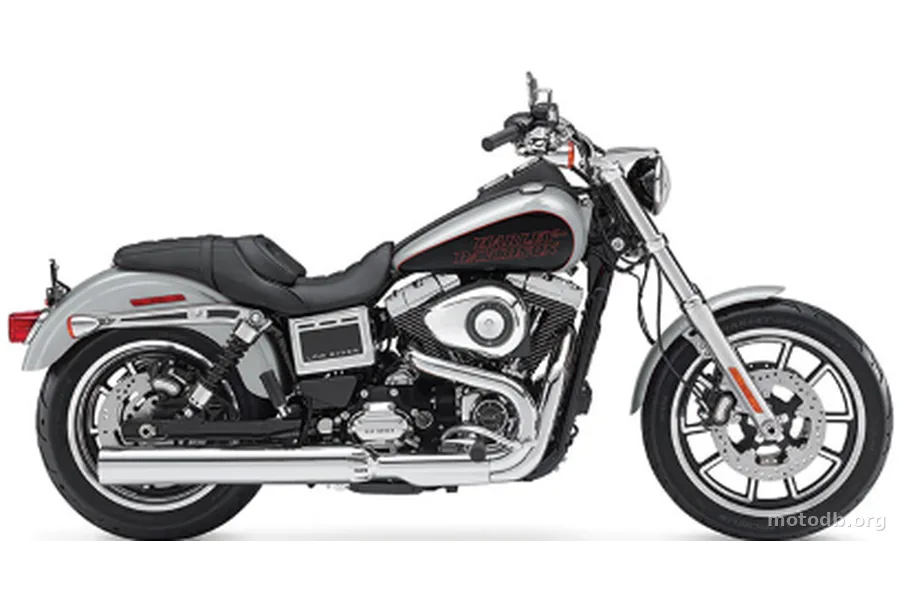
The Milwaukee Eight wasn't yet present for this 2017 version. It is therefore the 103 cubic inches, or 1690 cm3 twin at 45 degrees, that occupies the space between the two tubes of the Dyna frame. Seventy-seven horsepower at 5020 rpm, 125 Nm of torque available from 3500 rpm. On paper, this seems modest compared to a Ducati Diavel or even an Indian Scout. But comparing these figures is like judging a bourbon by the number of bubbles it makes. This engine, with its very square bore-stroke ratio of 98.3 x 111.1 mm, delivers a fat, slow, and resolutely physical push. It vibrates, it jumps, it breathes. This is precisely what the buyer of the Harley-Davidson Dyna Low Rider is looking for, whether they are coming from a 1584 or discovering the 1690 displacement for the first time.
The ergonomics deserve attention. The seat at 680 mm of height makes it accessible to an average build, and the engineers worked on the position: footpegs advanced by 51 mm compared to previous generations, adjustable handlebar with 60 mm of travel, seat adjustable in length by 38 mm. For 311 kg fully fueled, the low center of gravity is reassuring when stopped, even if maneuvering in a tight parking lot quickly reminds you that you are not on a 125. The seat height combined with the actual weight makes this motorcycle a machine rather reserved for drivers who already have a few thousand kilometers in their boots. A beginner on a Harley-Davidson Dyna Low Rider 1690 used will be well advised to first go through lighter machines.
The technical equipment for 2017 remains honest without being generous. 49 mm telescopic fork, double rear shock absorber, three-disc braking system with four-piston calipers at the front and two pistons at the rear, ABS as standard, six-speed belt transmission, Smart Security System. The final belt transmission, a Harley characteristic, offers a smoothness that the chain cannot imitate in this segment. The central console with two round dials plays the vintage card without ostentation. Chrome spoked rims complete the picture with consistency. For the Harley-Davidson Dyna Low Rider motorcycle in the 2017 version, the entry ticket is 16,350 euros in the catalog, which clearly positions it in the high end of the European custom market compared to Triumph Thunderbird Sport or Moto Guzzi Eldorado.
The main regret remains the engine. At that time, Harley had already equipped some Softail models with the 103 High Output, which was more refined and more responsive. The Dyna Low Rider inherited the standard engine, less flattered. This is even more visible for anyone looking for an objective Harley-Davidson Dyna Low Rider review: the motorcycle is consistent, well-built, and has an authentic character that the recent versions with Milwaukee Eight have somewhat diluted. It is aimed at the solitary traveler who prefers national roads to highways, who does not need 170 km/h in cruising speed but who wants to feel every meter traveled. It's not a flaw, it's a choice. And the Dyna Low Rider has held this choice with remarkable consistency for forty years.
Reviews & comments
No reviews yet. Be the first to share your opinion!