Key performance
Technical specifications
Engine
- Displacement
- 1801 cc
- Power
- 97.0 ch @ 5250 tr/min (71.3 kW)
- Torque
- 154.9 Nm @ 3500 tr/min
- Engine type
- Bicylindre en V à 45°, 4 temps
- Cooling
- combiné air / huile
- Compression ratio
- 9.2 : 1
- Bore × stroke
- 101.6 x 111.1 mm
- Valves/cylinder
- 2
- Fuel system
- Injection
Chassis
- Frame
- Cadre tubulaire en acier
- Gearbox
- boîte à 6 rapports
- Final drive
- Courroie
- Front suspension
- Fourche telescopique Ø 49 mm, déb : 130 mm
- Rear suspension
- 2 amortisseurs latéraux, déb : 54 mm
Brakes
- Front brakes
- Freinage 2 disques Ø 300 mm, étrier 4 pistons
- Rear brakes
- Freinage 1 disque Ø 292 mm, étrier 2 pistons
- Front tyre
- 100/90-19
- Rear tyre
- 160/70-17
Dimensions
- Seat height
- 685.00 mm
- Fuel capacity
- 17.80 L
- Weight
- 305.00 kg
- Dry weight
- 293.00 kg
- New price
- 19 290 €
Overview
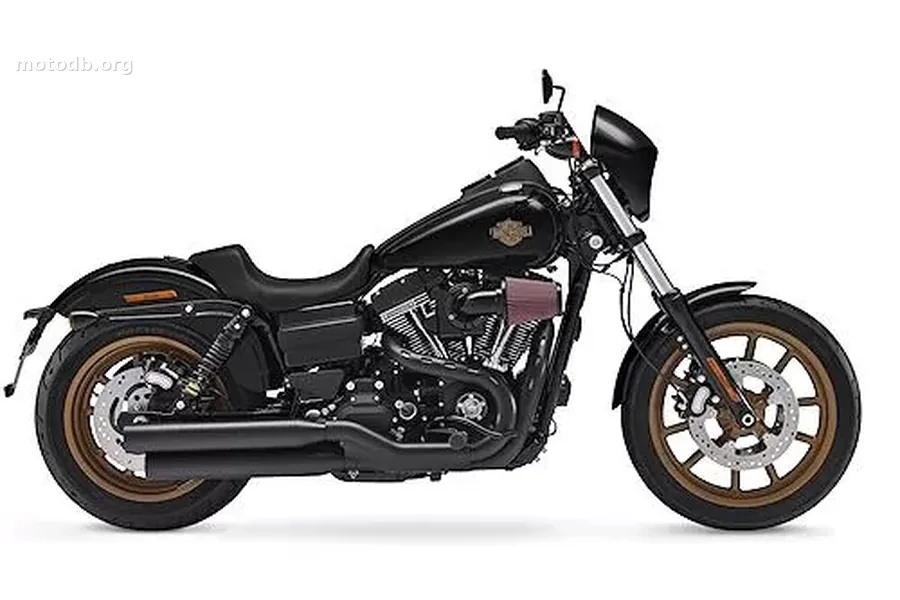
Forty years the Low Rider has been carving its path through the Harley-Davidson catalog. Forty years of stripped-down custom, built for those who prefer character over frills. With the 2016 FXDLS variant, Milwaukee pushes things up a notch by grafting its biggest V-twin beneath the tank: the Twin Cam 110, 1801 cc of American cast iron. This is no longer a simple restyle, but a machine that fully embraces its muscular ambitions.
The real selling point of the Low Rider S isn't found on the power line, even though 97 horsepower at 5250 rpm remains respectable for a 305 kg wet-weight custom. What changes the game is the torque. 154.9 Nm available from just 3500 rpm — a leap of nearly a quarter over the 1690 cc standard Low Rider. With every twist of the throttle, the V-twin shakes the tubular steel frame with that irregular 45-degree firing order that only Harley knows how to produce. The single-pin crankshaft churns away, vibrations travel up through the grips, and the rider quickly understands they're not riding a motorcycle — they're negotiating with one. The six-speed gearbox and belt drive absorb it all without flinching.
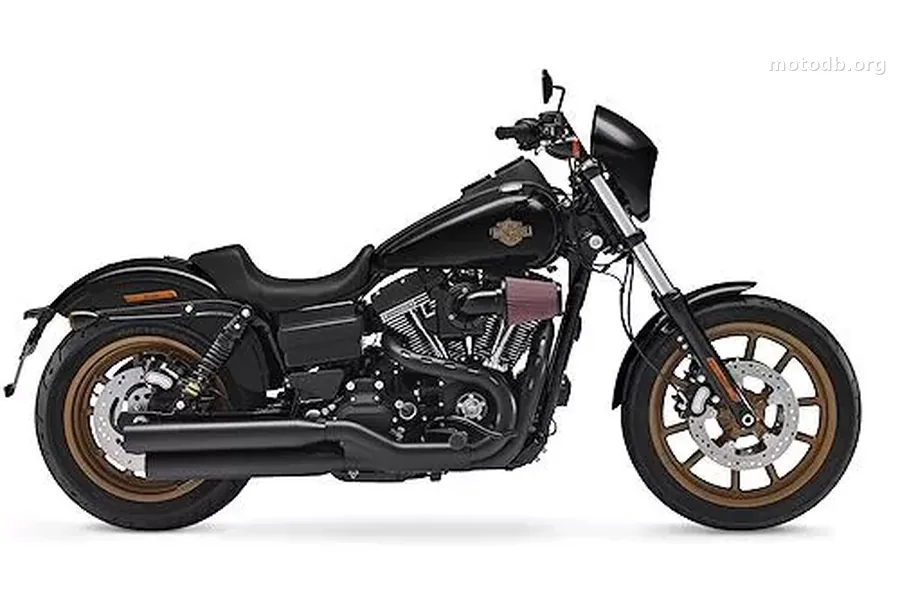
Visually, this S version doesn't do subtlety. All-black livery, Magnum Gold wheels recalling the magnesium alloys of sixties race cars, shortened rear fender, solo seat. The message is clear: no passenger, no compromise. The Drag Bar handlebar leans the rider forward and gives the whole package an aggressive stance that the 685 mm seat height only accentuates. The oversized air filter sits proudly on the right side of the engine, feeding the 1801 cc with the appetite they deserve. The dual exhaust, in the spirit of the Fat Bob, unleashes a deep rumble that leaves no doubt about the displacement.
On the chassis side, Harley made a notable effort with Premium Ride suspension: a 49 mm telescopic fork offering 130 mm of travel up front, and two lateral shock absorbers at the rear. Rear travel remains limited to 54 mm, betraying the machine's smooth-tarmac vocation. Braking relies on an ABS system with dual 300 mm discs gripped by four-piston calipers at the front and a 292 mm disc with a two-piston caliper at the rear. For a machine of this size, it's a decent setup that inspires confidence during hard braking. The inclusion of cruise control as standard is a reminder that this Low Rider can also devour main roads without tiring its owner, despite a mere 17.8-liter tank that will demand regular fuel stops.
At €19,290, the Low Rider S asks for roughly €3,000 more than the standard version. That's the price of the Twin Cam 110, the revised suspension, and the specific equipment. Alongside the Fat Boy S and Slim S that round out the family, it stands apart with its more spirited temperament and stripped-back styling. In the custom landscape, it competes with the big Indian Chiefs or the Victory Gunners of the era, but with one asset the competition struggles to replicate: that raw, almost archaic mechanical signature that is the essence of Harley-Davidson. The Low Rider S is aimed at experienced riders who want character without going the CVO route and its stratospheric price tag. A brute in a black suit, built for straightaways and sideways glances at red lights.
Standard equipment
- Assistance au freinage : ABS de série
Practical info
- La moto est accessible aux permis : A
Reviews & comments
No reviews yet. Be the first to share your opinion!