Key performance
Technical specifications
Engine
- Displacement
- 1158 cc
- Power
- 170.0 ch @ 10500 tr/min (124.1 kW)
- Torque
- 125.0 Nm @ 8750 tr/min
- Engine type
- V4, four-stroke
- Cooling
- Liquid
- Compression ratio
- 14.0:1
- Bore × stroke
- 83.0 x 53.5 mm (3.3 x 2.1 inches)
- Valves/cylinder
- 4
- Camshafts
- 2 ACT
- Fuel system
- Injection. 46mm eliptical throttle bodies with Ride-by -Wire system
- Valve timing
- Desmodromic valve control
- Starter
- Electric
Chassis
- Frame
- Aluminum Monocoque
- Gearbox
- 6-speed
- Final drive
- Chain (final drive)
- Clutch
- Multiplate wet hydraulic control, self-servo action on drive, slipper action on over-run
- Front suspension
- 50mm fully adjustable usd forks, electronic compression and rebound damping adjustment with Ducati Skyhook
- Rear suspension
- Fully adjustable monoshock , electronic adjustment with Ducati Skyhook, aluminum double-sided Swingarm
- Front wheel travel
- 170 mm (6.7 inches)
- Rear wheel travel
- 180 mm (7.1 inches)
Brakes
- Front brakes
- Double disc. Brembo M50 Stylema monoblock 4-piston 2 pad calipers, ABS
- Rear brakes
- Single disc. ABS. Brembo Two-piston calipers.
- Front tyre
- 120/70-ZR19
- Front tyre pressure
- 2.40 bar
- Rear tyre
- 170/60-ZR17
- Rear tyre pressure
- 2.50 bar
Dimensions
- Seat height
- 840.00 mm
- Wheelbase
- 1567.00 mm
- Fuel capacity
- 22.00 L
- Weight
- 242.00 kg
- Dry weight
- 215.00 kg
- New price
- 19 590 €
Overview
Imagine that Ducati took its Superbike engine, widened it to 1158 cm3, and slid it under a grand-touring trail bike, coldly announcing the price at 19,590 euros. That’s exactly what Bologna did with the Ducati Multistrada V4 2022, and the result deserves serious consideration. The Granturismo V4, derived from the MotoGP lineage before irrigating the Panigale and Streetfighter, develops 170 horsepower at 10,500 rpm and 125 Nm at 8,750 rpm. Compared to the BMW S 1000 XR, a direct rival in this sporty-road segment, the Ducati creates a five-horsepower gap. It’s not an ego battle, it’s a statement of intent.
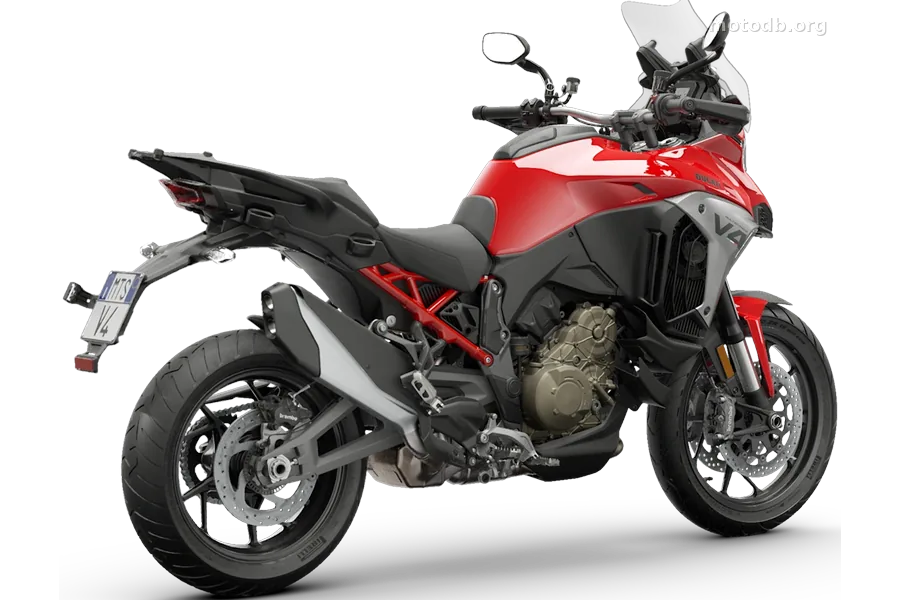
What immediately strikes you about the Ducati Multistrada V4 is the break with the brand’s historical DNA. Monocoque aluminum frame instead of a tubular trellis, standard double-sided swingarm instead of the iconic single-sided arm, classic bucket and rocker valve actuation after decades of desmodromic distribution. Purists who grew up with the twin-cylinder will cringe. Let them console themselves with the valve inspection interval extended to 60,000 km and oil changes spaced at 15,000 km: the V4 is less demanding in terms of maintenance than its predecessors. The displacement of the four cylinders (83 x 53.5 mm bore-stroke, compression ratio of 14:1) was built to produce usable torque on the road, not just to flash on a specification sheet. The rear cylinder cut-off at idle, a process now shared by some American motorcycles, effectively manages heat and the announced fuel consumption of 6.5 liters per 100 km.
The chassis follows the same logic of competition transposed onto asphalt. An adjustable 50 mm inverted fork with preload, compression, and rebound damping provides 170 mm of travel at the front, the rear shock offering 180 mm. The front wheel goes to 19 inches, a sign of slightly adventurous ambitions without completely shifting into pure trail. To do so, you will need to order the spoked rims as an option on the S version. At the stop, 242 kg all full, which places the Ducati Multistrada V4 in the upper middle of the category. Brembo M50 Stylema four-piston calipers bite two 320 mm discs at the front, cornering ABS included. It’s hypersport hardware mounted on a trail bike, and you can feel it with every deceleration.
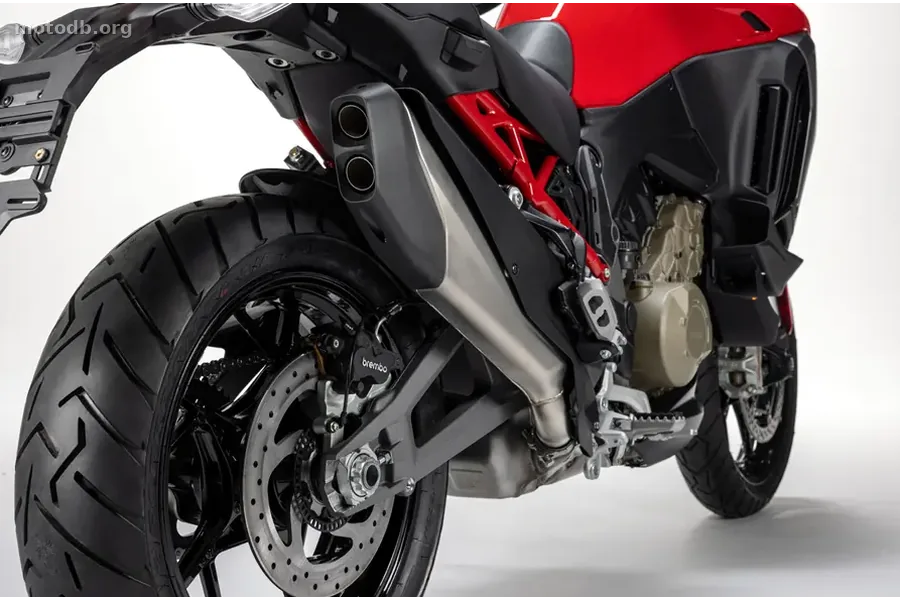
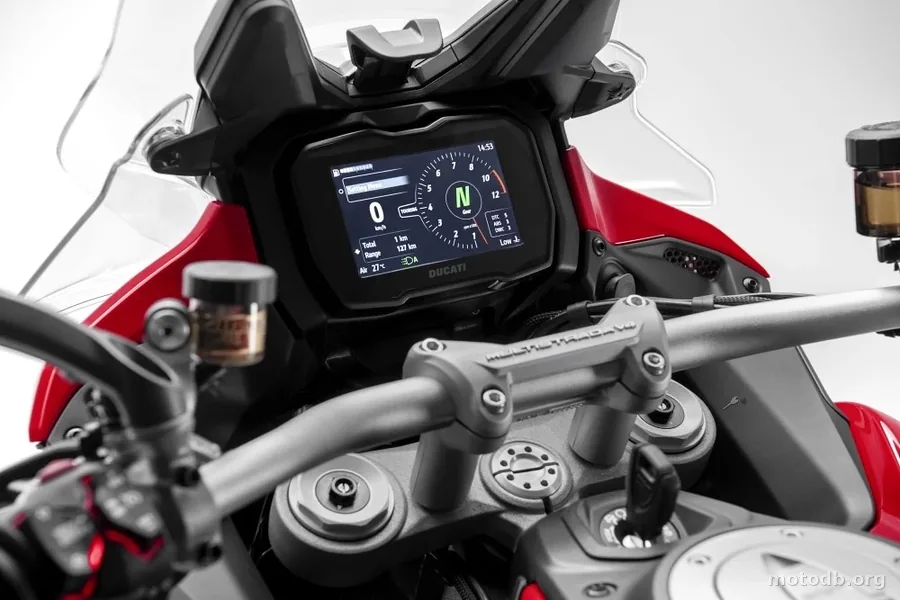
Electronics today constitute a criterion for choice as decisive as the engine itself, and Ducati has taken care of its digital co-pilot. Six-axis IMU inertial unit, traction control on eight levels, wheelie control on eight levels, three-level ABS with cornering function and anti-stoppie, four riding modes (Sport, Touring, Urban, Enduro) that modulate power between 115 and 170 horsepower depending on the moment's desire. The 5-inch TFT screen adopts the graphics of the sport V4s, abandoning the aging interface of previous generations. Radar for adaptive cruise control remains reserved for the S version and the Ducati Multistrada V4 S Sport, an absence that stings a bit at this price. The 22-liter tank offers correct autonomy, the adjustable seat between 840 and 860 mm caters to both the medium-build touring rider and the pilot standing on the footpegs in light off-road. The center stand is still not part of the standard program, a regrettable omission for a grand-touring machine.
The Ducati Multistrada V4 test highlights a motorcycle built for the road rider who wants character without imposing the compromises of a pure sportbike. It’s neither the playground of beginners nor that of hardcore trail riders aiming for serious trails. It’s a proposition for ambitious kilometer eaters, lovers of winding roads, those who naturally compare the Ducati Multistrada V4 used with a new one, as demand remains strong in this segment. Those looking for more exoticism will look towards the Ducati Multistrada V4 Pikes Peak, with its Öhlins suspensions and racing livery. For others, the standard version at 19,590 euros builds a solid argument against its competitors, provided you accept that Ducati has drawn a line over several of its most deeply rooted traditions to deliver a coherent, modern, and uncomplexed machine.
Standard equipment
- Assistance au freinage : ABS in curves
- Bluetooth
Practical info
- La moto est accessible aux permis : A
Indicators & positioning
Similar bikes
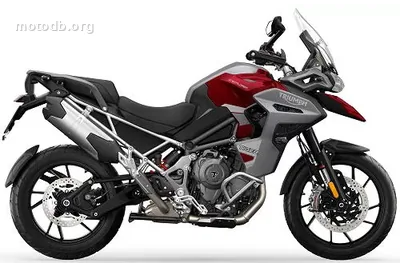
Tiger 1200 GT Explorer
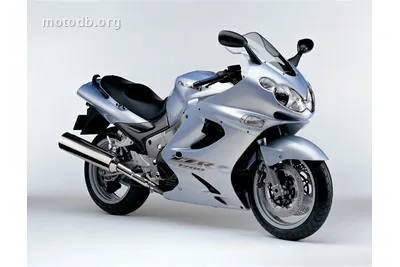
ZZ-R 1200
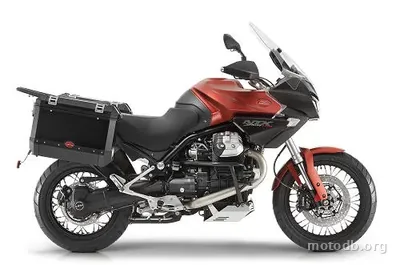
STELVIO 1200 8V NTX
Reviews & comments
No reviews yet. Be the first to share your opinion!