Key performance
Technical specifications
Engine
- Displacement
- 1158 cc
- Power
- 170.0 ch @ 10750 tr/min (125.0 kW)
- Torque
- 124.0 Nm @ 9000 tr/min
- Engine type
- 4 cylindres en L à 90°, 4 temps, calage de type Twin Pulse - 0° - 90° - 290° - 380°
- Cooling
- liquide
- Compression ratio
- 14 : 1
- Bore × stroke
- 83 x 53.5 mm
- Valves/cylinder
- 4
- Camshafts
- 2 ACT
- Fuel system
- Injection Ø 46 mm
- Starter
- électrique
- Euro standard
- Euro 5+
Chassis
- Frame
- monocoque en aluminium
- Gearbox
- boîte à 6 rapports
- Final drive
- Chaîne
- Front suspension
- Fourche téléhydraulique inversée Ø 50 mm, déb : 170 mm
- Rear suspension
- Mono-amortisseur, déb : 180 mm
Brakes
- Front brakes
- Freinage 2 disques Brembo Ø 320 mm, fixation radiale, étrier 4 pistons
- Rear brakes
- Freinage 1 disque Brembo Ø 280 mm, étrier 2 pistons
- Front tyre
- 120/70-19
- Front tyre pressure
- 2.40 bar
- Rear tyre
- 170/60-17
- Rear tyre pressure
- 2.50 bar
Dimensions
- Seat height
- 840.00 mm
- Seat type
- Selle biplaces
- Fuel capacity
- 22.00 L
- Weight
- 229.00 kg
- New price
- 20 890 €
Overview
Now, there are no longer really any bad motorcycles when looking at the manufacturers' catalogs. While some choose their motorcycle based on brand loyalty, others are drawn to technological innovations. If you are one of those people, listen carefully, as what I am about to tell you could strongly appeal to you if you are looking for an ultra-versatile machine. The Ducati Multistrada V4 adopts leading-edge technologies such as automatic motorcycle lowering (for the S model) and an improvement to cylinder deactivation…
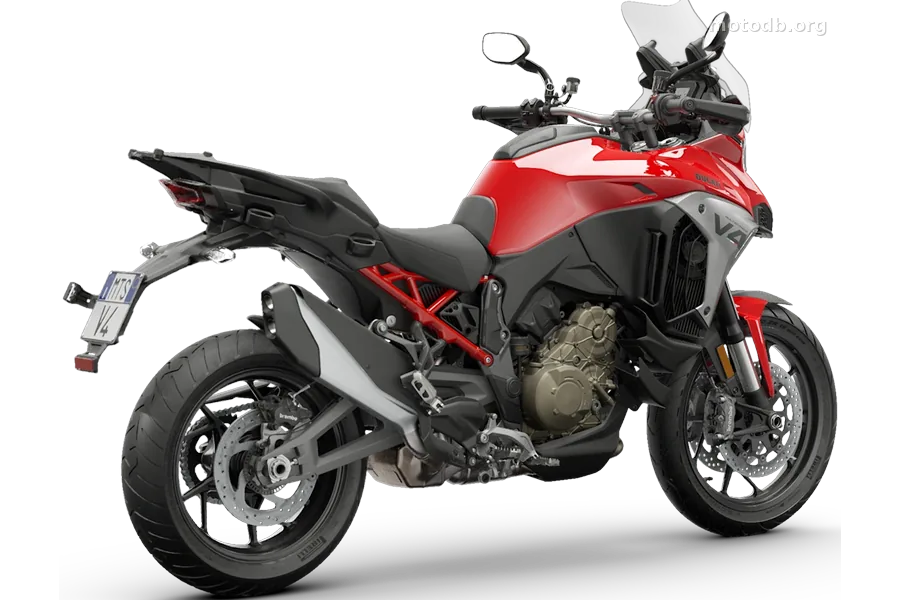
In terms of style, this motorcycle benefits from a slight refresh of the front end. The brand's stated goal is to make the motorcycle more aggressive, more sporty, definitively leaving the rally character to the Desert range. The Multistrada's credo: fast road riding but with comfort! According to the manufacturer's press release, the style of the fork should allow you to immediately make the connection with the Panigale V4. Even better! The painted parts that frame it completely would recall the 916 and 1098. Indeed, Ducati sees the 916 everywhere.
There’s no doubt about it, the Italians are strong when it comes to marketing. In reality, you’ll need a keen eye to play “spot the differences” between a 2024 model and this 2025-2026 model. The LED daytime running lights lengthen to further emphasize the look of this large supermoto that likes to travel. It’s true that the fork appears less raw black plastic. Therefore, by modulating the color scheme of the bodywork (which ultimately remains the same), Ducati proposes a new identity.
Another slight change, the exhaust silencer adopts a new shape that, according to the press release, gives the Multistrada a new voice.
Automatic Lowering Device
Let's take a detour to discuss a bit of technology from the S model. It will be easier to handle when stationary and at low speeds thanks to the introduction of the automatic lowering device (Automatic Lowering Device). The operation is simple: the motorcycle lowers by reducing suspension travel automatically when it descends below 10 km/h. When the rider accelerates, beyond 50 km/h, the Multistrada V4 S automatically returns to the riding height. This assistance is certainly very practical, but can still be disconnected by the rider.
Ducati Vehicle Observer
The Multistrada V4 becomes even safer and more efficient, thanks to electronic controls capable of acting with greater precision. This function allows for a more precise estimation of the motorcycle's position in space and its total mass, by simulating the input of 70 sensors to integrate the data provided by the inertial platform. The Ducati Vehicle Observer, developed by Ducati Corse in MotoGP and introduced with the Panigale V4 my25, uses 70 virtual sensors to constantly analyze the motorcycle in order to feed data to the inertial unit. Then, the electronics manage ABS Cornering, Ducati Wheelie Control (DWC), and Ducati Traction Control (DTC) more finely and precisely.
The MTS V4 is also equipped with the adjustable Engine Brake Control (EBC) system with three levels. This assistance allows the rider to personalize engine braking according to their riding style and the context. Finally, the combined electronic braking system, which optimally distributes braking between the front and rear, adds a new analysis parameter to its operation by taking into account the load of the motorcycle.
In addition to the front-to-rear strategy, which manages the rear brake even when using only the front control, the new Multistrada V4 2025 is now equipped with a rear-to-front strategy that optimizes braking power when using only the rear control.
In addition to the basic information (speed, rpm, etc.), the rider manages all these functions from the 5-inch color TFT dashboard. Again, Ducati wants to mark the difference between the standard model and the more upscale side of the V4 and its 6.5-inch screen, enriched with features.
Engine: a V4 that transforms into a parallel-twin
The Multistrada is still equipped with the V4 Granturismo engine. With a displacement of 1,158 cm3, the V4 develops 170 hp (125 kW) at 10,750 rpm and 123.8 Nm at 9,000 rpm when all its cylinders are engaged by the fury of your right wrist. However, in cruising situations, to meet Euro 5+ standards, the Italian engineers had a good German idea. You know that Ducati belongs to Audi. German cars have been equipped with cylinder deactivation for a few years. It is therefore natural that the transfer of technology takes place across the Alps.
Thus, the electronic management of the engine deactivates the rear cylinders when the motorcycle is stationary and when the engine is not running at full load. This trick allows the V4 to be less fuel-hungry with a 6% reduction in fuel consumption and emissions.
Honda had already imagined a somewhat comparable system with the V-TEC of its V4 on the VFR, but which deactivated not the cylinders themselves but 2 valves on four in each cylinder. A trial of the Italian system will allow us to judge the relevance of this improvement on the Multistrada. Note that this technology will work regardless of the riding mode chosen by the rider.
However, of the five riding modes available to you, Ducati has thoroughly revised the Enduro mode and proposes a new Wet (wet/rain) mode. Let's mention the others: Sport (170 hp), Touring (170 hp), and Urban (115 hp).
The selection of the Enduro mode reduces the V4 power to 114 hp with a softer throttle response in off-road situations on relatively paved roads. DTC intervention is reduced to a lower level and DWC is deactivated. Rear wheel ABS is also deactivated and the cornering assist and rear lift detection are inhibited to adapt to off-road use.
As for the chassis, the Multistrada V4 retains its well-proven foundations. It still relies on a monocoque aluminum frame, with a double-sided aluminum die-cast swingarm. The axis of which is repositioned 1 millimeter higher. The goal is to prevent the motorcycle from sagging under the load you impose on it. Another modification, more legroom for the passenger thanks to a new arrangement of the top case and panniers. Adaptive cornering lights are now standard.
Packages and finishes
The Multistrada V4 is now offered in 4 finishes. We already knew the Radar and Travel & Radar models. Ducati adds the Sport Travel & Radar and Adventure Travel & Radar packs. These versions include a center stand, heated grips and seat, and of course front and rear radars.
The Sport finish adds panniers and forged wheels that reduce unsprung weight by 2 kg. The handling gain will be certain with this version. The Adventure version is characterized by aluminum panniers and spoked wheels.
Finally, Ducati still offers one of the most versatile motorcycles on the market. The definition of the Multistrada is a bit of going fast but with relative comfort. And yes, at 50, you may no longer want to break yourself in 3 to stay on an hypersport. However, the big trail does not quite appeal to you. Indeed, many BMW GS owners never put their wheels in the dirt except in their driveway. So why not think of a more sporty machine? The answer is there…
Vincent Beaucousin - Photos manufacturer
Standard equipment
- Assistance au freinage : ABS
- Nombre de mode de conduite : 5
- Taille de l'écran TFT couleur : 12,70 cm / 5 pouces
- ABS Cornering
- Jantes aluminium
- Shifter
- Indicateur de vitesse engagée
- Régulateur de vitesse
- Bluetooth
- Aide au démarrage en côte (Hill Hold Control)
- Contrôle de traction
- Contrôle anti wheeling
- Embrayage anti-dribble
- Selle réglable
- Commodes rétro-éclairés
- Phares adaptatifs en virage
Practical info
- La moto est accessible aux permis : A
- Pays de fabrication : Italie
Indicators & positioning
Similar bikes
Tiger 1200 GT Explorer
ZZ-R 1200
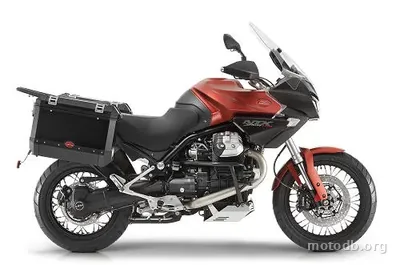
STELVIO 1200 8V NTX
Reviews & comments
No reviews yet. Be the first to share your opinion!