Key performance
Technical specifications
Engine
- Displacement
- 1285 cc
- Power
- 205.0 ch @ 10500 tr/min (149.6 kW)
- Torque
- 144.6 Nm @ 8750 tr/min
- Engine type
- V2, four-stroke
- Cooling
- Liquid
- Compression ratio
- 12.5:1
- Bore × stroke
- 116.0 x 60.8 mm (4.6 x 2.4 inches)
- Valves/cylinder
- 4
- Camshafts
- 2 ACT
- Fuel system
- Injection. Twin injectors per cylinder. Full ride-by-wire elliptical throttle bodies.
- Valve timing
- Desmodromic valve control
- Starter
- Electric
Chassis
- Frame
- Monocoque Aluminium
- Gearbox
- 6-speed
- Final drive
- Chain (final drive)
- Clutch
- Slipper and self-servo wet multiplate clutch with hydraulic control
- Front suspension
- Marzocchi 50mm pressurized and fully adjustable usd fork with hard anodized aluminum lightweight slider
- Rear suspension
- Fully adjustable Sachs unit. Adjustable linkage: Progressive/flat. Aluminum single-sided swingarm.
- Front wheel travel
- 120 mm (4.7 inches)
- Rear wheel travel
- 130 mm (5.1 inches)
Brakes
- Front brakes
- Double disc. ABS. Floating discs. Four-piston calipers. Radially mounted.
- Rear brakes
- Single disc. ABS. Two-piston calipers.
- Front tyre
- 120/70-ZR17
- Front tyre pressure
- 2.30 bar
- Rear tyre
- 200/55-ZR17
- Rear tyre pressure
- 2.10 bar
Dimensions
- Seat height
- 830.00 mm
- Wheelbase
- 1437.00 mm
- Length
- 2070.00 mm
- Width
- 745.00 mm
- Height
- 1105.00 mm
- Fuel capacity
- 17.00 L
- Weight
- 190.50 kg
- Dry weight
- 166.50 kg
- New price
- 21 390 €
Overview
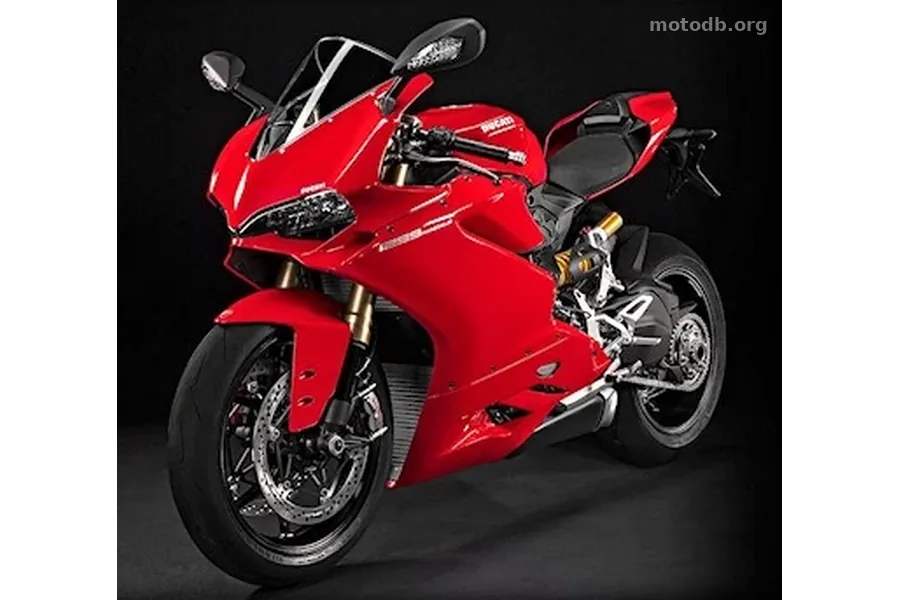
When Ducati decided to bring the Panigale to 1285 cm3, the Superbike world paddock coughed in its beard. SBK regulations cap twin-cylinder engines at 1200 cm3, and Bologna had just sent that constraint flying with a flick of the wrist. It doesn’t matter: the Ducati 1299 Panigale was not born to tick boxes in a sporting regulation. It was born to hurt.
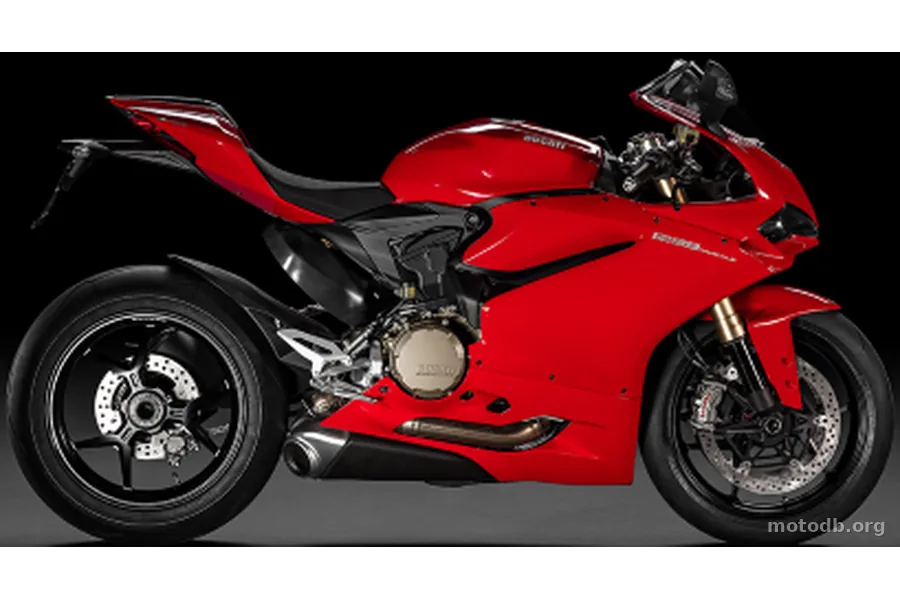
The Superquadro powering the 1199 had character, but it had to be hunted high in the rev range, where the needle brushed the redline. With pistons carried to 116 mm bore on an unchanged 60.8 mm stroke, the new engine changes register. At 6,250 rpm, one hundred horsepower is already available under the right hand. Two thousand revolutions later, we brush 170. The peak arrives at 10,500 rpm with 205 hp and 144.6 Nm at 8,750 rpm. To put the scale of the thing into perspective: the BMW S 1000 RR, a four-cylinder inline engine, reaches this level of power only around 10,000 rpm. The Italian twin therefore does the same job with two cylinders and a temperament of a steroid-fueled workhorse. The Ducati 1299 Panigale technical specifications speak for themselves, but it’s under the rider’s seat that it all makes sense.
The chassis, however, did not wait for the engine figures to impress. The aluminum monocoque frame simultaneously acts as a load-bearing structure and an airbox, eliminating any parasitic trellis. The steering head angle has been tightened by half a degree, to 24 degrees exactly. The swingarm pivot has slid 4 mm downwards. The rake gains 4 mm, going to 100 mm. These are minor adjustments on paper, decisive in high-speed cornering. The 50 mm Marzocchi inverted fork absorbs the violent braking imposed by the Brembo M50 monoblock calipers and 330 mm discs. The high-section single-sided swingarm completes the ensemble with that aggressive style the 1299 shares with its variants, whether it’s the Ducati 1299 Panigale S or the Ducati 1299 Panigale R reserved for homologated competitions.
For 2017, the most substantial update concerns the electronics. Traction Control DTC and Wheelie Control DWC go to version EVO, an evolution inaugurated on the Ducati 1299 Panigale S Anniversario. The DTC Evo refines its algorithms to intervene on the throttle butterflies in addition to ignition and injection, with more slip freedom at level 1. The DWC Evo relies on the IMU inertial unit, which calculates the motorcycle's movements on three axes and doses anti-dive intervention with surgical precision. ABS now manages braking in curves thanks to the same inclination data. The bi-directional shifter, without a clutch on the upshift as well as the downshift, completes an electronic arsenal worthy of a prepared competition machine. The TFT screen displays the lean angle in real time, and the DDA+GPS option allows you to download telemetry data after each session.
Let’s not lie: at €21,390, the Ducati 1299 Panigale price is not an invitation extended to all audiences. It’s not a motorcycle for beginners, nor for touring riders seeking lumbar comfort. It’s a tool for experienced track riders, or for enthusiasts who want to push their own limits within a safe environment. The 190.5 kg when fully fueled and the 830 mm seat height also impose a minimum stature and experience. Those looking for a Ducati 1299 Panigale used will find on the market examples at more accessible prices, notably 2015 models or the 2017 Ducati 1299 Panigale which receives these EVO evolutions. The Ducati 1299 Panigale Final Edition, for its part, closes the chapter with a collector's emphasis. Whatever the version, the premise remains the same: an uncompromising machine, built around an engine that holds nothing back, and electronics that help you survive your own ambitions.
Standard equipment
- Assistance au freinage : ABS Bosch 9MP
Practical info
- La moto est accessible aux permis : A
Reviews & comments
No reviews yet. Be the first to share your opinion!