Key performance
Technical specifications
Engine
- Displacement
- 1339 cc
- Power
- 150.0 ch @ 8000 tr/min (110.3 kW)
- Torque
- 132.4 Nm @ 6500 tr/min
- Engine type
- Bicylindre en V à 45°, 4 temps
- Cooling
- combiné air / huile
- Compression ratio
- 12.5 : 1
- Bore × stroke
- 103.6 x 79 mm
- Valves/cylinder
- 2
- Fuel system
- Injection Ø 62 mm
Chassis
- Frame
- périmétrique en aluminium, contenant le carburant
- Gearbox
- boîte à 5 rapports
- Final drive
- Courroie
- Front suspension
- Fourche téléhydraulique inversée Öhlins Ø 43 mm
- Rear suspension
- Mono-amortisseur Öhlins
Brakes
- Front brakes
- Freinage
- Rear brakes
- Freinage 1 disque
- Front tyre
- 120/70-17
- Rear tyre
- 190/55-17
Dimensions
- Fuel capacity
- 16.70 L
- New price
- 30 000 €
Overview
There are engineers who know when to stop, and then there is Erik Buell. After pushing his XB9 and XB12 to their absolute limits, this obsessive American decided to cross the white line separating a road motorcycle from a pure track tool. The XBRR is not homologated for use on public roads. That is not an administrative oversight — it is a statement of intent.
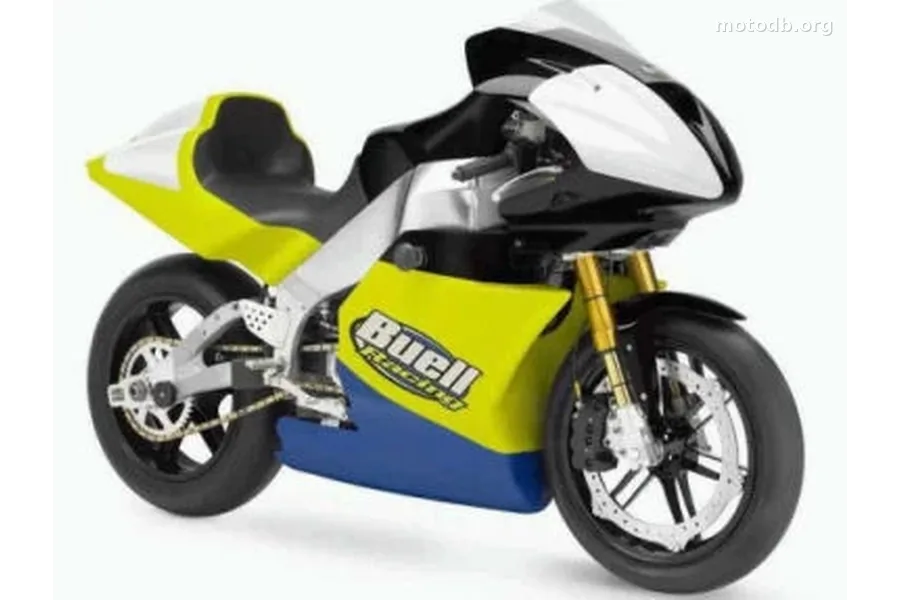
To understand this machine, you have to go back to the mid-1980s, when Buell was building his RW750 by hand to compete in the AMA championship. The XBRR reconnects with that artisanal, radical mindset. The aluminum perimeter frame doubles as the fuel tank, the swingarm contains the engine oil, and compactness is pushed to the extreme. But the real innovation lies in the adjustable wheelbase: by altering the linkage pivot point, the rider can set the wheel spacing anywhere from 1315 to 1367 mm depending on the circuit layout. That kind of adjustment is typically found on factory Superbike prototypes, not on a machine priced at 30,000 euros and produced in fifty units.
The running gear is entrusted to Öhlins, with a 43 mm inverted fork and a single shock absorber built to withstand full days of intensive track use. Braking relies on a single perimeter disc gripped by an eight-piston caliper — two more than on the road-going versions. The magnesium wheels reduce unsprung mass by one third compared to conventional rims, a difference felt directly in the precision of corner entry. The full fairing is carbon fiber.
Beneath the bodywork, the 45-degree V-twin derived from the collaboration with Harley-Davidson displaces 1339 cc. It produces 150 horsepower at 8,000 rpm and 132.4 Nm of torque at 6,500 rpm, with a compression ratio of 12.5:1 and a bore of 103.6 mm over a 79 mm stroke. Fueling runs through dual-body 62 mm injectors and a ram-air intake buried in the fairing, channeling cold air directly to the oil cooler mounted above the frame-tank. This is an engine that does not seek to seduce through smoothness, but through the density of its torque across a broad rev range.
Fifty units produced, 30,000 euros, zero license plates possible. The XBRR is not aimed at weekend riders or collectors who keep their machines under glass. It speaks to track riders who are already familiar with the XB range, who want something more surgical than a production Japanese Superbike and who are willing to pay the price of a machine conceived from the outset for a single purpose. Measured against a Honda RC51 SP2 or a Ducati 999R from the same era, the Buell plays a different tune — more handcrafted, less consensus-driven. That is precisely what gives it character.
Practical info
- La moto est accessible aux permis : A
Indicators & positioning
Similar bikes
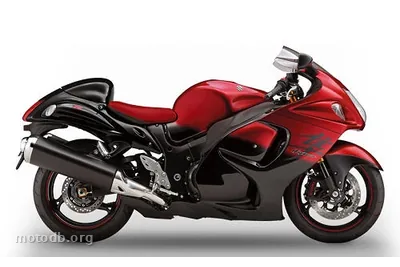
1300 GSX-R Hayabusa SE 50th anniversary
Reviews & comments
No reviews yet. Be the first to share your opinion!