Key performance
Technical specifications
Engine
- Displacement
- 1285 cc
- Power
- 205.0 ch @ 10500 tr/min (149.6 kW)
- Torque
- 144.6 Nm @ 8750 tr/min
- Engine type
- V2, four-stroke
- Cooling
- Liquid
- Compression ratio
- 12.6:1
- Bore × stroke
- 116.0 x 60.8 mm (4.6 x 2.4 inches)
- Valves/cylinder
- 4
- Camshafts
- 2 ACT
- Fuel system
- Injection. Twin injectors per cylinder. Full ride-by-wire elliptical throttle bodies.
- Valve timing
- Desmodromic valve control
- Starter
- Electric
Chassis
- Frame
- Monocoque Aluminium
- Gearbox
- 6-speed
- Final drive
- Chain (final drive)
- Clutch
- Slipper and self-servo wet multiplate clutch with hydraulic control
- Front suspension
- Öhlins NIX30 43mm fully adjustable USD fork with TiN treatment. Electronic compression and rebound damping adjustment with semi-active mode
- Rear suspension
- Fully adjustable Ohlins TTX36 unit. Electronic compression and rebound damping adjustment with semi-active mode. Adjustable linkage: Progressive/flat. Aluminium single-sided swingarm
- Front wheel travel
- 120 mm (4.7 inches)
- Rear wheel travel
- 130 mm (5.1 inches)
Brakes
- Front brakes
- Double disc. ABS. Floating discs. Four-piston calipers. Radially mounted.
- Rear brakes
- Single disc. ABS. Two-piston calipers.
- Front tyre
- 120/70-ZR17
- Front tyre pressure
- 2.30 bar
- Rear tyre
- 200/55-ZR17
- Rear tyre pressure
- 2.10 bar
Dimensions
- Seat height
- 830.00 mm
- Wheelbase
- 1437.00 mm
- Length
- 2070.00 mm
- Width
- 745.00 mm
- Height
- 1105.00 mm
- Fuel capacity
- 17.00 L
- Weight
- 190.50 kg
- Dry weight
- 166.50 kg
- New price
- 26 490 €
Overview
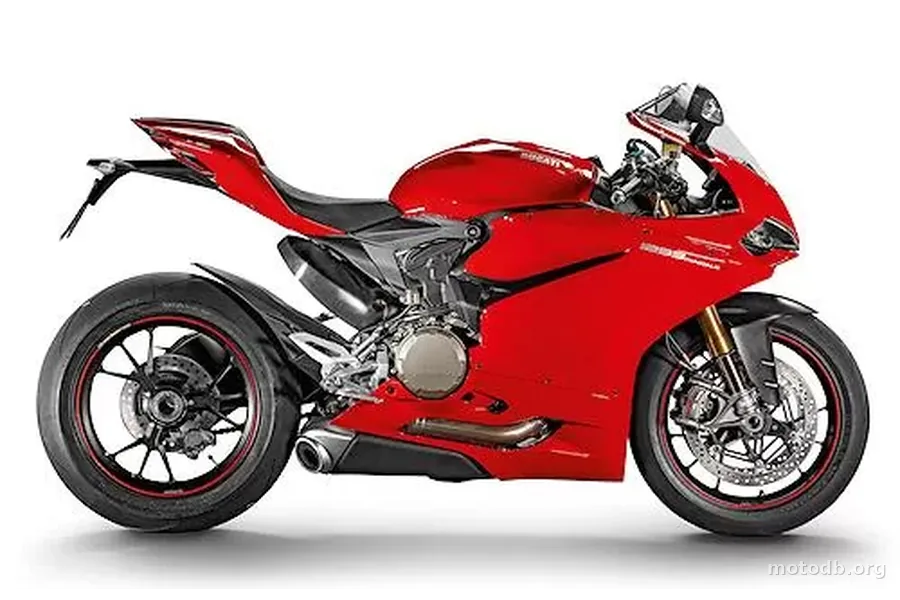
With the 1299 Panigale, Ducati breaks free from the limits of the Superbike and lets its engine revel in the intoxication of power. Previously, with 1199 cm3 and fighter jet technology, the Superquadro shattered all established benchmarks for the twin sport. And if Ducati added another 86 cm3, just to stuff it even more, with torque and horsepower everywhere!?! The engine is a monster. Imprisoned in the Ducati 1299 Panigale version S, it can indulge all sorts of fantasies for many track riders and enthusiasts of high-pedigree machines.
The 1299 Panigale S takes 2017 to benefit from improvements to the DTC and DWC, the traction control and wheelie control systems. Named EVO, these updates first appeared on the 1299 Panigale S Anniversario. Regarding the DTC Evo, it is optimized thanks to new algorithms, the electronics acting in a more precise way. It allows the rider to push the limits a little further, acting on the throttle butterflies in addition to ignition timing and injection, and allows level 1 more rear wheel slip freedom than before. The DWC Evo uses the IMU inertial unit to control wheelies and optimize acceleration. With its new software, it detects the frequency and intensity of the front wheels more precisely and intervenes in a suitable and precise manner.
The Panigale demands total commitment from its rider. The 1299 S goes further, allowing only the daring and those ready to sell their souls for its handlebars to approach. Taking control of a 205 horsepower Superbike with over 14 mkg requires a very serious technical background, composure, and a certain devotion. The S version presented here is enjoyed with an even higher degree of efficiency. For the aperitif, a carbon fiber front fender, fully LED headlights, and forged aluminum wheels signed Marchesini. For the main course, top-of-the-line semi-active Öhlins suspension. An inverted 43 mm NIX 30 fork, a TTX36 rear shock, and a steering damper.
Ducati S versions have carried Swedish components for many years; it is even their main characteristic. The previous Panigale S version, the 1199, was already equipped with piloted components. Small engines controlled by the onboard unit regulated compression and rebound depending on the driving modes chosen. On the 1299, the suspension is much more advanced. It offers two modes: constant electronic adjustment according to the driver's desire or semi-active to dynamically respond to the road profile. The Öhlins SMART EC system will heat up the neurons and high-voltage sport enthusiasts. The bike thinks for you, sensors replace the senses. Thus, in non-active piloted suspension mode, the driving mode (Race, Sport, or Wet) defines the level of intervention of the riding aids as well as the appropriate setting for the fork, the shock, and the steering damper tension. Everyone their own damping level and it remains until the pilot chooses another. Top for the track. On the road, surface changes are much more frequent and random. No problem, just switch to semi-active mode. Thanks to all the signals it receives, the Panigale 1299 S "sees" the road. It thus adjusts in real time the behavior of the damping while taking into account the "behavior level", from stiff to soft, wanted by the pilot.
Very beautiful hardware, under constant control of the electronics; Abundant on board. Whether it's the Panigale 1299 or the S, the list of modules is plentiful. Enough to freak out a geek. Let's draw a brief overview of the forces in play: - An ABS, the Bosch 9MP, executing its effort via Brembo M50 calipers. It also regulates cornering braking thanks to the onboard Inertial Measurement Unit. - The EBC, the engine braking control on 3 levels - The DTC Evo traction control, adjustable on 8 levels - The DQS shifter, allowing to upshift and downshift without touching the clutch lever - The DWC Evo wheelie control adjustable on 8 levels - and the Riding Modes, allowing to modify the character and the level of efficiency of the Panigale. They are programmed with pre-defined levels for each assistance. Race orders a direct response to the throttle and a maximum level of efficiency of the electronic crutches; Sport offers less radical performances, typified for road use; Wet drops the power to 120 hp and delivers it in a more considerate way, the DTC, DWC, ABS and EBC are calibrated for maximum safety. For the more advanced, it is possible to modify the parameters to extremely personalize the co-piloting. - As an option, you can indulge yourself with the DDA+ GPS, the data acquisition system coupled with the GPS.
Over-equipped, the Panigale also displays a striking design, which appeared with the first generation 1199. No more steel trellis but a maximum of parts anchored to the engine. A steering column held by a monocoque structure serving as an airbox and a minimalist frame, a column whose angle at 24° is recessed by 0.5° compared to the previous version. A captivating look in more than one way and an exacerbated sportiness. All this for only 166.5 kilograms, or 2.5 more than its predecessor.
Condemned to offer maximum riding pleasure to those who will / can ride it, the Ducati 1299 Panigale S has closed its doors to competition due to its too large displacement. It is the Panigale R that takes care of the explanations in Superbike. The prestige is not diminished. But pleasure comes at a price. Not just the one displayed before the euros; the one that incites you to surpass yourself and give yourself entirely to it. Don't believe you are the strongest! Its twin and its personality are more so.
M.B - Manufacturer Media
Standard equipment
- Assistance au freinage : ABS Bosch 9MP
Practical info
- La moto est accessible aux permis : A
Reviews & comments
No reviews yet. Be the first to share your opinion!