Key performance
Technical specifications
Engine
- Displacement
- 1099 cc
- Power
- 160.0 ch @ 9750 tr/min (117.7 kW)
- Torque
- 122.6 Nm @ 8000 tr/min
- Engine type
- Bicylindre en L à 90°, 4 temps
- Cooling
- liquide
- Compression ratio
- 12.5 : 1
- Bore × stroke
- 104 x 64 mm
- Valves/cylinder
- 4
- Camshafts
- 2 ACT
- Fuel system
- Injection
Chassis
- Frame
- treillis tubulaire en tube d'acier
- Gearbox
- boîte à 6 rapports
- Final drive
- Chaîne
- Front suspension
- Fourche téléhydraulique inversée Ø 43 mm, déb : 127 mm
- Rear suspension
- Mono-amortisseur, déb : 127 mm
Brakes
- Front brakes
- Freinage 2 disques Ø 330 mm, fixation radiale, étrier 4 pistons
- Rear brakes
- Freinage 1 disque Ø 245 mm, étrier 2 pistons
- Front tyre
- 120/70-17
- Rear tyre
- 190/55-17
Dimensions
- Seat height
- 820.00 mm
- Fuel capacity
- 15.50 L
- Dry weight
- 173.00 kg
- New price
- 17 195 €
Overview
When Bologna decides to turn a page, it doesn't do so halfway. The 999 had divided the purists with its angular shapes and frog-like appearance; its successor would have to repair the damage while carrying an unprecedented technical ambition. It is within this tense context that the Ducati 1098 arrived in 2007, then in an enhanced version for 2008, with a simple proposition: 160 horsepower in a 173 kg frame. For a Series L-twin, this is unheard of. The Yamaha R1 of the same era weighs 4 kg more for comparable power, and it receives its horsepower from a four-cylinder engine. Here, two large 104 mm bore pistons are enough to produce this result, thanks to an extended 64 mm stroke that brings the engine to 1099 cc and gives it a torque of 122.6 Nm at 8000 rpm. The character changes with the displacement: less nervous in the high revs than the previous 999 cc, more meaty in the mid-range, the Desmoquattro twin regains elasticity that makes it exploitable without being tamed.
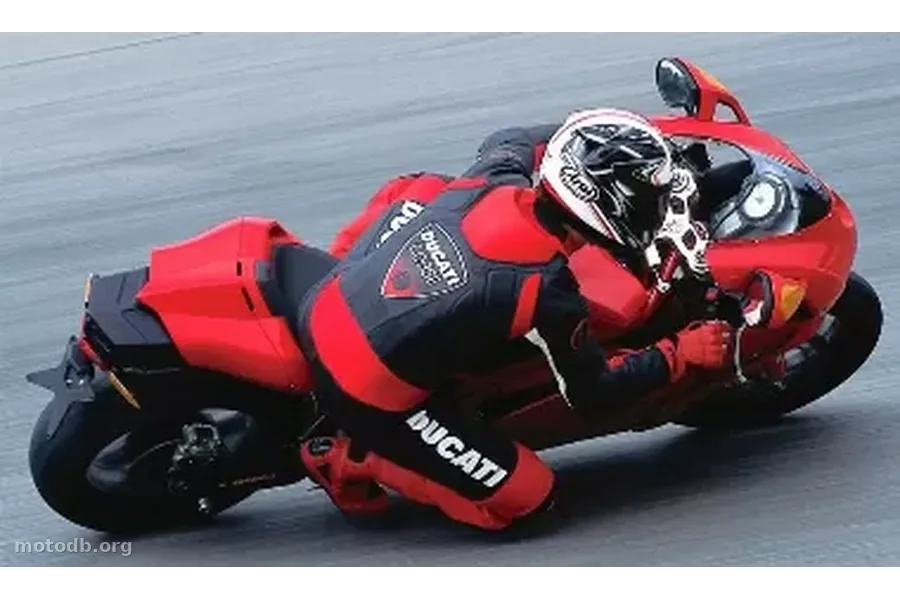
The tubular steel trellis frame, a hallmark of the house, evolves with tubes with revised diameters and lightweight walls. The result is paradoxical: stiffer, lighter. Engineers combed through every component, from the rims to the magnesium cylinder heads, to arrive at this dry weight of 173 kg that commands respect in the superbike category. The 43 mm inverted fork and the single shock absorber each offer 127 mm of travel, a setting designed for the track but usable on the road for those who accept to compromise with the firmness. The front calipers, monoblock machined aluminum like on the MotoGP Desmosedici, bite down on 330 mm discs with a frankness that deserves to be anticipated. The Ducati 1098 technical specifications confirm it: this machine is designed to go fast, not to spare the nerves.
The exterior envelope deserves attention, because it constitutes one of the strongest arguments of the machine. Bologna succeeds here what the 999 had not been able to do: create a drawing that reconciles the old and the new. We find nods to the 916, in the general silhouette and the way the fairing embraces the engine without stifling it. The double exhaust under the seat returns, the single-sided swingarm displays its muscular presence. The full digital instrumentation recalls the paddocks. It is no coincidence that the Ducati 1098 S, the enhanced version with Öhlins suspensions and forged rims, or the Ducati 1098 R pushed to over 180 horsepower in race homologation, immediately found their audience among pilots who frequent circuits. The Ducati 1098 SBK factory version exceeds 200 horsepower without forcing, which gives an idea of the available margin in the engine architecture.
At 17,195 euros at the new price, the Ducati 1098 price positions the machine in the high end of the segment, above a CBR1000RR or a GSX-R 1000, but below the R and S versions that climb significantly. On the Ducati 1098 used market, prices remain high for well-maintained examples, which testifies to a solid rating despite legitimate questions about Ducati 1098 reliability, particularly around the maintenance of the desmodromic components which require rigor and budget. The maximum speed announced at 300 km/h remains in the symbolic realm on public roads, but it places the machine in its universe: that of circuit hypersports dressed for the road, not the other way around.
What the Ducati 1098 does better than many of its contemporaries is to concentrate an entire philosophy into a coherent object. It doesn's try to please everyone. It addresses pilots who know what they are looking for, who accept the maintenance rigor and the tucked riding position on the 15.5-liter tank, and who want in return a mechanical authenticity that Japanese four-cylinder engines cannot offer. Between the 916 that preceded it and the Panigale that will succeed it, the Ducati 1098 occupies a singular position in the history of the brand: that of a machine that knew how to push the limits at the right time, without betraying the DNA that defines it.
Practical info
- La moto est accessible aux permis : A
Reviews & comments
No reviews yet. Be the first to share your opinion!