Key performance
Technical specifications
- Frame
- treillis tubulaire en tube d'acier → treillis tubulaire en tube d\'acier
Engine
- Displacement
- 1099 cc
- Power
- 160.0 ch @ 9750 tr/min (117.7 kW)
- Torque
- 122.6 Nm @ 8000 tr/min
- Engine type
- Bicylindre en L à 90°, 4 temps
- Cooling
- liquide
- Compression ratio
- 12.5 : 1
- Bore × stroke
- 104 x 64 mm
- Valves/cylinder
- 4
- Camshafts
- 2 ACT
- Fuel system
- Injection
Chassis
- Frame
- treillis tubulaire en tube d\'acier
- Gearbox
- boîte à 6 rapports
- Final drive
- Chaîne
- Front suspension
- Fourche téléhydraulique inversée Ø 43 mm, déb : 127 mm
- Rear suspension
- Mono-amortisseur, déb : 127 mm
Brakes
- Front brakes
- Freinage 2 disques Ø 330 mm, fixation radiale, étrier 4 pistons
- Rear brakes
- Freinage 1 disque Ø 245 mm, étrier 2 pistons
- Front tyre
- 120/70-17
- Rear tyre
- 190/55-17
Dimensions
- Seat height
- 820.00 mm
- Fuel capacity
- 15.50 L
- Dry weight
- 173.00 kg
- New price
- 17 195 €
Overview
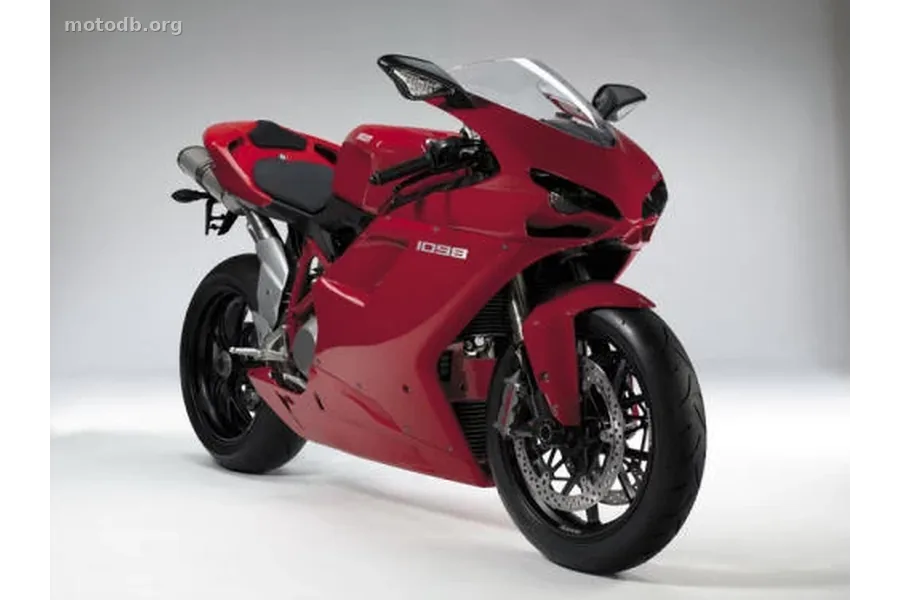
When Bologna decides to draw a line under a decade of frustration, it doesn's result in a timid evolution. It results in the Ducati 1098. In 2007, Ducati didn't tinker with its sporty twin; it rebuilt it from the ground up, with a clear ambition: to dominate Superbike before the SBK regulations officially allowed large-displacement twin-cylinder bikes. The result is a 1099 cc liquid-cooled L-twin, with magnesium cylinder heads, intake valves at 42 mm, a compression ratio boosted to 12.5:1, and a torque curve that hits hard from low RPM with 122.6 Nm at 8000 rpm. But the figure that really stings the Japanese four-cylinders is 160 horsepower at 9750 rpm. It was unprecedented for a production twin.
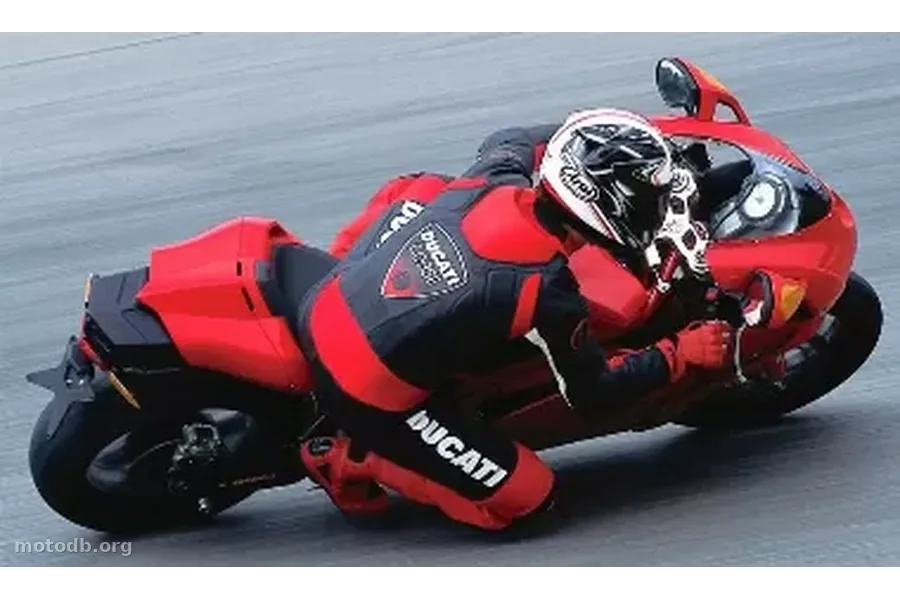
This engine, with a bore of 104 mm and a stroke of 64 mm, is no longer the extreme oversquare of the 999. It gains flexibility for what it cedes in revving ability, and the rider comes out on top on the road as well as on the track. The Ducati 1098 2007 weighs 173 kg dry, 4 kg less than a Yamaha R1 of the same year. It’s an engineering feat for a twin-cylinder that few competitors can claim. The steel trellis frame retains the house philosophy but with increased diameter tubes and thinned walls, resulting in a more rigid assembly for a controlled weight. The 43 mm Öhlins inverted fork, the single rear shock absorber, the aluminum monoblock calipers clamping 330 mm discs – everything here speaks the same dialect as the machines from the world championship. The announced Ducati 1098 top speed exceeds 300 km/h, a symbolic threshold that places the machine in a category of its own.
Stylistically, the 1098 settles accounts with the 999. The latter had divided enthusiasts with its polarizing design; its technology was recognized, but not its charm. The 1098, on the other hand, reconnects with something more instinctive, a taut line, an incisive nose, a fairing that flows smoothly to the rear monobrach. Certain angles recall the 916, and that was intentional. The all-digital dashboard, directly inspired by the MotoGP Desmosedici, sets the tone as soon as you straddle the 820 mm seat. It’s not a bike for leisurely rides; it’s a bike for performance. The Ducati 1098 S, with its standard Öhlins suspension and enhanced finishes, pushes the cursor even further. The Ducati 1098 S Tricolore, for its part, adds the collector's dimension that purists appreciate. The Ducati 1098 R, the homologation race version, is in another price and usage galaxy.
At 17,195 euros in the catalog, the new Ducati 1098 price was not cheap. It never claimed to be. This ultra-premium positioning initially filters its audience: experienced riders, capable of managing 160 horsepower on a sharpened chassis, without the electronic aids that would become the norm a few years later. It’s not a bike for beginners, nor even for occasional touring riders. It’s a pure sportbike, close to what the Ducati 1098 SBK entered on the circuits. Today, on the Ducati 1098 used market, well-maintained examples remain sought after. Ducati 1098 reliability is often questioned, and rightly so: the engine requires strict valve adjustment monitoring, and the timing belts are a factor not to be overlooked. But that’s the Ducati pact, assumed forever.
The 916 forged a legend. The 999 opened a technical parenthesis without ever truly inhabiting it. The Ducati 1098, on the other hand, closed that parenthesis with authority, laying the foundations for what would later become the Ducati 1098 Panigale a few years later. This name, 1098, has been etched in the memory of enthusiasts as a promise kept.
Practical info
- La moto est accessible aux permis : A
Reviews & comments
No reviews yet. Be the first to share your opinion!