Key performance
Technical specifications
Engine
- Displacement
- 1170 cc
- Power
- 95.0 ch @ 7250 tr/min (79.6 kW)
- Torque
- 116.0 Nm @ 6000 tr/min
- Engine type
- Two cylinder boxer, four-stroke
- Cooling
- Oil & air
- Compression ratio
- 12.0:1
- Bore × stroke
- 101.0 x 73.0 mm (4.0 x 2.9 inches)
- Valves/cylinder
- 4
- Camshafts
- 2 ACT
- Fuel system
- Injection. Electronic port fuel injection
- Valve timing
- Double Overhead Cams/Twin Cam (DOHC)
- Starter
- Electric
Chassis
- Frame
- Three-section frame consisting of one front and two rear sections, load-bearing engine- gearbox unit, removeable pillion frame for single ride use
- Gearbox
- 6-speed
- Final drive
- Shaft drive (cardan) (final drive)
- Clutch
- Single dry plate clutch, hydraulically operated
- Front suspension
- Telescopic forks with 43 mm fixed-tube diameter
- Rear suspension
- Cast aluminium single swinging arm with BMW Motorrad Paralever
- Front wheel travel
- 120 mm (4.7 inches)
- Rear wheel travel
- 120 mm (4.7 inches)
Brakes
- Front brakes
- Double disc. ABS. Four-piston calipers.
- Rear brakes
- Single disc. ABS. Floating disc. Two-piston calipers.
- Front tyre
- 120/70-ZR17
- Front tyre pressure
- 2.50 bar
- Rear tyre
- 180/55-ZR17
- Rear tyre pressure
- 2.90 bar
Dimensions
- Seat height
- 805.00 mm
- Wheelbase
- 1493.00 mm
- Length
- 2105.00 mm
- Width
- 884.00 mm
- Height
- 1240.00 mm
- Fuel capacity
- 17.00 L
- Weight
- 219.00 kg
- New price
- 14 690 €
Overview
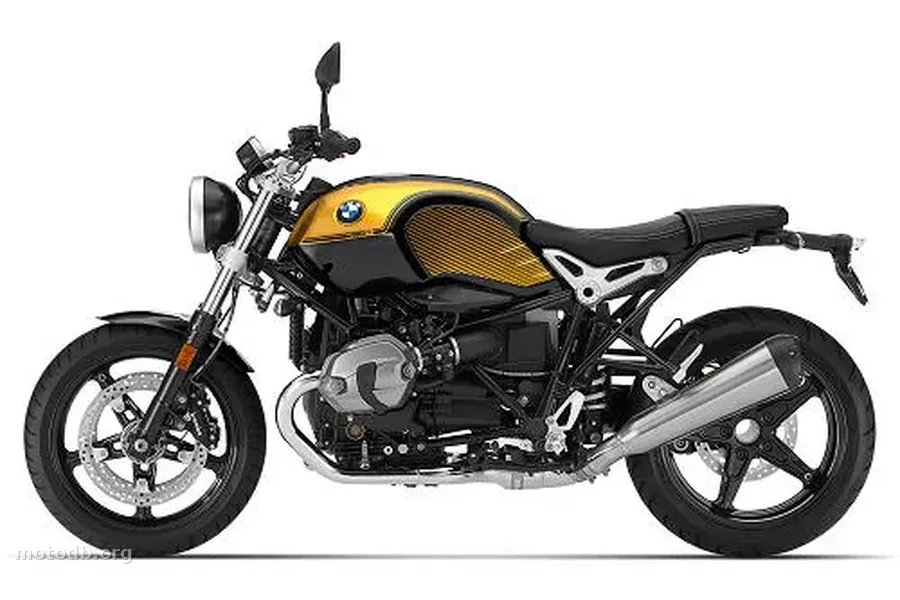
Where does the NineT begin? With the Pure. The most affordable, the simplest, the least powerful (in France), and the most customizable. However, that doesn’t mean it’s stripped down. Especially since 2021 brought it a significant update.
Let’s immediately see what we can identify at a glance. A stylish plate on the airbox, different cylinder head covers, and new switchgear. Let's examine the right-hand side – the new ‘Mode’ button will speed up understanding.
This is one of the new features that appeared across the entire NineT family: riding modes. There are two, 'Rain' and 'Road'. These are upgradable to a third 'Dyna', a more dynamic type, by tapping into the options corner. Another improvement is the braking system. ABS is in the Pro version, allowing it to distribute braking force based on the motorcycle’s lean angle. A USB port is included, as well as a rear suspension modification for more progressive action. Everyone will appreciate the remote preload adjuster.
But what prompted BMW to revise the entire Heritage range wasn’t so much the need to graft more electronics onto it as the need to bring it up to date and give it the pass for Euro5. The air-cooled boxer engine of the previous generation has therefore been revised accordingly. New cylinder heads optimize the air-fuel mixture and inflate the power and torque curves, especially in the mid-range. The maximum horsepower figure drops by one unit while peak torque remains unchanged... for most NineT models. The French Pure is not like the others. It will be marketed in a restricted A2 version. Therefore, with 95 horsepower in the tank instead of 109 and a little less torque. This opens the door for younger riders to obtain a NineT.
The list of options has also been adapted. The classic round headlight is packed with technology. Full LED, it can accommodate adaptive cornering lights. There are also heated grips, cruise control, Option 719 components, several types of rims, new colors, etc.
The changes didn't wait for the new model year. 2020 had already marked the Pure. BMW integrated ASC (Automatic Stability Control) as standard equipment.
The Pure carries its name for a reason. It aims to be streamlined, essential, and authentic, returning to the basics of the classic roadster. Indeed, it appears to be; and when comparing it to the more premium NineT, you can feel the difference. Not necessarily in a good way. Ciao to the inverted fork borrowed from the S 1000 RR, radial calipers, aluminum tank, double exhaust and spoked rims. We have just listed the essentials that differentiate a NineT from the Pure, and the latter seems to descend from the high-end rung. But if it's the spirit of this BM that interests you, you will do without these differences, just as you will pay little attention to the single instrument cluster, and the handlebar ends without aluminum counterweights. The design always has something to satisfy enthusiasts, and the Pure has managed to retain distinctive elements, such as the air intake covered with an anodized aluminum cover, and the stylized plates under the seat.
No surprises on the chassis side, the Pure having taken care to retain the 3-section steel tubular structure. With the possibility of removing the passenger frame, customization will be at the heart of discussions. That's for the garage, evenings, and weekends. For the day and the road, we will use the standard 43 mm fork and Paralever rear system more often. The Pure announcing a slightly longer wheelbase than the NineT but a lower weight, we will find a very similar behavior, although a little less sporty. The braking system offers standard Brembo services at this level of range, counting at the end of its braided hoses 3 brake calipers and as many discs. The front consists of two 320 mm floats bitten by axial 4-piston calipers; the rear relies on a 265 mm disc and a 2-piston caliper.
Entry-level model in the BMW Heritage clan, the R NineT Pure aims to be a simple, stripped-down roadster, using simplicity to allow others' creativity to invade it. A source of inspiration machine, in short. Like the Urban G/S model, it is derived from the NineT Scrambler. And cannot claim preferential titles like the first NineT. The Pure has shed a number of chic elements – doing so, its price reflects it.
M.B - manufacturer images
Standard equipment
- Assistance au freinage : ABS de série
- Poignées chauffantes
Practical info
- Véhicule accessible au permis A2 ou bridable à 47.5ch / 35 Kw
- La moto est accessible aux permis : A, A2
Indicators & positioning
Similar bikes
Speed Triple 1200 RR Bond Edition
Reviews & comments
No reviews yet. Be the first to share your opinion!