Key performance
Technical specifications
- Power
- 110.0 ch @ 7750 tr/min (35.0 kW) → 125.0 ch @ 7750 tr/min (90.1 kW)
- Torque
- 120.0 Nm @ 6000 tr/min → 125.0 Nm @ 6500 tr/min
- Cooling
- Oil & air → Liquid
- Compression ratio
- 12.0:1 → 12.5:1
- Fuel system
- Injection. Electronic intake pipe injection/BMS-K digital engine management with overrun fuel cut-off, twin spark ignition → Injection. Electronic intake pipe injection/BMS-K digital engine management with electromotive throttle actuator
- Frame
- Two-section frame consisting of front and rear sections, load- bearing engine-gearbox unit → Twin-section frame, front- and bolted on rear frame,load-bearing engine
- Clutch
- Single dry plate clutch, hydraulically operated → Oil lubricated clutch, hydraulically operated
- Rear suspension
- Cast aluminium single-sided swing arm with BMW Motorrad Paralever → Cast aluminium single swingarm with BMW Motorrad Paralever
- Front brakes
- Double disc. Optional integral ABS. Can be switched off. → Double disc. Floating discs. Four-piston calipers.
- Rear brakes
- Single disc. Optional integral ABS. Can be switched off. → Single disc. Floating disc. Two-piston calipers.
- Front tyre
- 110/80-R19 → 120/70-R19
- Rear tyre
- 150/70-R17 → 170/60-R17
- Width
- 915.00 mm → 953.00 mm
- Weight
- 229.00 kg → 238.00 kg
- Dry weight
- 203.00 kg → —
- New price
- 14 400 € → 15 450 €
Engine
- Displacement
- 1170 cc
- Power
- 125.0 ch @ 7750 tr/min (90.1 kW)
- Torque
- 125.0 Nm @ 6500 tr/min
- Engine type
- Two cylinder boxer, two-stroke
- Cooling
- Liquid
- Compression ratio
- 12.5:1
- Bore × stroke
- 101.0 x 73.0 mm (4.0 x 2.9 inches)
- Valves/cylinder
- 4
- Camshafts
- 2 ACT
- Fuel system
- Injection. Electronic intake pipe injection/BMS-K digital engine management with electromotive throttle actuator
- Valve timing
- Double Overhead Cams/Twin Cam (DOHC)
- Lubrication
- Dry sump
- Starter
- Electric
Chassis
- Frame
- Twin-section frame, front- and bolted on rear frame,load-bearing engine
- Gearbox
- 6-speed
- Final drive
- Shaft drive (cardan) (final drive)
- Clutch
- Oil lubricated clutch, hydraulically operated
- Front suspension
- BMW Motorrad Telelever
- Rear suspension
- Cast aluminium single swingarm with BMW Motorrad Paralever
- Front wheel travel
- 190 mm (7.5 inches)
- Rear wheel travel
- 200 mm (7.9 inches)
Brakes
- Front brakes
- Double disc. Floating discs. Four-piston calipers.
- Rear brakes
- Single disc. Floating disc. Two-piston calipers.
- Front tyre
- 120/70-R19
- Front tyre pressure
- 2.50 bar
- Rear tyre
- 170/60-R17
- Rear tyre pressure
- 2.90 bar
Dimensions
- Seat height
- 850.00 mm
- Wheelbase
- 1507.00 mm
- Length
- 2210.00 mm
- Width
- 953.00 mm
- Height
- 1450.00 mm
- Fuel capacity
- 20.00 L
- Weight
- 238.00 kg
- New price
- 15 450 €
Overview
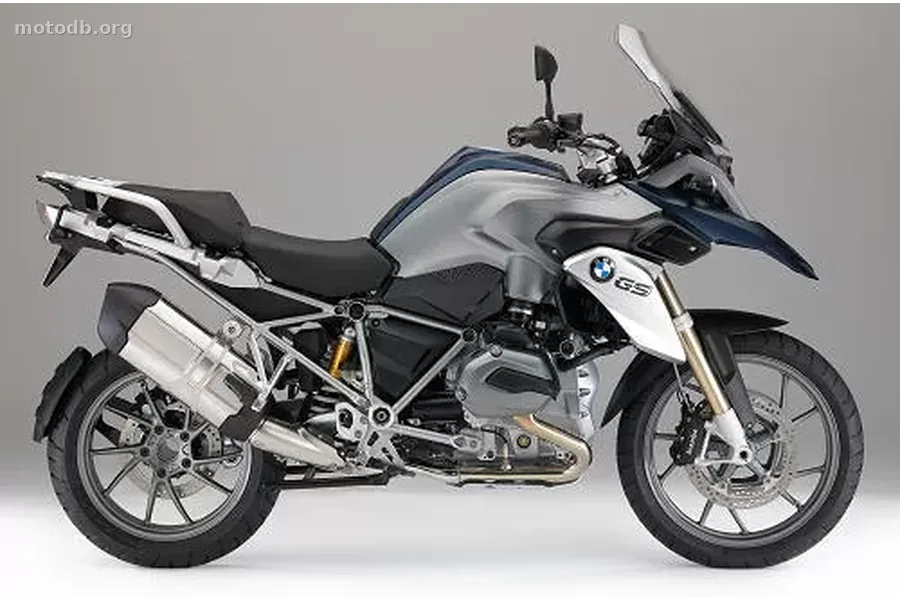
Gelände Straße. Two words German that few people know, but whose initials have redrawn the map of the motorcycle world for millions of riders. Since the R 80 G/S, BMW has maintained the same course: to build a machine capable of swallowing the highway in the morning and biting into the rocky track in the afternoon. But in 2013, the Bavarian brand crossed a Rubicon that many considered impossible, almost sacrilegious. The flat-twin, this air-cooled boxer for so long, traded its fins for radiators. Not entirely, that's where the genius of the operation lies: the new engine combines both technologies, liquid cooling handling the cylinder heads and the most thermally stressed areas, while the fins—still present—continue their supporting work. The visual result is almost deceptive. One might believe it to be a simple restyling, as Munich engineers have preserved the characteristic boxer silhouette. This camouflage comes at a cost of 2.7 kilograms, due to emissions regulations.
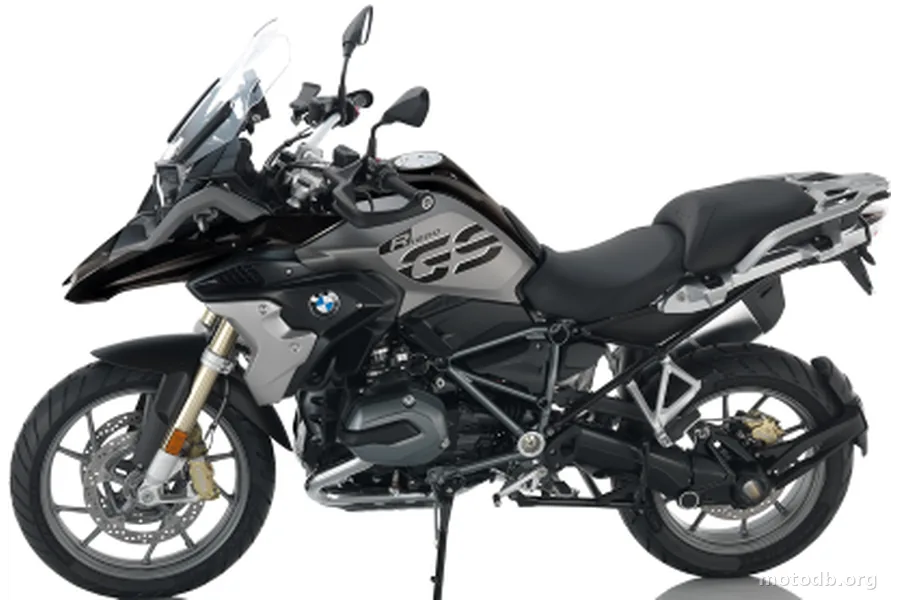
Under this familiar hood, the mechanics have been turned inside out. The 6-speed gearbox, formerly housed separately according to a distinct BMW tradition, is now integrated into the engine cases. The 180 mm dry single-plate clutch has been replaced by a 147 mm multi-plate wet clutch with an anti-dribble system. The crankshaft has been lightened and stiffened, the valves widened by one millimeter, the compression ratio increased from 12:1 to 12.5:1, and injection increased to 52 mm. On paper, the bore-stroke dimensions have not changed by a tenth, still 101 x 73 mm for 1170 cc. In reality, the BMW R 1200 GS now delivers 125 horsepower at 7750 rpm and 125 Nm at 6500 rpm, fifteen horsepower more than the previous generation. Not a revolution in raw figures, but a profound transformation of engine character: more responsive, more linear, more robust for long distances.
The chassis has undergone the same fundamental treatment. Telelever has seen its steering tube diameters go from 41 to 37 mm—counterintuitive, but the 42-degree steering angle is maintained despite the side radiators. Paralever, third generation, has been exchanged with the exhaust: the muffler moves to the right, which prevents the rider from burning their shin or forearm during off-road maneuvers. Tires adopt wider sections, 120/70-R19 at the front and 170/60-R17 at the rear, with correspondingly widened rims. The dual floating disc brakes with four-piston calipers do their job seriously, the standard ABS managing extreme situations. For those seeking the best tires for a BMW R 1200 GS in mixed use, the original fitments constitute a solid base upon which to progress.
The electronic arsenal is where the 2014 BMW R 1200 GS truly breaks with previous models like the 2011 or 2008 BMW R 1200 GS. Ride-by-wire opens the door to five riding modes: "Rain" and "Road" standard since 2014, "Dynamic," "Enduro," and "Enduro Pro" optionally via the Pro Riding Modes pack. The latter mode deactivates rear ABS on demand, allows controlled slip, and transforms the GS into a machine for experienced enduro riders. Coupled with the dynamic ESA semi-active suspension, the motorcycle adapts its damping in real time according to the terrain and selected mode. Facing the Ducati Multistrada and its Skyhook or the KTM 1190 Adventure, BMW responds point by point, with a mechanical coherence that few manufacturers achieve. The downside remains the same for years: options accumulate and the catalog price quickly rises above the base price of 15,450 euros.
With 238 kilograms all fueled up, a seat at 850 mm, a 20-liter tank, and a top speed of 200 km/h, the BMW R 1200 GS is intended for the grand traveler as much as for the rider seeking sensations off the asphalt. It is not a motorcycle for beginners, even if its modular ergonomics and electronic aids broaden the spectrum of users. On the used market, a used BMW R 1200 GS from this year remains a safe bet, provided you check the maintenance history and the condition of the BMW R 1200 GS accessories often added by successive owners. The competition has strengthened its ranks since then, but this liquid-cooled generation has laid foundations that subsequent versions, up to the 2020 BMW R 1200 GS, have not fundamentally questioned.
Standard equipment
- Assistance au freinage : ABS de série
- Poignées chauffantes
Practical info
- La moto est accessible aux permis : A
Indicators & positioning
Similar bikes
Stelvio 1200 8V
Reviews & comments
No reviews yet. Be the first to share your opinion!