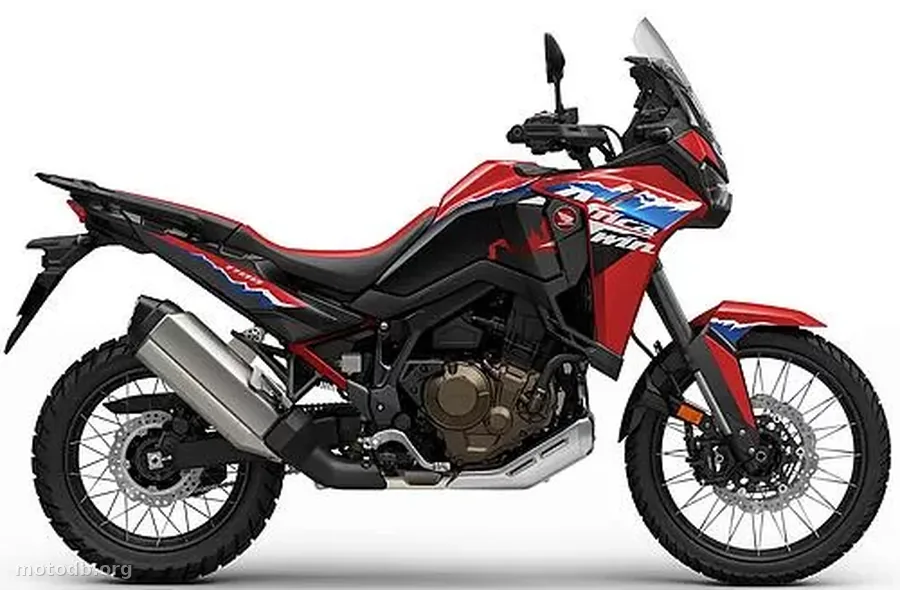
Key performance
Technical specifications
Engine
- Displacement
- 1084 cc
- Power
- 102.0 ch @ 7500 tr/min (75.0 kW)
- Torque
- 112.0 Nm @ 5500 tr/min
- Engine type
- Bicylindre en ligne, 4 temps, calé à 270°
- Cooling
- liquide
- Compression ratio
- 10.5 : 1
- Bore × stroke
- 92 x 81.5 mm
- Valves/cylinder
- 4
- Camshafts
- 1 ACT
- Fuel system
- Injection Ø 46 mm
- Ignition
- Full transistorized ignition
- Starter
- électrique
- Euro standard
- Euro 5+
Chassis
- Frame
- Double poutre + simple berceau dédoublé en acier
- Gearbox
- boîte à 6 rapports
- Final drive
- Chaîne
- Clutch
- Wet, multiplate with coil springs, aluminium cam assist and slipper clutch, DCT 2 wet multiplate clutches with coil springs
- Front suspension
- Fourche téléhydraulique inversée Ø 45 mm, déb : 230 mm
- Rear suspension
- Mono-amortisseur, déb : 220 mm
Brakes
- Front brakes
- Freinage 2 disques Nissin Ø 310 mm, fixation radiale, étrier 4 pistons
- Rear brakes
- Freinage 1 disque Ø 256 mm, étrier simple piston
- Front tyre
- 90/90-21
- Front tyre pressure
- 2.25 bar
- Rear tyre
- 150/70-18
- Rear tyre pressure
- 2.50 bar
Dimensions
- Seat height
- 850.00 mm
- Seat type
- Selle biplaces
- Wheelbase
- 1575.00 mm
- Ground clearance
- 220.00 mm
- Fuel capacity
- 18.80 L
- Weight
- 231.00 kg
- New price
- 14 999 €
Overview
In 2026, the DCT gearbox is no longer available on the Africa Twin; only the Adventure Sports version can be equipped with it. This shouldn’t impact its success, as Africa Twins are everywhere. Honda can be proud of its large trail bike, which perpetuates an image forged in the heyday of rally-raids. In 2024, Honda’s star has seen a few changes; slight cosmetic updates and a bit more pronounced technical refinements.
Rest assured, the AT 1100 retains the design that defines its identity and strength. Only the face has been very subtly retouched. What’s most interesting is the larger windscreen, a guarantee of better protection for this adventurer at heart. 5 adjustment possibilities are available to the rider.
Within the engine, the airflow has optimized its path. The displacement remains 1084 cm3 but with an increased compression ratio, larger intake ducts, repositioned injection bodies, and new settings in the ECU, the twin gains 7% of torque, totaling 11.4 Nm; moreover, obtained 750 rpm earlier. This work also provides more consistency in the low and mid ranges. Power hasn’t changed; its 102 horsepower proves more than sufficient in all situations.
The most significant evolution of this update is certainly the arrival of semi-active Showa EERA suspensions. Previously reserved for the Adventure Sports version, this system allows you to enjoy automatically reactive damping to the sinking speed of the suspensions. Various sensors inform the electronic control unit, which then sends adjustment instructions to the 45 mm inverted fork and the Pro-Link shock absorber. The servo-motors react in just 15 milliseconds; that's 10 times faster than a blink of an eye.
5 suspension modes are available: -MID offers versatile settings, suitable for most situations. This mode is automatically active in URBAN riding mode. -HARD exploits the hardest damping force throughout the range to meet the requirements of riding with a passenger and luggage. This mode is automatically active in TOUR mode. -SOFT presents the lowest damping force for comfortable and reassuring reactions. This mode is automatically active in GRAVEL mode. -OFF-ROAD gradually increases the damping force as the front fork sinks, primarily using the hardest settings at the rear. This mode is automatically active in OFF-ROAD mode. - As for the "USER" option, it allows for a personalized adjustment of the damping force according to the riding style. Thus, 24 levels are available for spring preload, both front and rear.
The electronic driver assistance systems also benefit from a slight refinement, especially in terms of traction control (of torque for Honda). The Africa Twin 1100 also features tubeless rims and a lighter, more compact lithium-ion battery.
But let's return to the standard version, which already handles a lot of electronics. When it became the 1100, the Africa Twin was swept along by the current of omnipresent assistance systems. The rider will immediately notice this when discovering the color TFT screen. A beautiful touchscreen tablet is packed with information, in a 6.5-inch format, featuring Apple CarPlay, Bluetooth, a clean and clear layout, and customization possibilities. That was the appetizer. The rest is a real buffet. For example, the turn signals have automatic shut-off and also have a quick-operation function during sudden braking. The AT 1100 is equipped with a cruise control, an ABS active in corners, and a 6-axis inertial unit. This allows it to enrich its torque control with 4 power levels and 3 engine braking sides. There are 7 settings available for the anti-wheelspin, improved thanks to the IMU data. There is also an anti-stoppie and a wheelie control at 3 levels: 1 to let the stunt express itself, 2 to moderate the rear wheel, 3 to keep the front wheel on the ground regardless of the accelerator agitation. Finally, the electronics are supervised by 6 riding modes, two of which are customizable. Between "Tour", "Urban", "Gravel" and "Off-road", the computers know how to adapt to most uses. The "User" modes will satisfy more exclusive uses. More details below for the curious *.
If we add the piloted suspensions to that, we realize that the Africa Twin 1100 has become a monster of technology. Too much perhaps? Submerged in assistance, the Honda of raids still plays a small nod to the essentials of the globetrotter. Under the 16.5 cm high-tech screen, a mini dashboard provides the essentials with the speed, the gear engaged and the trip kilometer. The top would be to have the screen above removable to replace it with a roll-out road book.
Details of the riding modes:
-TOUR: for use with a passenger and luggage; Maximum power level (1), engine braking at level 2 and cornering ABS activated; -URBAN: responds to most situations; Intermediate power level (2), engine braking at level 2 and cornering ABS activated. -GRAVEL: use on track/TT. Minimum power level (4), weak engine braking (3), cornering ABS activated but all-terrain specific settings. In this configuration, ABS cannot be disconnected on the rear wheel. -OFF-ROAD: intermediate power level (3), weak engine braking (3), cornering ABS activated but all-terrain specific settings. ABS can be disconnected on the rear wheel. -USER 1 & 2: allows the rider to define two distinct custom settings. He can then choose his power level (between 1 and 4) and his engine braking level (between 1 and 3) as well as the type of intervention of the ABS (road/all-terrain parameters).
It's almost surprising and paradoxically reassuring to see the steel backbone of the 1100 CRF. But that's what's most indicated as a frame for the use it is destined for. Its 21 and 18 inch spoke rims are fitted with mixed tires with dimensions of 90/90 – 21 and 150/70 – 18. Their hubs are garnished with a pair of 310 mm discs at the front and a 256 mm disc at the rear. The 4-piston radial calipers will know how to do the job. Consistent with calming 231 kilos ready to roll.
Honda continues to improve its star trail with small touches. Desires remain, the physique certifies it, and technology fans will delight in the plethora of driver assistance systems that the trail carries. All this at a price, starting around 15,000 euros.
To enhance it, several packs are available, with themes very focused on satisfying the various tastes of escape. The "Rally" contains a quickshifter, wider footrests, engine protection and a radiator grille. With the "Adventure", we target raids with high crashbars, a duo of additional headlights, a 4.5-liter tank bag and side stickers to protect the tank. The "Travel" aims, as its name suggests, travel: aluminum or plastic cases welcome 70 liters of capacity with specific bags, accompanied by "comfort" footrests. Finally, the city is targeted with the "Urban" pack, consisting of a center stand and a top case - either in aluminum of 42 liters or in plastic of 58 liters with passenger backrest.
M.B - Manufacturer photos
Standard equipment
- Assistance au freinage : ABS
- Nombre de mode de conduite : 6
- Taille de l'écran TFT couleur : 16,51 cm / 6.5 pouces
- ABS Cornering
- Jantes à rayon
- Indicateur de vitesse engagée
- Régulateur de vitesse
- Bluetooth
- Contrôle de couple
- Contrôle anti wheeling
- Embrayage anti-dribble
- Contrôle du frein moteur
Practical info
- La moto est accessible aux permis : A
- Pays de fabrication : Japon
Reviews & comments
No reviews yet. Be the first to share your opinion!