Key performance
Technical specifications
Engine
- Displacement
- 999 cc
- Power
- 212.0 ch @ 13000 tr/min (149.6 kW)
- Torque
- 113.0 Nm @ 11000 tr/min
- Engine type
- In-line four, four-stroke
- Cooling
- Liquid
- Compression ratio
- 13.5:1
- Bore × stroke
- 80.0 x 49.7 mm (3.1 x 2.0 inches)
- Valves/cylinder
- 4
- Camshafts
- 2 ACT
- Fuel system
- Injection. Electronic fuel injection with ride-by-wire throttle system, variable intake, and knock sensor
- Valve timing
- Double Overhead Cams/Twin Cam (DOHC)
- Lubrication
- Wet sump
- Starter
- Electric
Chassis
- Frame
- Bridge-type frame, cast aluminum, load-bearing engine
- Gearbox
- 6-speed
- Final drive
- Chain (final drive)
- Clutch
- Multiplate clutch in oil bath, slipper clutch
- Front suspension
- Upside-down telescopic forks, slider tube diameter 45 mm spring preload, rebound and compression stage adjustable
- Rear suspension
- Aluminium beam double-sided swinging arm with central spring strut, spring preload, rebound and compression stage adjustable
- Front wheel travel
- 120 mm (4.7 inches)
- Rear wheel travel
- 118 mm (4.6 inches)
Brakes
- Front brakes
- Double disc. ABS. Floating discs. Four-piston calipers.
- Rear brakes
- Single disc. ABS. Floating disc. Two-piston fixed caliper.
- Front tyre
- 120/70-ZR17
- Front tyre pressure
- 2.50 bar
- Rear tyre
- 200/55-ZR17
- Rear tyre pressure
- 2.90 bar
Dimensions
- Seat height
- 832.00 mm
- Wheelbase
- 1457.00 mm
- Length
- 2073.00 mm
- Width
- 848.00 mm
- Height
- 1151.00 mm
- Fuel capacity
- 16.50 L
- Weight
- 192.00 kg
- Dry weight
- 192.00 kg
- New price
- 33 270 €
Overview
Imagine what would happen if an engineer from the M GmbH subsidiary, the one that transforms Bavarian sedans into projectiles capable of humiliating Porsches on the track, decided one beautiful morning to tackle a motorcycle. The result bears three letters on its flank and is called the BMW M 1000 RR. Not just another sportbike in the lineup. A statement of intent.
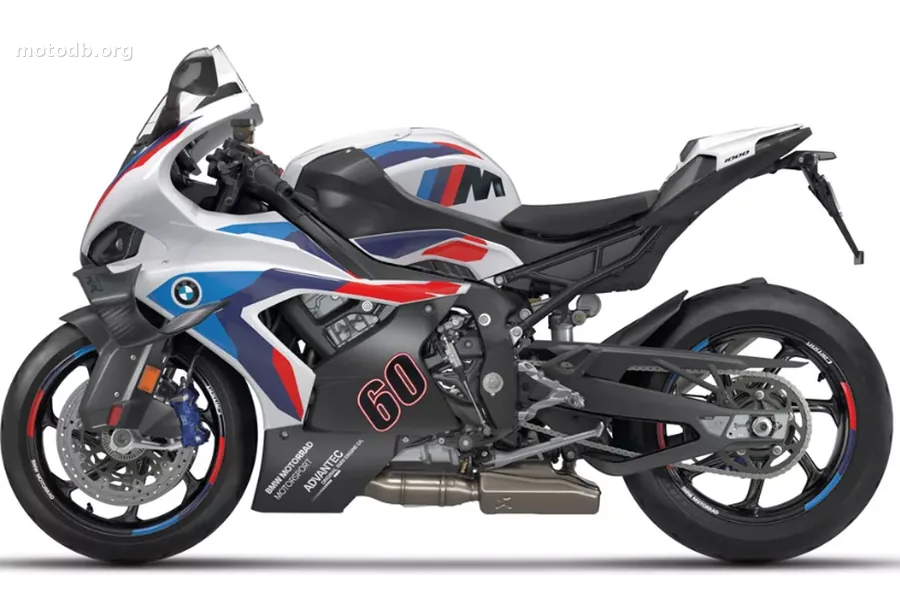
The inline four-cylinder engine with a displacement of 999 cc hasn't simply been tweaked; it has been rebuilt from the inside out. Forged, lightweight pistons, titanium connecting rods, a compression ratio increased to 13.5:1, an optimized ShiftCam system: every gram saved serves to release even more energy. The quantified result is 212 horsepower at 13,000 rpm and 113 Nm of torque at 11,000 rpm. Five horsepower more than the base S 1000 RR, which may seem modest given the work involved. But the logic isn't solely road-focused. BMW has pushed the maximum allowable rev limit because the World Superbike regulations index that of the competition version based on the production engine. Homologated, the M allows its track avatar to seek additional performance. The road is just a pretext; the stopwatch is the objective.
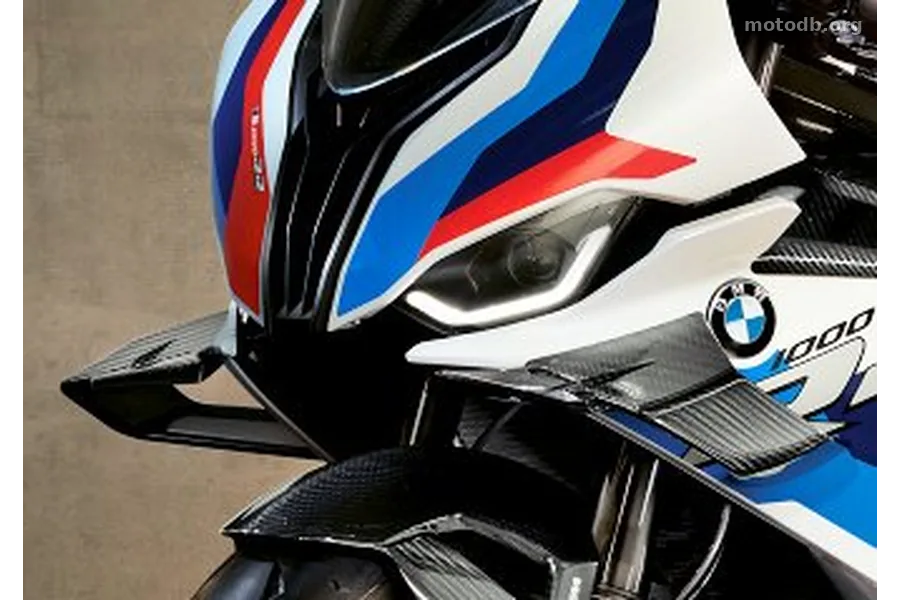
Visually, the machine doesn't seek to seduce; it seeks to intimidate. The carbon winglets on the front flanks aren't there for style: at 200 km/h they exert 5.9 kg of downforce on the front end, a figure that rises to 13.4 kg past 300 km/h. That's useful, even if Ducati masters this exercise better with its Panigale V4 R, which generates up to 30 kg of downforce. BMW also works with the tall screen and the overall aerodynamics of the bodywork to shave off 0.5 to 0.7 seconds per lap. On a 25-lap run, the addition becomes serious. The wheelbase, extended to 1,457 mm, the increased rake, and the swingarm lengthened by 12 mm all participate in the same logic: missile-like stability rather than the nervous agility of a compact supersport.
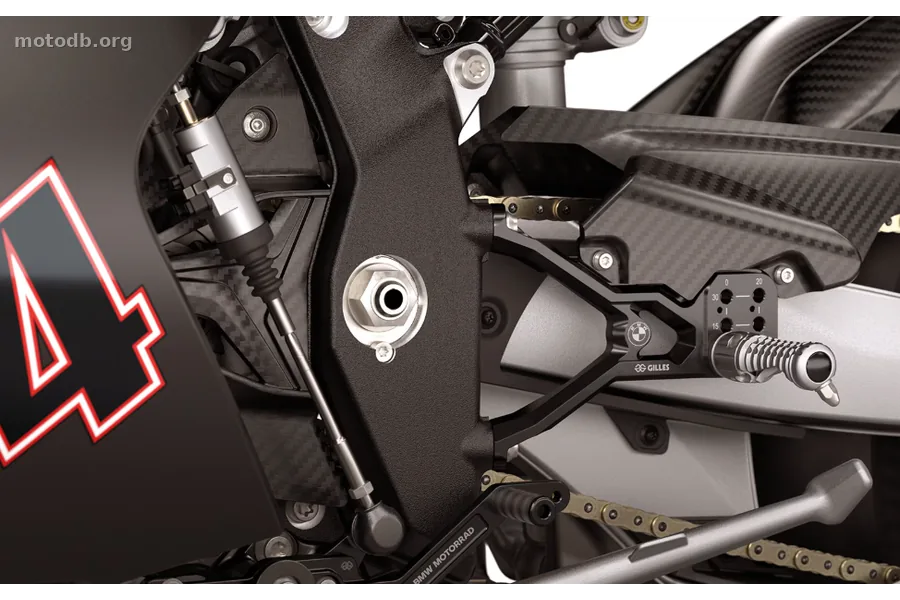
The landing gear deserves attention. Rather than the traditional Öhlins forks found on the high-end competition, BMW has reworked the 45 mm Marzocchi inverted fork with extended adjustment ranges and a 6 mm increase in stroke. At the braking point, exit Brembo and its Stylema R calipers. The new four-piston radial calipers developed with Nissin weigh 60 grams less than those of the S, clamp 5 mm-thickened 320 mm discs, and feature blue anodizing that divides aesthetic opinions, but not performance. The total weight announced is 192 kg, a figure that warrants attention: the internal improvements theoretically represent more than 7 kg of savings, but the displayed gap with the S 1000 RR remains unclear. BMW has not clearly answered this arithmetic.
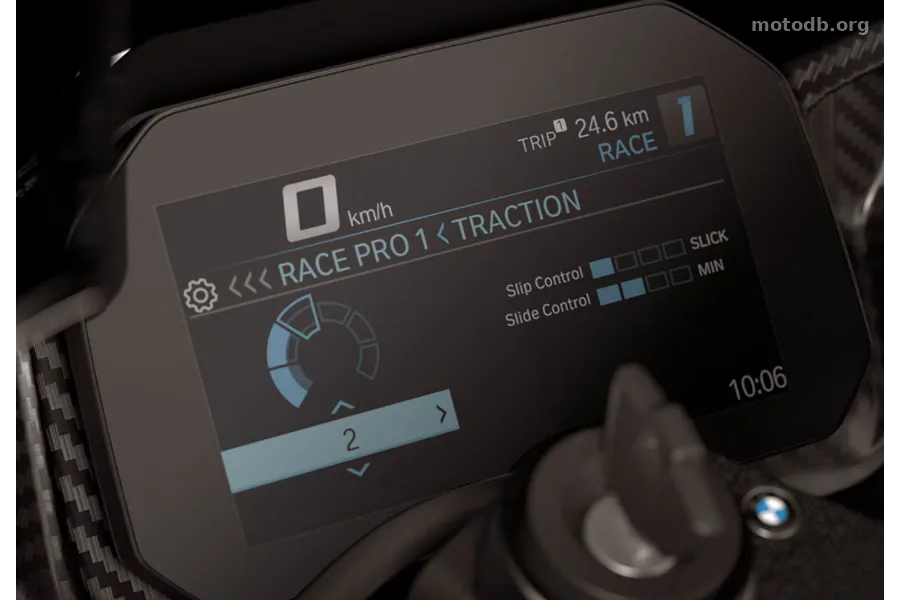
At €33,270, the BMW M 1000 RR delivers carbon rims, cruise control, and heated grips as standard. The seven riding modes, the six-axis inertial unit, launch control, curved ABS, and wheelie control are part of the electronic package at no extra cost. On the other hand, the carbon fairings, GPS telemetry, and adjustable footrests remain in the accessories catalogs. For an object produced in a minimum of 500 units and designed for competition, this is a consistent pricing policy but leaves a sense of incompleteness. The BMW M 1000 RR is an authentic track tool, homologated for road use by regulatory necessity. Its audience is not the Sunday tourist or the urban commuter. It is the demanding amateur rider, the one who prepares his track weekends with the same rigor as a professional, and who accepts paying the price of a machine first and foremost designed for the stopwatch.
Standard equipment
- Assistance au freinage : ABS Pro
- Poignées chauffantes
Practical info
- La moto est accessible aux permis : A
Reviews & comments
No reviews yet. Be the first to share your opinion!