Key performance
Technical specifications
Engine
- Displacement
- 999 cc
- Power
- 212.0 ch @ 14500 tr/min (154.7 kW)
- Torque
- 113.0 Nm @ 11000 tr/min
- Engine type
- In-line four, four-stroke
- Cooling
- Liquid
- Compression ratio
- 13.3:1
- Bore × stroke
- 80.0 x 49.7 mm (3.1 x 2.0 inches)
- Valves/cylinder
- 4
- Camshafts
- 2 ACT
- Fuel system
- Injection. Electronic fuel injection with ride-by-wire throttle system, variable intake, and knock sensor
- Valve timing
- Double Overhead Cams/Twin Cam (DOHC)
- Lubrication
- Wet sump
- Starter
- Electric
Chassis
- Frame
- Aluminium composite bridge frame, engine supported
- Gearbox
- 6-speed
- Final drive
- Chain (final drive)
- Clutch
- Multiplate clutch in oil bath, anti-hopping clutch, mechanically controlled
- Front suspension
- Upside-down telescopic forks, slider tube diameter 45 mm spring preload, rebound and compression stage adjustable
- Rear suspension
- Aluminium beam double-sided swinging arm with central spring strut, spring preload, rebound and compression stage adjustable
- Front wheel travel
- 120 mm (4.7 inches)
- Rear wheel travel
- 118 mm (4.6 inches)
Brakes
- Front brakes
- Double disc. ABS. Floating discs. Four-piston calipers.
- Rear brakes
- Single disc. ABS. Floating disc. Two-piston fixed caliper.
- Front tyre
- 120/70-ZR17
- Front tyre pressure
- 2.50 bar
- Rear tyre
- 200/55-ZR17
- Rear tyre pressure
- 2.90 bar
Dimensions
- Seat height
- 832.00 mm
- Wheelbase
- 1457.00 mm
- Length
- 2073.00 mm
- Width
- 848.00 mm
- Height
- 1151.00 mm
- Fuel capacity
- 16.50 L
- Weight
- 197.00 kg
- Dry weight
- 170.00 kg
- New price
- 33 270 €
Overview
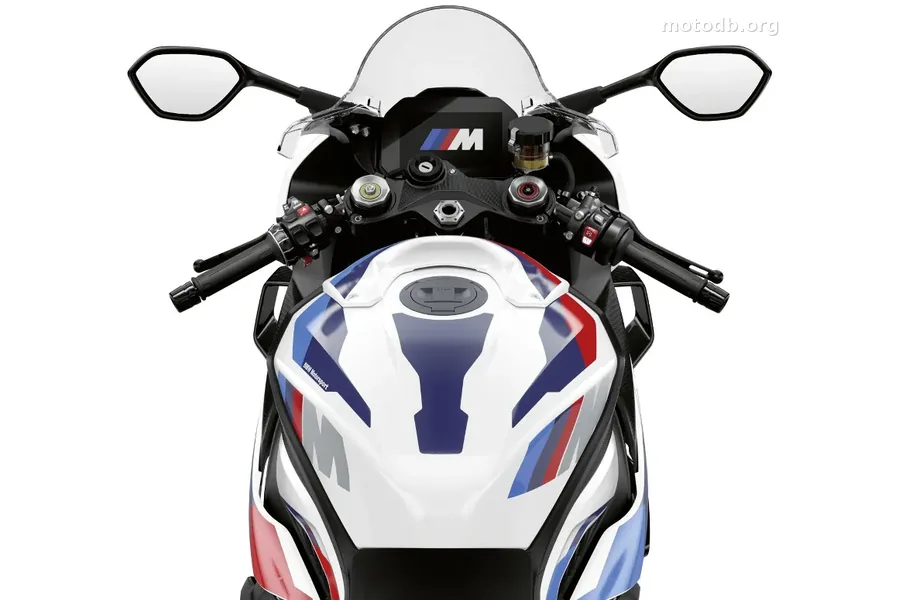
When BMW appends an “M” to something, the message is clear: forget comfort, forget compromise, put on your helmet. In the four-wheeled world, this letter transforms a sedan into a track-ready machine homologated for the road. On two wheels, the BMW M 1000 RR 2021 applies exactly the same logic, with the same assumed brutality.
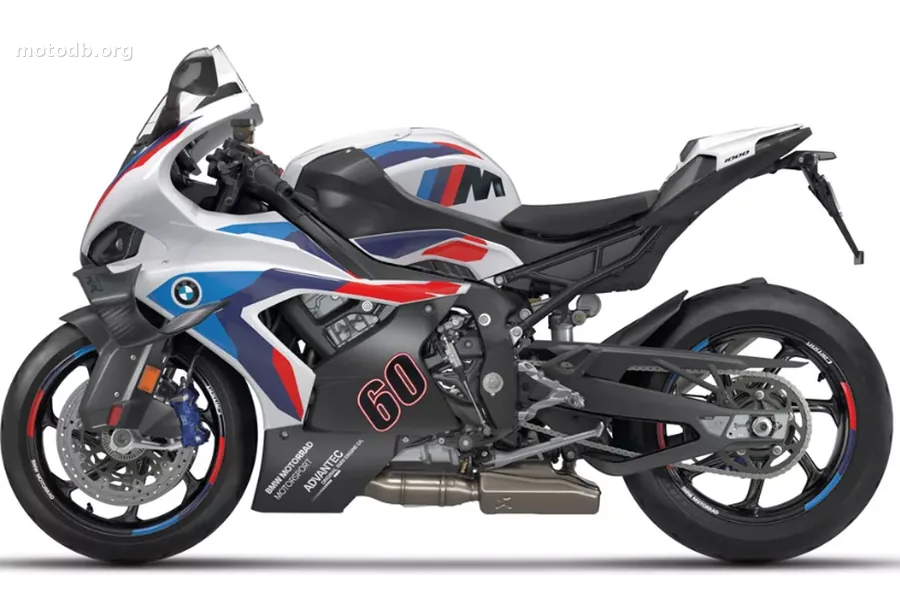
The inline four-cylinder engine with a displacement of 999 cc is not a superficial evolution. Forged Mahle pistons, Pankl titanium connecting rods, a compression ratio increased to 13.3:1, a revised Shiftcam distribution: every gram saved, every tenth of a millimeter of bore optimized converges on a single figure, 212 horsepower at 14,500 rpm. The maximum rev limit climbs to 15,100 rpm, not for sonic pleasure, but because the World Superbike regulations index the authorized rev limit in racing on that of the production machine. It's competitive strategy disguised as a spec sheet. Torque of 113 Nm at 11,000 rpm remains within the segment standard, but it is well above 200 km/h that the beast reveals its true character, with a top speed announced at 306 km/h. As for how many horsepower the BMW M 1000 RR has without its regulated catalytic converter, racing exhaust specialists readily mention 220 hp. The answer will come from the race tracks.
Facing a Ducati Panigale V4R that generates up to 30 kg of aerodynamic downforce, the M’s winglets display 13.4 kg at 300 km/h. Insufficient to claim the same level of cornering work, but sufficient to stabilize braking and reduce anti-wheelie stress, which allows more power to pass to the rear wheel. Aerodynamics is not just a marketing argument on this machine; it is an integral part of the WSBK strategy. Aprilia RSV4 and Honda CBR1000RR-R Fireblade compete in the same category, but none come with a technical specification as oriented towards competition while remaining street legal.
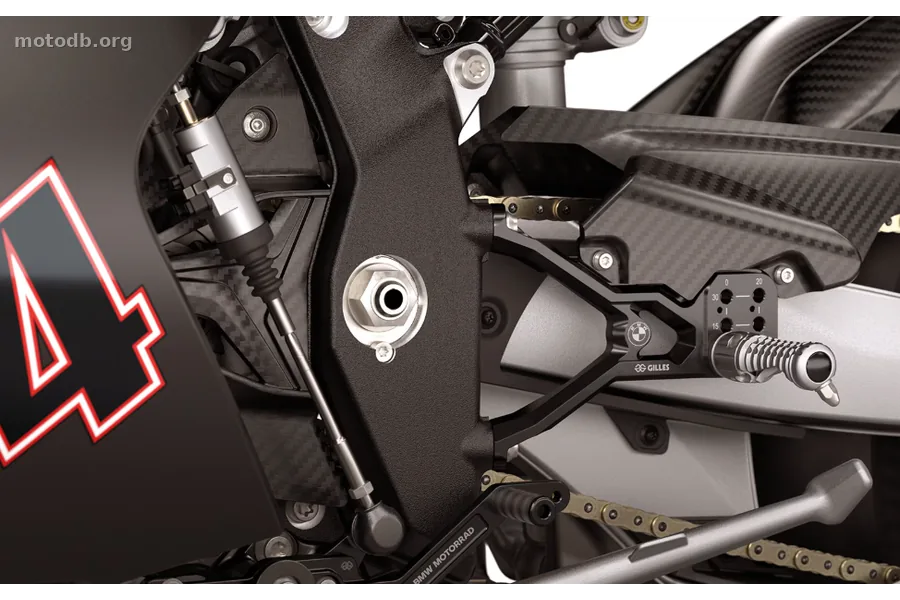
The double-beam aluminum chassis has been reworked in its fundamental dimensions: wheelbase lengthened to 1,457 mm, rake increased, swingarm extended by 12 mm. The Marzocchi 45 mm inverted fork and rear shock remain in-house, without outsourced Öhlins, with extended settings that assume a rider who knows what they are doing. At 197 kg fully fueled for a seat at 832 mm from the ground, the machine clearly targets a specific stature and experience. It is not a motorcycle for beginners, nor even for intermediate riders looking to progress. It is a tool for those who already know where they want to go and at what speed.
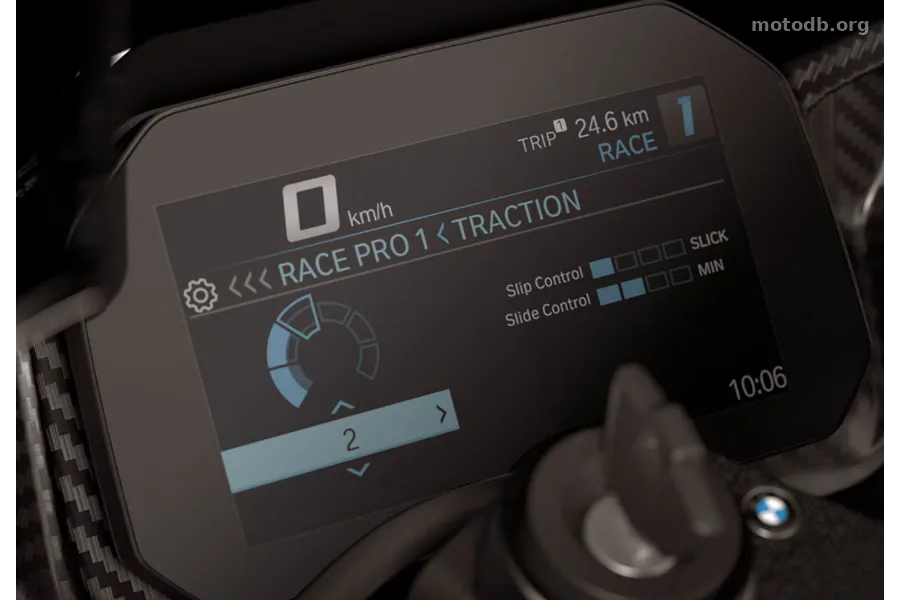
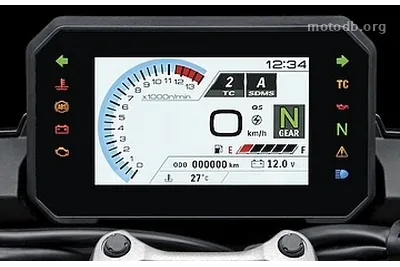
Braking abandons Brembo in favor of four-piston radial Nissin calipers, 60 grams lighter than those of the S 1000 RR, mounted on 320 mm thick 5 mm discs. The blue anodization makes a visual impact, but what matters is the bite and consistency over a sequence of repeated track braking. Onboard electronics cover the entire expected spectrum: six-axis IMU, traction control, cornering ABS, launch control, bidirectional shifter, seven modes including three fully programmable. The 6.5-inch TFT screen centralizes everything. Nothing is missing, except perhaps restraint.
The price of the BMW M 1000 RR was set at 33,270 euros at launch, and the question of what the price of a BMW M 1000 RR is regularly arises in conversations among enthusiasts. The brief answer: a lot, and that's before carbon packs, GPS telemetry, racing footpegs, or the Endurance M chain. For the BMW M 1000 RR 2023 or BMW M 1000 RR 2024 models that followed, prices have logically evolved with inflation and electronic updates, without the philosophy changing by a degree. The initial production limited to a minimum of 500 copies has also contributed to the machine's aura as much as its price on the second-hand market. Even the Lego Technic 42130 BMW M 1000 RR kit released in parallel testifies to a cultural presence exceeding the circle of track riders.
What BMW has built here is as much a statement of intent as a motorcycle. The M 1000 RR does not seek to please everyone. It seeks to win.
Standard equipment
- Assistance au freinage : ABS Pro
- Poignées chauffantes
Practical info
- La moto est accessible aux permis : A
Reviews & comments
No reviews yet. Be the first to share your opinion!