Key performance
Technical specifications
Engine
- Displacement
- 1099 cc
- Power
- 164.0 ch @ 9750 tr/min (120.6 kW)
- Torque
- 122.6 Nm @ 8000 tr/min
- Engine type
- Bicylindre en L à 90°, 4 temps
- Cooling
- liquide
- Bore × stroke
- 104 x 64.7 mm
- Valves/cylinder
- 4
- Fuel system
- injection
Chassis
- Frame
- treillis tubulaire en tube d'acier relié à des platines en alu
- Gearbox
- boîte à 6 rapports
- Final drive
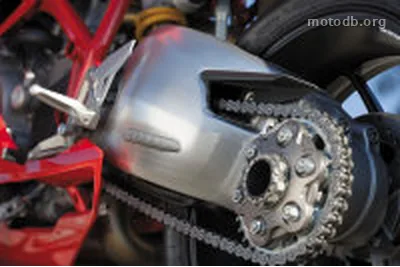
- Chaîne
- Front suspension
- Fourche téléhydraulique inversée Ø nc, déb : 120 mm
- Rear suspension
- Mono-amortisseur, déb : 120 mm
Brakes
- Front brakes
- Freinage
- Rear brakes
- Freinage 1 disque
- Front tyre
- 120/70-17
- Front tyre pressure
- 2.30 bar
- Rear tyre
- 190/55-17
- Rear tyre pressure
- 2.30 bar
Dimensions
- Fuel capacity
- 16.00 L
- Dry weight
- 170.00 kg
- New price
- 25 490 €
Overview
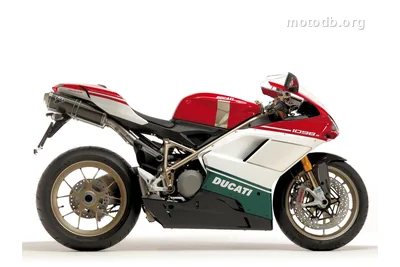
Rimini has never done things by halves. After a few years of cultivating its image with machines that were certainly elegant but relatively restrained – the DB5, DB6, and Tesi 3D revolved around a Ducati air-cooled two-valve twin, generous in character but measured in raw power – the small Italian manufacture decided to show its claws. The DB7 is this ace in the hole, built around the 1099 cm3 L-twin at 90° from Bologna’s 1098, an engine that is nothing short of significant in the hands of an ordinary engine builder, let alone in the hands of Rimini’s engineers.
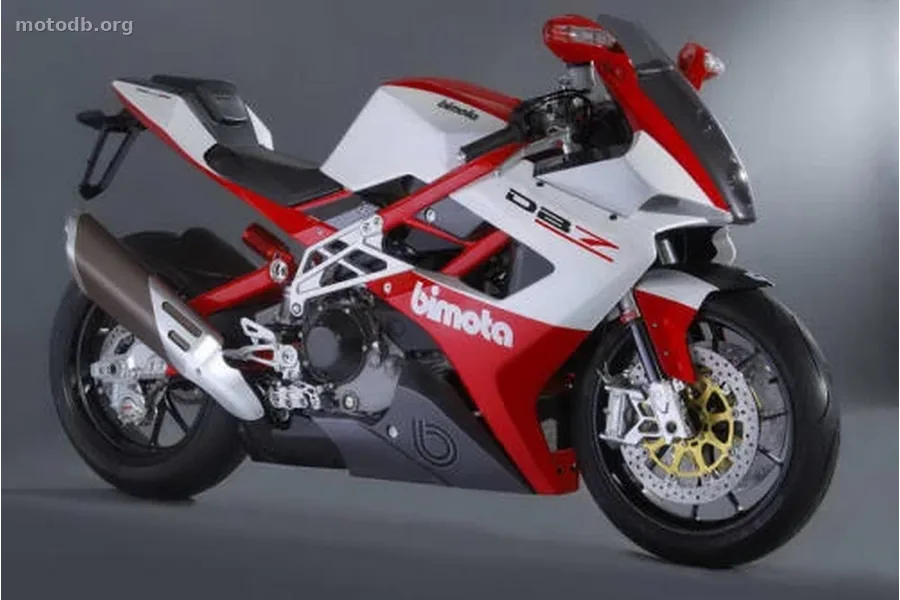
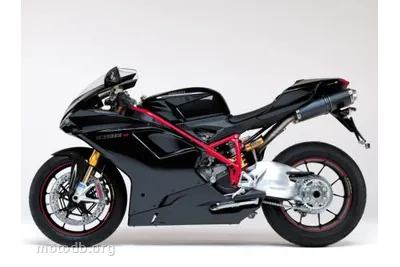
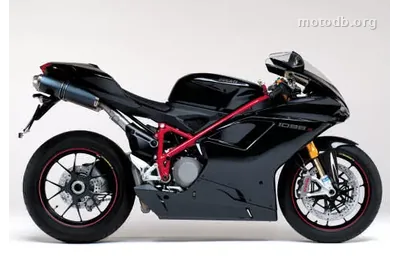
Because that’s been the core of Bimota since its creation: to take a leading Japanese or Italian engine, wrap it in a home-designed chassis with the rigor of a goldsmith, and deliver an object that mass production cannot produce. The DB7 scrupulously respects this doctrine. The steel trellis frame reinforced with aluminum plates therefore accommodates this L-twin which develops 164 horsepower at 9750 rpm and 122.6 Nm of torque at 8000 rpm. These figures place the machine in the yard of the most radical of its time, alongside Aprilia RSV4 and other Ducati 1198. The comparison is legitimate, even if Bimota plays in a different price category.
At 170 kilograms dry, the DB7 gains five kilograms on the SB8K, its direct predecessor in the hypersport range. It’s not a revolution on the scales, but on a motorcycle of this size and power, every gram counts in corners. The inverted fork and single shock work on 120 mm of travel, values consistent with track-oriented use without sacrificing all road practicality. Tires in 120/70-17 at the front and 190/55-17 at the rear complete a package designed to go fast, really fast, since Bimota announces a top speed of 280 km/h.
The target audience here is not the Sunday rider looking for a comfortable motorcycle to drive to Provence. The DB7 is aimed at the passionate collector, the demanding track rider who wants something unique in the paddocks, at the one who considers that a Ducati 1098 is a good starting point but not an end in itself. The 16-liter tank and six-speed chain gearbox still recall that we remain in the realm of the practical, not the museum motorcycle.
The price, 25,490 euros at launch, clearly states the positioning. It’s double that of a standard Ducati 1098, for a machine produced in a very small series with an artisanal care that large manufacturers cannot offer. One can discuss the intrinsic value of this gap, but not the coherence of the approach. Bimota has never claimed to be accessible. The DB7 embraces this rarity as a quality in its own right.
Practical info
- La moto est accessible aux permis : A
Reviews & comments
No reviews yet. Be the first to share your opinion!