Key performance
Technical specifications
Engine
- Displacement
- 998 cc
- Power
- 228.0 ch @ 15000 tr/min (167.7 kW)
- Engine type
- 4 cylindres en ligne, 4 temps
- Cooling
- liquide
- Compression ratio
- 14.5 : 1
- Bore × stroke
- 78 x 52.2 mm
- Valves/cylinder
- 4
- Camshafts
- 2 ACT
- Fuel system
- Injection Ø 45 mm
Chassis
- Frame
- Deltabox en aluminium
- Gearbox
- boîte à 6 rapports
- Final drive
- Chaîne
- Front suspension
- Fourche téléhydraulique inversée Öhlins TTR Ø 43 mm, déb : 120 mm
- Rear suspension
- Monoamortisseur Öhlins RSP40, déb : 120 mm
Brakes
- Front brakes
- Freinage 2 disques Ø 316 mm, fixation radiale, étrier 4 pistons
- Rear brakes
- Freinage 1 disque Ø 218 mm, étrier 2 pistons
- Front tyre
- 120/75-17
- Rear tyre
- 190/65-17
Dimensions
- Fuel capacity
- 23.00 L
- Dry weight
- 159.00 kg
- New price
- 100 000 €
Overview
Recalling the 2011 R1 Factory means diving into a pivotal era when the superbike war was fought as much in the pit lane as on the corners. That year, the Yamaha arrived with the aura of the 2009 SBK title, but without its rider, Ben Spies, who had moved on to MotoGP. The Sterilgarda team nevertheless fielded a formidable duo, with former Supersport champion Cal Crutchlow and the experienced James Toseland. The battle promised to be fierce, and the machine destined to deliver it was a high-flying exercise between series production and prototype.
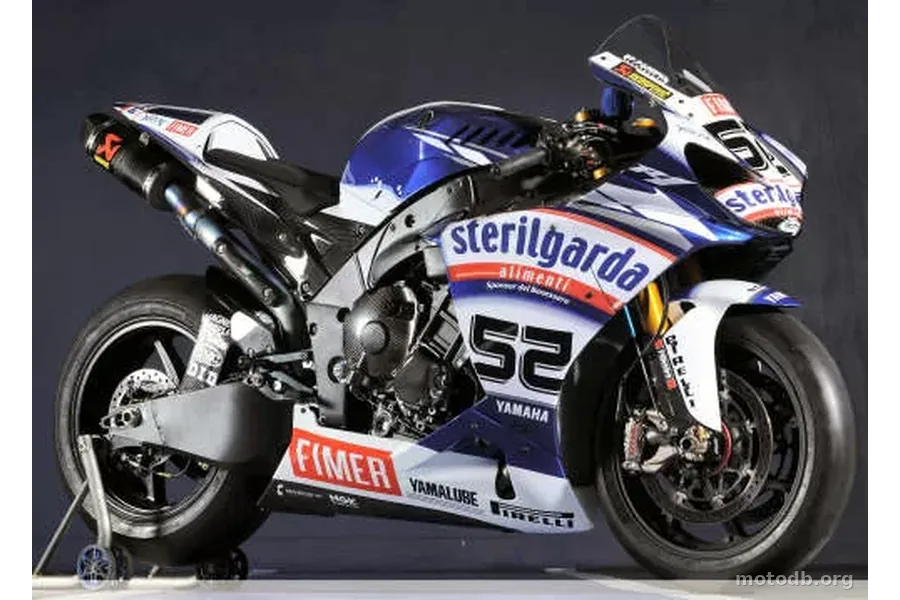
Visually, the Factory was understated, mainly displaying its sponsor's colors. But beneath the carbon fiber fairing, the metamorphosis was radical. The fuel tank had migrated under the seat to optimize mass, freeing up space for electronics worthy of a spaceship. The rider navigated menus for traction control and modifiable maps, even by GPS signal depending on the circuit. It was far from a simple headlight switch; the left handlebar control was now a command post. The era of electronic assistance was no longer an option, but the ultimate weapon to channel a phenomenal amount of power.
Because the 998 cm³ engine had been unleashed. Thanks to work on the camshafts, intake, and Magneti Marelli injection, it screamed up to 15,000 rpm to spit out more than 220 horsepower, some thirty more than the civilian version. The sound of the titanium and carbon Akrapovic exhausts was no deception. Admittedly, compared to the surprising Aprilia RSV4 of the time, the official figures might have seemed slightly behind, but the power was there, raw and requiring an oversized radiator whose price could have bought a used 600. Managing this fury was a challenge, even for seasoned riders.
The chassis, for its part, played the game of extreme lightness with the rigor of a monk-soldier. Only the original Deltabox frame was retained, as required by regulations. Everything else was optimized for the track: a 15% stiffer swingarm, Öhlins suspensions inherited directly from Rossi’s M1 in MotoGP, and Brembo monoblock brakes with radial mountings and quick-release fittings. The 16.5-inch magnesium rims were so light that you could lift them with a finger, contributing to a dry weight of 159 kg. In this relentless pursuit of kilos, the Yamaha even retained an incongruous luxury: an electric starter, making it the only true “race bike” that could, in theory, be started without a kickstand.
At €100,000, this Factory was obviously not a motorcycle, but a pure racing instrument. It targeted an ultra-specific audience: professional racing teams and wealthy championship riders. Compared to a standard R1, the gap was abysmal. It embodied the quintessence of SBK technology of its time, a perfect compromise between the regulations that required a series production base and the desire for victory that pushed to rethink everything. It was proof that at the time, to dominate in superbike, you needed more than a big engine; you needed an electronic gas factory, an obsession with weight, and a Grand Prix chassis. A concentrated dose of mechanical madness that still makes you dream today.
Reviews & comments
No reviews yet. Be the first to share your opinion!