Key performance
Technical specifications
Engine
- Displacement
- 689 cc
- Power
- 74.0 ch @ 9000 tr/min (54.4 kW)
- Torque
- 68.6 Nm @ 6500 tr/min
- Engine type
- Bicylindre en ligne, 4 temps
- Cooling
- liquide
- Compression ratio
- 11.5:1
- Bore × stroke
- 80 x 68.6 mm
- Valves/cylinder
- 4
- Camshafts
- 2 ACT
- Fuel system
- Injection
Chassis
- Frame
- Double berceau en tubes d'acier
- Gearbox
- boîte à 6 rapports
- Final drive
- Chaîne
- Front suspension
- Fourche téléhydraulique inversée Ø 43 mm, déb : 210 mm
- Rear suspension
- Mono-amortisseur, déb : 200 mm
Brakes
- Front brakes
- Freinage 2 disques Ø 282 mm, étrier 2 pistons
- Rear brakes
- Freinage 1 disque Ø 245 mm, étrier simple piston
- Front tyre
- 90/90-21
- Front tyre pressure
- 2.20 bar
- Rear tyre
- 150/70-18
- Rear tyre pressure
- 2.50 bar
Dimensions
- Seat height
- 880.00 mm
- Fuel capacity
- 16.00 L
- Weight
- 216.00 kg
- New price
- 11 656 €
Overview
There are machines that pretend to go elsewhere, and others that have nothing else on their mind. The Explorer version of the Ténéré 700 belongs unambiguously to the second category. Yamaha did not build a trail bike for weekend photo shoots: since 2019, this 689 cc parallel twin claims a direct lineage with the Ténéré models of the 1980s — the ones that used to arrive at Dakar covered in dust. The positioning is clear, almost provocative.
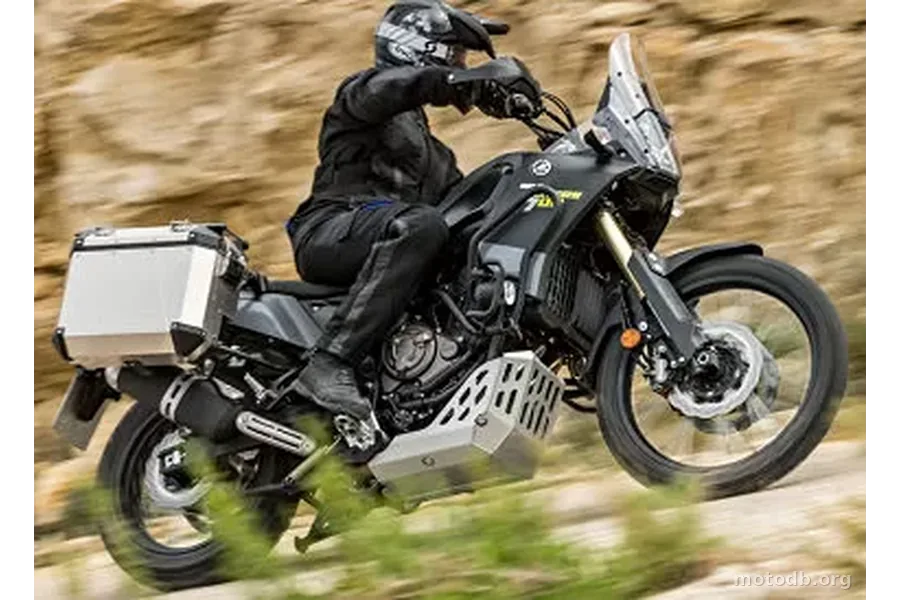
What strikes you first is the proportions. The Ténéré 700 weighs 216 kg fully fuelled, a figure that puts it several dozen kilograms below the heavyweights of the segment, with the BMW GS 1250 and the Africa Twin leading that pack. The seat sits at 880 mm, and the steel double-cradle frame maintains a slim, almost slender silhouette for a trail bike. The CP2 engine — the one from the MT-07 — delivers 74 horsepower at 9,000 rpm and 68.6 Nm at 6,500 rpm. Reasonable figures, sufficient to tackle the trails without ever exceeding the rider's abilities, but ones that refuse to compete in the same arena as the 1,000 cc twins found in premium rivals. It is a deliberate choice: the Ténéré 700 targets the rider who wants to ride fast on rough terrain, not the one who wants to make an impression on a national highway.
The Explorer equipment justifies its name through a set of protection and luggage solutions designed for extended journeys. Two aluminium panniers flank the motorcycle — 35 litres on the left, 37 on the right — enough to carry the gear needed for a serious crossing. The passenger seat disappears in favour of a rear rack, which settles the question of two-up travel once and for all. The engine bash plate, reinforced and one-third thicker than the standard part, protects the twin from rock strikes. Crash bars surround the engine and sides. The centre stand, often absent on this type of machine, makes it possible to work on the chain or change a wheel without searching for a flat patch of ground. These 12 kg of additional equipment come at a cost of €1,941, bringing the total to €11,656 — a price Yamaha defends by pointing out that buying the accessories separately would come to virtually the same figure.
The 43 mm inverted fork offers 210 mm of travel, the rear monoshock 200 mm, the 21-inch front wheel and 18-inch rear wheel forming a coherent geometry for absorbing ruts and holding a line on degraded surfaces. This is not an enduro bike disguised as a trail, but it is considerably more serious than what the competition offers at this price in this displacement class. The Honda CB500X or the Kawasaki Versys 650 do not operate in the same off-road register; the Ténéré 700 aims higher, without demanding the mastery required by a true enduro machine.
The target rider is an intermediate-level motorcyclist who has moved beyond the discovery phase and wants to travel far, for a long time, on roads that gradually cease to be roads. Not a beginner, because the seat height and laden weight require some experience. Not a track-day enthusiast either — the power output simply does not lend itself to that. The self-sufficient adventurer, the one who plans stages with a paper map and a compass, will find in this Explorer version a proposal that holds together from start to finish. The 16-litre tank remains the sole weak point in an otherwise well-constructed package: on isolated tracks, range can become a genuine constraint.
Standard equipment
- Assistance au freinage : ABS désactivable
Practical info
- La moto est accessible aux permis : A
Reviews & comments
No reviews yet. Be the first to share your opinion!