Key performance
Technical specifications
Engine
- Displacement
- 749 cc
- Power
- 41.0 ch @ 5500 tr/min (30.2 kW)
- Torque
- 57.9 Nm @ 4300 tr/min
- Engine type
- Bicylindre à plat, 4 temps
- Cooling
- par air
- Compression ratio
- 8.6 : 1
- Bore × stroke
- 78 x 78 mm
- Valves/cylinder
- 2
- Fuel system
- Injection
Chassis
- Frame
- tubulaire double berceau en acier soudé
- Gearbox
- boîte à 4 rapports
- Front suspension
- fourche à balancier et à amortisseurs hydrauliques verticaux à 5 positions
- Rear suspension
- 2 amortisseurs latéraux
Brakes
- Front brakes
- Freinage Brembo
- Rear brakes
- Freinage 1 disque
Dimensions
- Fuel capacity
- 19.00 L
- Dry weight
- 331.00 kg
- New price
- 15 700 €
Overview
A drone mounted on a Soviet sidecar. That sentence alone deserves a moment's pause, as it perfectly captures the extraordinary leap Ural took with this AIR limited edition, produced in only 40 units.
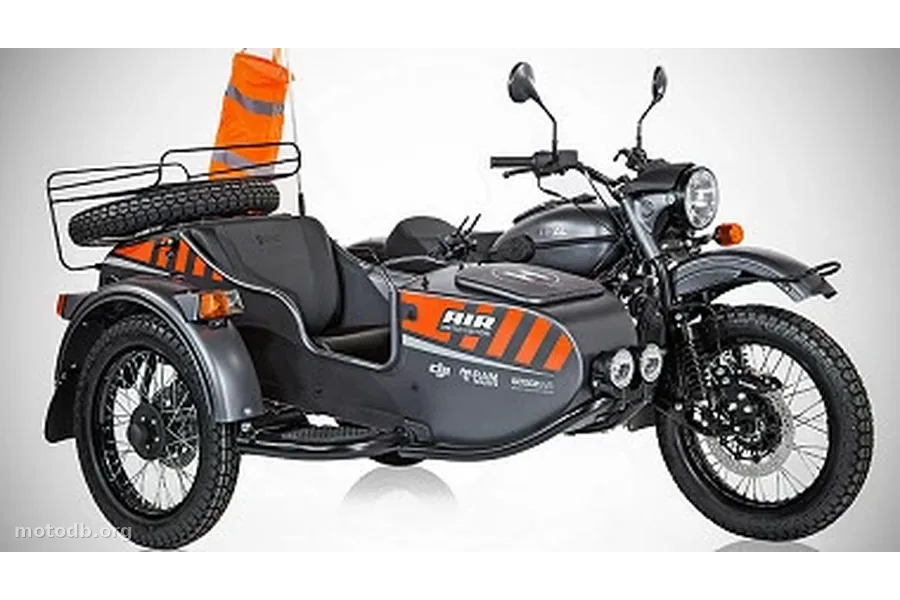
The Russian manufacturer dressed its rig in the colors of the "Strategic Air Command," that American military doctrine of the Cold War that choreographed strategic bombers like metronomes of nuclear apocalypse. The aesthetic choice speaks volumes about the spirit of the project: this isn't about devouring highway miles, but about pushing down forest tracks, bivouacking in forgotten clearings, playing the adventurer on a collector's budget. The 749cc flat-twin, its 41 horsepower at 5,500 rpm and 57.9 Nm of torque at 4,300 rpm won't carry you beyond a top speed of 100 km/h in any case. On a fast road, this 331-kilogram machine would simply be out of its element.
What sets the AIR apart from its siblings is the presence of a DJI Spark housed in a compartment designed by Stratasys, manufactured by 3D printing and integrated into the nose of the sidecar. The hatch opens on command via a button accessible to the passenger, assisted by small actuators, and the platform thus revealed displays a landing "H," like a helicopter deck. An integrated USB port allows the drone to be recharged between reconnaissance runs. RAM Mounts supplied the remote controller mount so the passenger can pilot the flying craft without leaving their seat. On paper, you can film your own tracks, scout a trail before committing to it, or simply have fun. In practice, it sits closer to communicative gadget than indispensable field tool — and Ural probably knows that as well as we do.
The ancillary equipment is more convincing for those seeking genuine autonomy: spare wheel, jerrycan, shovel, fog lights, reinforced bumper on the sidecar. The telescoping mast at the rear of the rig doesn't fly the flag of some vanished nation, but a wind sock. Because before launching a drone into the sky, you first need to know the current conditions. That detail, almost anachronistic in its rusticity, says more about this sidecar's design brief than anything else: conceived for wide open spaces, built for organized improvisation.
At €15,700 (the North American starting price was $17,999), you're buying an experience as much as a motorcycle. The intended audience isn't the daily commuter or the touring traveler; it's the enthusiast of slow adventure, filmed journeys, and unapologetic mechanics. Measured against a BMW R 1250 GS or even a well-equipped Yamaha Ténéré, the Ural holds no comparison in terms of performance or dynamic comfort. But it occupies a radically different register — that of the character sidecar, the singular piece that tells a story at first glance. Forty units worldwide is less a limited series than a statement of intent. That of a manufacturer who understood that its survival depends on originality rather than the horsepower race.
Standard equipment
- Assistance au freinage : no
Practical info
- La moto est accessible aux permis : A
Reviews & comments
No reviews yet. Be the first to share your opinion!