Key performance
Technical specifications
Engine
- Displacement
- 773 cc
- Power
- 48.0 ch @ 6000 tr/min (34.3 kW)
- Torque
- 62.9 Nm @ 4800 tr/min
- Engine type
- V2, four-stroke
- Cooling
- Air
- Compression ratio
- 8.4:1
- Bore × stroke
- 77.0 x 83.0 mm (3.0 x 3.3 inches)
- Valves/cylinder
- 4
- Camshafts
- 1 ACT
- Fuel system
- Injection. DFI® with 34mm throttle body
- Valve timing
- Single Overhead Cams (SOHC)
- Ignition
- TCBI w/digital advance
- Starter
- Electric
Chassis
- Frame
- Double-cradle high tensile steel
- Gearbox
- 5-speed
- Final drive
- Chain (final drive)
- Front suspension
- Telescopi fork
- Rear suspension
- Swingarm
- Front wheel travel
- 130 mm (5.1 inches)
- Rear wheel travel
- 107 mm (4.2 inches)
Brakes
- Front brakes
- Single disc. Petal-style disc with 2-piston calipers, ABS
- Rear brakes
- Single disc. Petal-style disc with 2-piston caliper, ABS
- Front tyre
- 100/90-18
- Front tyre pressure
- 2.00 bar
- Rear tyre
- 130/80-18
- Rear tyre pressure
- 2.25 bar
Dimensions
- Seat height
- 770.00 mm
- Wheelbase
- 1465.00 mm
- Ground clearance
- 130.00 mm
- Length
- 2135.00 mm
- Width
- 925.00 mm
- Height
- 1120.00 mm
- Fuel capacity
- 15.00 L
- Weight
- 221.00 kg
- New price
- 9 349 €
Overview
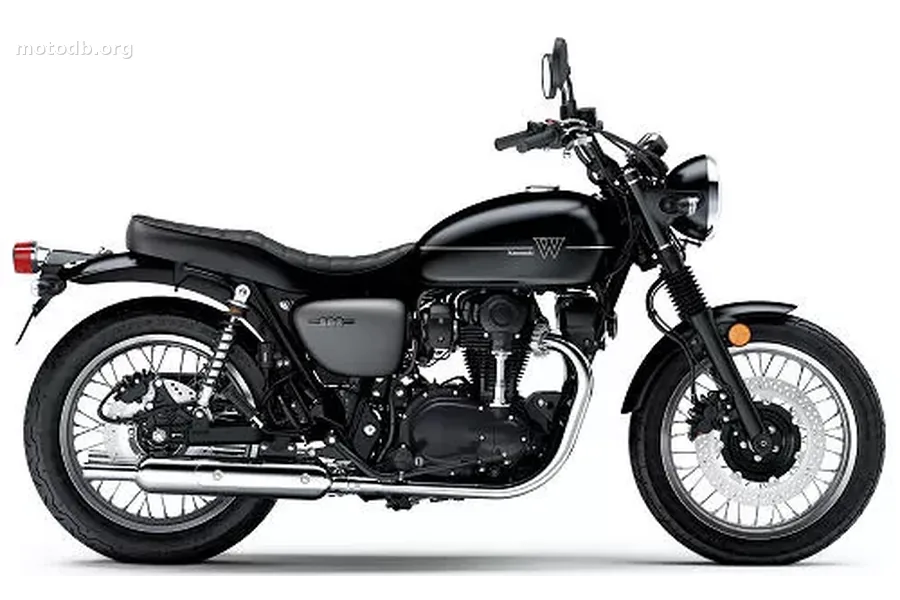
It’s a shame, really. As the Vintage movement confirmed its rise, here came the Euro4 standards to sabotage the survival of the W 800. A machine that perfectly illustrated the ‘classic’ at Kawasaki, one that recalled the W1 of the 1960s, such a retro bike with nothing neo, fragile as a bee among bumblebees. Push me through the door and I’m back out the balcony. The time of a pause in Akashi workshops allowed this machine to prepare its return. The W 800 is as it was before, but it has almost completely changed.
Its resemblance to the Triumph Bonneville isn’t new. Since the W 650, it’s always been like that. And it continues. One even wonders what has changed since the last episode in 2016. Let’s take a look..... So, there’s less, much less chrome. Black everywhere, smaller turn signals, an LED headlight borrowed from the Z 900 RS. Oh, and because it had to comply with legislation, it now has unsightly retroreflectors and ABS lines. That can’t be all; Kawa announces that only 10% of the old W has been carried over. A whole host of parts have therefore been reworked, without it necessarily being noticeable.
The presence of ABS raises an eyebrow. It would have been difficult to install it with the front drum brake. Consequently, the W 800 Street, like the Café, receives a rear brake disc – with a two-piston caliper. The front disc grows from 300 to 320 mm while the wheel that holds it goes from 19 to 18 inches. Essential elements, the spoked wheels, sausage-style silencers, and fork gaiters are still part of the package. The steel double cradle frame is identical in form, except that each element has been reevaluated, the thickness of the tubes modified, and rigidity reviewed for all the parts that make it up. The fork gains diameter with 41 mm per tube. The tank pushes the walls to gain 1 liter. As for the scale, it records a weight gain of 5 kilos. The W 800 is intended to show a little more rigor in its escapades. Apart from the increased frame rigidity, the suspensions have been stiffened. Let’s not get carried away either, the bike dreams of undulating departmental roads; absolutely no stunts.
What about the engine? To revive the W 800, it had to be made compatible with Euro4. O2 sensors and new catalysts take care of that. From the outside, the 773 cm3 twin is unchanged. Same cases, same fins, same antique charm, and especially this bevel-gear distribution. This bike is the only one on the market to still offer this gear kinematic for agitating the valves. The main advantage of this engine is its character: it feels like the past, it lives like the past, and it conceives power like the past. It claims a maximum of 35 kW, the same power as the previous version. Its 48 horsepower corresponds to its silhouette and its vocation. A small bonus, they are reached 500 rpm earlier than before. The torque has even gained a bit of fat: 0.3 mkg, for a peak at 6.4 mkg. We are moderately pleased. The maximum is achieved at 4800 rpm - whereas the ex-W 800 offered it at 2500 rpm. This block is not a lightning bolt, rather a friendly engine on a leisurely ride, with more class than vigor. Yet, Kawa has grafted a slipper clutch onto it. It provides more safety during downshifts (if you shift 8 gears at once...) and above all a pleasant lever softness. As a bonus for young riders, the watts are just right for the A2 license.
Promoting a relaxed riding position, the W 800 will invite you to enjoy yourself. At the handlebars, you will find the dual-dial instrument cluster, two needles, a digital window, and a series of signals noticeably enriched. The internal décor has been revised, while the redline has lost 500 rpm. In any case, liveliness at high revs has never really been its thing. Shame, the center stand is no longer standard. The knee grips on the tank either. Well, if it can help keep a reasonable price. Oops no, the price is not contained at all. The update hurts the wallet, the W 800 being displayed with 17% more. It’s barely cheaper than a 900 Bonneville T100, more powerful and better equipped. Against a Street Twin, there’s no point in trying to compete. The Kawasaki W 800 Street will above all have to rely on a love affair. A love affair not limited to its aesthetics but also to its bucolic riding of yesteryear. Its behavior is expected to be a notch above that which we tested on the roads of nostalgia.
M.B - Photos manufacturer
Standard equipment
- Assistance au freinage : ABS
Practical info
- La moto est accessible aux permis : A
Reviews & comments
No reviews yet. Be the first to share your opinion!