Key performance
Technical specifications
Engine
- Displacement
- 1160 cc
- Power
- 150.0 ch @ 9000 tr/min (110.3 kW)
- Torque
- 129.9 Nm @ 7000 tr/min
- Cooling
- liquide
- Compression ratio
- 13.2 : 1
- Bore × stroke
- 90 x 60.7 mm
- Valves/cylinder
- 4
- Camshafts
- 2 ACT
- Fuel system
- Injection
- Euro standard
- Euro 5+
Chassis
- Frame
- Structure en acier tubulaire
- Gearbox
- boîte à 6 rapports
- Final drive
- Cardan
- Front suspension
- Fourche téléhydraulique inversée Ø 49 mm, déb : 220 mm
- Rear suspension
- mono-amortisseur, déb : 220 mm
Brakes
- Front brakes
- Freinage 2 disques Brembo Ø 320 mm, fixation radiale, étrier 4 pistons (Stylema monobloc)
- Rear brakes
- Freinage 1 disque Ø 282 mm, étrier 2 pistons
- Front tyre
- 90/90-21
- Rear tyre
- 150/70-18
Dimensions
- Seat height
- 875.00 mm
- Fuel capacity
- 20.00 L
- Weight
- 249.00 kg
- New price
- 21 545 €
Overview
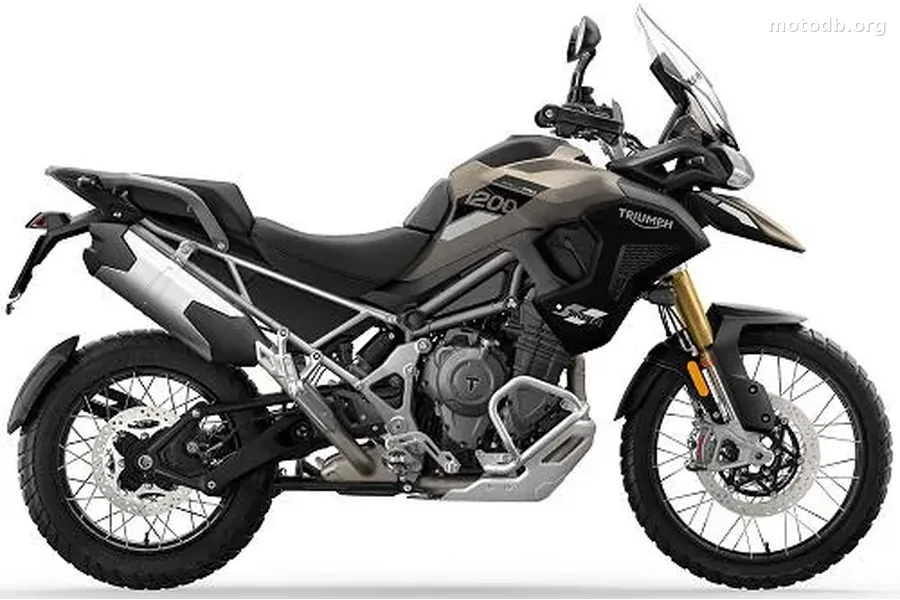
Que Triumph designates the large Tiger for GT or off-road use—or both, as the Rally Pro wants to do both—attention will be paid to comfort. This is the direction in which the 1200 evolved in 2024: the installation of needle roller bearings on the handlebars, a reshaped seat, a softer clutch, and a quieter engine are all on the menu to make it even more user-friendly. Triumph also modified several parts of the 3-cylinder engine (crankshaft, balancing, alternator) to increase inertia and low-end torque.
“What is difficult when riding a tiger is to dismount it,” says a hypothetical Chinese proverb discovered by chance. A bizarre maxim that nevertheless seems quite apt for presenting the Triumph Tiger 1200 Rally Pro, as the latest offspring of the English manufacturer seems to possess serious arguments to delight its rider and make them want to stay in the saddle for many hours.
Since 2022, Triumph has not indulged in a vague respray or a minor facelift to dress up another year of the Tiger 1200, originally released in 2012. Quite the contrary, to indelibly mark the tenth anniversary of its mega-large trail, the Hinckley firm has unveiled a completely new motorcycle, noticeably sharper than the previous model.
The renewal begins with the nomenclature used to designate the different versions of the Tiger 1200: exit XR, XRX, XCX, XRT, XCA… Today, the five versions are called: GT, GT Pro, GT Explorer, Rally Pro, and Rally Explorer. Which you will quickly realize, is much more practical for recognizing them. Simply put, the GTs have spoked wheels and are more geared towards the road; and the Rally models, with their spoke wheels, are more oriented towards off-road. Finally, the Explorer designation refers to the fuel tank capacity, which increases from 20 to 30 liters. In other words, it is the equivalent of the Adventure finish for BMW R 1250 GS.
The different versions of the Tiger 1200 share the same general technical characteristics, but a few details distinguish the Rally models from the GT versions. The Rally Pro receives a 21-inch tubeless front wheel instead of a 19-inch spoked wheel on the GT. To increase its off-road capabilities, the travel of the 49 mm Showa inverted fork increases from 200 to 220 mm. The front frame geometry is also slightly tighter to increase maneuverability, which is essential off-road. Meanwhile, the adjustable seat height rises by 25 mm, establishing itself between 875 and 895 mm.
If the old Tiger 1200 had become an excellent traveler over the years, ultra-equipped and capable of devouring hundreds of kilometers at a time, it had retained a certain bulkiness from its origins, with a feeling of high-mounted weight during low-speed maneuvers and a generous size that was not always reassuring at first. With its 2022 model year, Triumph starts from a clean slate and offers a more svelte, more athletic motorcycle. This is seen in the eye and is confirmed by the technical specifications, as the beauty is announced at 249 kg fully fueled (with 90% full and in running order, according to the manufacturer) against 248 kg… dry weight for the 2021 XCA version! This represents a weight saving of 15 kg, considering only the weight of the 20 liters of fuel (a liter of fuel weighing 0.75 kg).
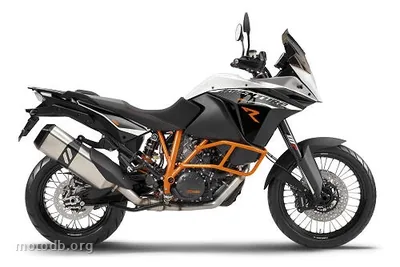
The Tiger 1200 exudes a noticeably more dynamic feel than the old model. It feels more feline, with a completely revised chassis, its tubular steel trellis, complemented by aluminum plates and a rear subframe, gives it a more muscular silhouette, emphasized by its exhaust silencer that follows the rear of the frame as closely as possible. Everything seems more compact, as if the Hinckley tiger was flexing all its muscles to pounce with more ferocity.
This aggressiveness is also found in its new look, whose daytime running LED bar is reminiscent of the linear lighting of the Harley Pan America. The minimalist fairing is trimmed to modernize the look as much as possible and expose the mechanical soul of this new trail, a bit in the style of an industrial decor that enhances the intrinsic beauty of the materials.
Triumph has accustomed us for several years to offer its motorcycles an exemplary finish. The Tiger Rally Pro does not seem to deviate from the rule. And that is not what the new Tri-Link rear swingarm will say otherwise. Not only does it retain the pleasantness and ease of use associated with the shaft drive, but its original design on the right side integrates the rear brake caliper in a particularly well-protected manner from various off-road projections. Note that the suspensions are semi-active and constantly adapt to the rider's driving and the terrain on which the motorcycle is evolving. The Rally Pro version adds to the five driving modes already present on the GT Pro, a "Off-Road Pro" mode that completely deactivates both ABS and traction control to fully enjoy the beast's off-road capabilities.
Of course, the Tiger 1200 Rally Pro is loaded with now-classic riding assistance electronics, but it also adds a clever blind-spot sensor. Heated grips, backlit controls, a 7-inch multifunctional and connected TFT dashboard are part of the long list of high-tech refinements offered by this chapter.
The three-cylinder engine is also all new: exit the 1215 cm3 block, the Tiger 2022 is adorned with the three-cylinder engine of 1160 cm3 that equips the latest generations of Speed Triple and is enriched with a T-Plane crankshaft. Like the cross-plane crankshaft used by Yamaha on the R1 four-cylinder engines, this system modifies the firing sequence of the cylinders, which now ignite at 180°, 270° and then again at 270°. Without going into the technical details, the idea is ultimately to obtain the torquey character of a bi-cylinder at low speed while retaining the three-cylinder's aggressiveness at high RPM. The Tiger gains 9 hp compared to the 2021 model year, its power now reaching 150 hp for a torque of 130 Nm. Enough to soar over roads and trails!
Thus armed, the Tiger 1200 Rally Pro brandishes very serious arguments against the queen of the genre, the unshakeable BMW R 1300 GS. Less powerful on paper (136 hp) and heavier (249 kg dry weight), the German will surely have a tough time against this next-gen Tiger! Yet, when you detail the technical specifications, the part does not yet seem to be winning: the 150 hp of the English are reached at 9000 rpm, against 7750 rpm for the 136 hp maxi of the German. At equivalent speed, there is every reason to believe that the measured powers will be close. On the other hand, the BMW retains the advantage in terms of torque, with 143 Nm at 6250 rpm against 130 Nm at 7000 rpm for the Triumph. And driving experience proves that it is not at the top of the rev counter that this kind of high-performance large trail is most used, but rather in the low and mid-range.
The part is therefore expected to be tight, even if Triumph, which had already hoped to knock out the GS in 2012, without however succeeding, will have taken advantage of the decade that has passed to design a motorcycle that is certainly exceptional. To be confirmed at the handlebars!
To facilitate access, the Tiger 1200 receives active pre-load functionality. By pressing the "Home" button on the handlebar switchgear for one second, this function is activated and allows the seat height to be lowered by 20 mm. When the motorcycle exceeds 40 km/h, the suspension returns to the setting defined by the rider. All Tiger 12s of this generation can benefit from this add-on via a software update.
M.L. - Manufacturer photos
Standard equipment
- Assistance au freinage : ABS
- Nombre de mode de conduite : 6
- Taille de l'écran TFT couleur : 17,78 cm / 7 pouces
- ABS Cornering
- Jantes à rayon
- Shifter
- Béquille centrale
- Indicateur de vitesse engagée
- Régulateur de vitesse
- Bluetooth
- Prise USB
- Aide au démarrage en côte (Hill Hold Control)
- Démarrage sans clé
- Contrôle de traction
- Poignées chauffantes
- Pare brise réglable
- Suspensions réglables électroniquement
- Crash Bars / Top Blocks
- Embrayage anti-dribble
- Selle réglable
- Centrale inertielle
- Commodes rétro-éclairés
- Phares adaptatifs en virage
Practical info
- La moto est accessible aux permis : A
Reviews & comments
No reviews yet. Be the first to share your opinion!