Key performance
Technical specifications
Engine
- Displacement
- 1195 cc
- Power
- 150.0 ch @ 9500 tr/min (109.5 kW)
- Torque
- 124.5 Nm @ 7500 tr/min
- Engine type
- V2, four-stroke
- Cooling
- Liquid
- Compression ratio
- 12.5 : 1
- Bore × stroke
- 105.0 x 69.0 mm (4.1 x 2.7 inches)
- Valves/cylinder
- 4
- Camshafts
- 2 ACT
- Fuel system
- Injection
- Lubrication
- Forced oil lubrication with 3 rotor pumps
- Ignition
- Keihin EMS with RBW, twin ignition
- Starter
- Electric
Chassis
- Frame
- Chromium-Molybdenum steel trellis frame, powder coated
- Gearbox
- 6-speed
- Final drive
- Chain (final drive)
- Clutch
- PASC slipper clutch, hydraulically actuated
- Front suspension
- WP-EDS USD Ø 48 mm
- Rear suspension
- WP-EDS Monoshock
- Front wheel travel
- 190 mm (7.5 inches)
- Rear wheel travel
- 190 mm (7.5 inches)
Brakes
- Front brakes
- Double disc. ABS. Four-piston calipers. Radially mounted.
- Rear brakes
- Single disc. ABS. Two-piston calipers.
- Front tyre
- 120/70-19
- Rear tyre
- 170/60-17
Dimensions
- Seat height
- 860.00 mm
- Wheelbase
- 1560.00 mm
- Ground clearance
- 220.00 mm
- Fuel capacity
- 23.00 L
- Weight
- 230.00 kg
- Dry weight
- 212.00 kg
- New price
- 15 795 €
Overview
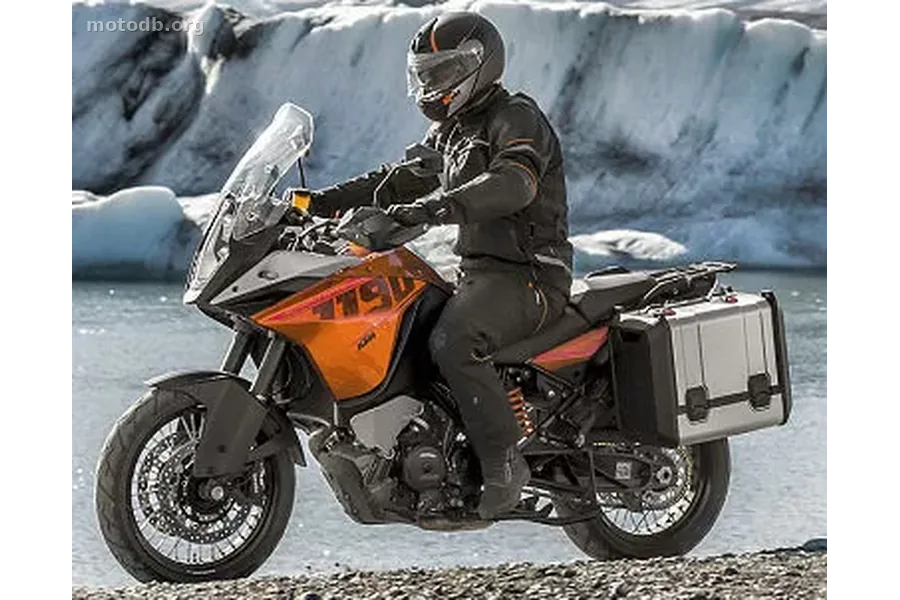
It's a notable sign. KTM, the specialist in off-road and rally racing, harbors greater ambitions in the trail-GT segment with its new Adventure version. Thoroughly revised, the Austrian machine attempts a balancing act, targeting two areas: the road, weaving between Ducati Multistrada and Yamaha XTZ to aim for the R 1200 GS – and the rocky terrain, Katoche’s preferred domain. Is it possible to do both? Not when proposing it in two versions: one R for desert, sand, and dust; and the standard Adventure that we discover here.
Gone is the flattened cube look on wheels. A much more streamlined trail takes over. With subtle nods to the SM-T, high and bulging shoulders, a body sculpted in the Californian style, the 1190 makes the previous Adventure look like a Viking carved from raw wood. It loses some of its "factory rally machine" feel, and leg protection seems less effective. But in terms of looks, we savor it :-). Technically, road orientation has largely supplanted off-road. The rims are still spoked, but the tires no longer have knobs. The almost enduro dimensions become much more road-oriented (120-70 / 19 and 170-60 / 17). The tank now holds 23 liters, and the ergonomics are carefully considered: an adjustable windshield, a double seat adjustable in two heights (860 or 875 mm), footrests and handlebars adjustable by 10 mm. The ride is refined at high RPM, while lower down, in the torque range, it plays in a completely different dimension.
Like hypersport bikes, large-trail bikes are entering an arms race. Today, the benchmark is 150 horsepower. After the Multistrada, it's the Adventure's turn to bite into that power. To achieve this, there's no secret: you need a big block. The 990 is phased out and replaced by the engine from the RC8-R. What could be better than a Superbike twin to power a trail bike!? That's now the rule, and KTM is employing it with measure. There's no question of grafting it as-is onto the Adventure. The 1195 cm3 goes to the flexibility and good manners workshops. Losing a few watts in the process, the power is redistributed in the mid-range, with a peak at 9500 rpm. Above all, by only taking 3 kilos and changing engine block, the Adventure ensures a significant increase in performance: 44 horsepower and 2.7 mkg more – an airplane! Plenty of torque, and plenty of control! It's hard to imagine a machine of this caliber without electronic assistance. The 1190 Adventure gets ride-by-wire, a 4-level traction control (Sport, Street, Rain, Offroad), Bosch 9ME ABS (multiple modes and switchable), and a double-effect PASC clutch: it requires less force on the lever, and its slip-limiting system manages the excess torque during deceleration. An engine damper reinforces steering control; with so much power, the front end will only ask to find its ease during strong acceleration.
In 2014, the Adventure gains a new asset in its electronic package: MSC stability control. This system regulates the force of the ABS based on the lean angle. Working in concert with the MTC anti-slip system, it brings a new dimension to active safety:
- MSC prevents wheel slippage when braking on the lean,- it reduces the moment of righting when braking on the lean,- it prevents front-end tucking when braking in an emergency,- it prevents rear-wheel spin when accelerating on the lean,- it prohibits front-wheel lift during acceleration.
Big engine, more power, more electronics, and for all that, a new chassis. As customary at Matighoffen, the frame is a structure of chrome-molybdenum tubing; it weighs only 9.8 kg and allows for high rigidity. Also new, the swingarm adopts the visible internal reinforcement profile, as on the 125 and 690 Duke. Braking, radial, is ensured by 4-piston Brembo calipers, 320 mm front discs, and a 268 mm rear disc. The suspension, from WP, offers 190 mm of travel. It consists of a 48 mm inverted fork and a mono-shock – fully adjustable, of course. KTM is not just offering a more approachable Adventure; it must be able to compete on a level playing field with the segment's heavyweights. And the innovation in the sector in 2013 was semi-active suspension. In competition with Ducati’s Skyhook and BMW’s dynamic ESA, here’s White Power’s EDS. That is Electronic Damping System: Via a switch on the handlebar, the rider can adapt the spring preload at the front and rear according to 4 modes (solo, solo with luggage, duo, duo with luggage) and also choose between three damping settings (Comfort, Street, Sport). Once on the road, it's up to the sensors to take over. They read the road and then send the information to the EDS control unit, which takes care of adapting the suspension hydraulics. It should be noted that this type of piloted suspension, likely to become commonplace in the medium term, will have been launched in series by European motorcycles. Japan is starting to react, but slowly.
EDS was previously offered as an option but is now part of the standard equipment. The "electronic pack" also includes a tire pressure controller. It will not be available on the R version.
More urban design, overflowing engine, omnipresent high-tech, the Adventure is clearly becoming more bourgeois. The completely revised dashboard is also a testament to this. The minimalist combined instrument panel is gone, replaced by an ultra-complete instrumentation. An analog tachometer with an embedded LCD tile displaying speed, trips, etc. is complemented by another screen for riding conditions. It displays the settings of the piloted suspension (if present), ABS, traction control, plus some information such as average speed, consumption, ambient temperature, and next service interval. It should be noted that these intervals have been extended to 15,000 km with the adoption of the 1195 cc LC8 twin.
Leave aside the philosophy of the 950 and 990 Adventure! The 1190 version loses some of its originality to carve out a share of the rich trail-GT pie. More appealing, much more powerful, full of resources, the Adventure does not deny its origins. The R version will be there to get off the paved roads: chassis protection, higher suspension, different wheels, specific seat, smaller bubble, and the famous orange frame.
In 2015, exhaust protection is improved at the level of the feet for the rider and the passenger. The seat is fitted with new foam that is more resistant over time, although its appearance is softer. You may want even more, more road-oriented, more powerful, more expensive, more equipment, more of everything... and that's a good thing, because it exists: the 1290 Super Adventure.
M.B - Photos manufacturer
Standard equipment
- Assistance au freinage : ABS combination
Practical info
- La moto est accessible aux permis : A
Reviews & comments
No reviews yet. Be the first to share your opinion!