Key performance
Technical specifications
Engine
- Displacement
- 798 cc
- Power
- 115.0 ch @ 10750 tr/min (84.6 kW)
- Torque
- 84.0 Nm @ 8500 tr/min
- Cooling
- liquide
- Compression ratio
- 13.2 : 1
- Bore × stroke
- 78 x 55.7 mm
- Valves/cylinder
- 4
- Camshafts
- 2 ACT
- Fuel system
- Injection
- Starter
- électrique
- Euro standard
- Euro 5+
Chassis
- Frame
- Structure en tubes d'acier
- Gearbox
- boîte à 6 rapports
- Final drive
- Chaîne
- Front suspension
- Fourche téléhydraulique inversée Ø 41 mm, déb : 120 mm
- Rear suspension
- Mono-amortisseur, déb : 130 mm
Brakes
- Front brakes
- Freinage 2 disques Ø 310 mm, fixation radiale, étrier 4 pistons
- Rear brakes
- Freinage 1 disque Ø 220 mm, étrier simple piston
- Front tyre
- 120/70-17
- Rear tyre
- 180/55-17
Dimensions
- Seat height
- 810.00 mm
- Seat type
- Selle biplaces
- Fuel capacity
- 14.00 L
- Weight
- 198.00 kg
- New price
- 9 695 €
Overview
With the 800 Trident, we are witnessing the marriage of two excellent machines from Triumph. In 2021, the smaller 660 Trident arrived with its 3-cylinder engine (the only one in a twin world) and made a positive impression. Four years later, the 800 Tiger Sport positions itself in the virulent mid-size trail-GT segment and matches. Everything was in place to combine them into a very promising roadster; with a price tag that could be memorable.
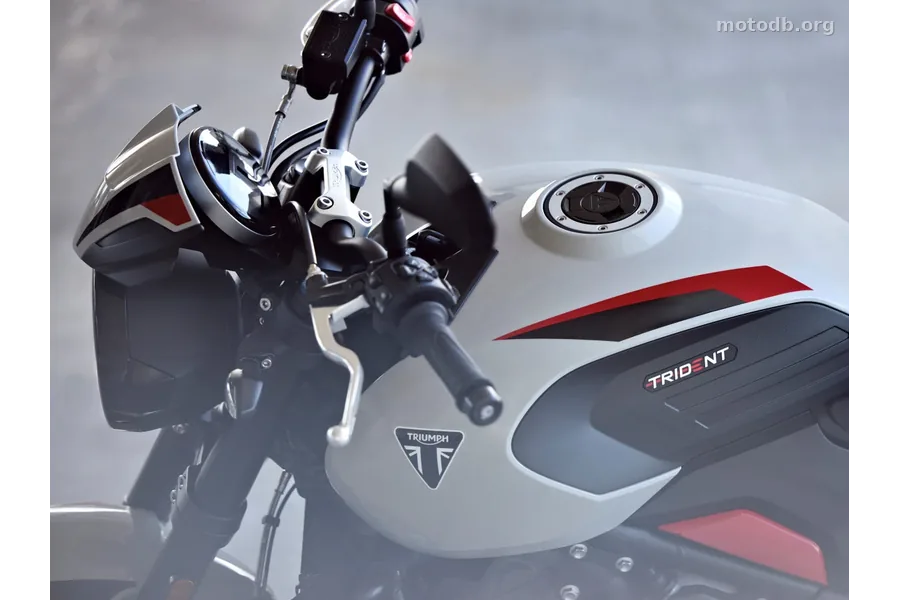
This “mid-size” Trident has let the name, as well as the lines, dictate its presence. A copy-paste of the 660, with just a bit more volume. Its full tank with curves, the shapes with accents of curves, the well-round headlight – the first glance immediately reveals that it’s the big brother. The next moment, you realize that the 800 doesn’t frequent the same club. Its tank is a bit more angular, the seat splits into two parts, the rear frame is dressed, the headlight becomes more complex and is topped with a mini windscreen, the exhaust pipe protrudes, the front fender grows, and an engine guard strengthens the belly.
Oh, it’s not all. The rims also change and the braking changes category. But we would quickly want to know what’s happening in the engine. Is it the 765 cm3 with another name? No risk of a brawl between the Trident and the Street Triple: they don’t have the same block. The 798 cm3 3-cylinder here present comes from the 800 Tiger Sport. Its power is established at 115 horsepower at 10,750 rpm, which is very nice for the displacement. To do better, you need more cylinders or more volume. Or look to the MV-Agusta 800 RR or the …. Street Triple.
The torque is established at 8.6 mkg maximum. Identical specifications to the trail cousin. And a large gap compared to the 660: 34 hp and 2 mkg more - enough to make it a super Trident. Especially since the engine is particularly successful, muscular and expressive in the Tiger Sport 800. It can only be the same in the roadster.
The advantage of being derived from an already efficient and well-born model is that you inherit a whole host of already validated, approved, and appreciated elements by the public. This will be the case for the cycle part, very convincing on the Tigre. The Trident still wants to have its own behavior and to do so, it opens its steering angle (from 23.8° to 24.5°), compensated by a reduced wheelbase of 20 mm. The weight difference of a small twenty kilos will also play a role in agility. The rest of the job will be handled by an inverted Showa fork of 41 mm of SFF-BP type with adjustable compression and rebound. The Japanese supplier also takes care of the rear shock absorber, this time with adjustable preload and rebound. As for the brakes, the Triumph badge hides J.Juan calipers, radially mounted and biting with their 4 pistons on 310 mm discs. No worries about their effectiveness, except in case of a big attack, where they will not have the high level of Italian calipers. But when you get there, it’s maybe that the Street Triple RS would suit the rider better.
Of course, the 800 Trident does not come out without chips, cables and silicon. Like everyone else. Triumph shows courtesy with a good bag, including three Riding Modes (Road / Sport / Rain), an IMU for more precision in traction control and ABS (cornering), a quickshifter Up&Down, a cruise control, automatic turn signals, full LED lighting and connectivity to manage the smartphone, calls, music and a simplified GPS navigator. 2 or 3 years ago, the English would have offered half of these equipment as an option. The competition is having an effect on historic brands; and on their pricing policy. It’s a shame that the dashboard is not up to the grade of this motorcycle. This LCD / TFT combination is of a particular taste. Frankly, the 800 Trident and Tiger Sport deserve better.
A Triumph, as you might guess, is not cheap. For a while now, the manufacturer has been working on its premium positioning, in pursuit of BMW. So, how much will we have to pay to grab the handlebars of this 800 Trident? 11,000? 12,000? Absolutely not! The English is playing tactical by settling just below 10,000. On the same line as the Z 900 and well below the iconic MT-09. There, we are witnessing each thing. Although the BMW F 900 R is laughing at all this world. At the same time, Triumph had to mark the difference with the Street Triple, whose R is only one step above in terms of price. This retiaire is therefore perfectly positioned between the 660 Trident and the 765 Street Triple, both in power and in finance.
The concept of a “roadster” in the 80-90s had gradually deviated towards the streetfighter. Then it came back slyly through neo-retro – a way to offer a naked less aggressive in the same range of watts and displacement. Since then, this kind of duo exists with almost every manufacturer: Yamaha XSR 900/MT-09 – Kawasaki Z 900/Z 900 RS – Suzuki GSX-8S/GSX-8T – Ducati Monster/Streetfighter V2 – Honda CB 750 Hornet/CB 650 Ret I’ll pass. Triumph now has its dyad with the 800 Trident and the 765 Street Triple. The latter has nothing left to prove; the new one could well cause extra sweat to the competition.
M.B - Photos manufacturer
Standard equipment
- Assistance au freinage : ABS
- Nombre de mode de conduite : 3
- Taille de l'écran TFT couleur : 8,89 cm / 3.5 pouces
- Jantes aluminium
- Shifter
- Indicateur de vitesse engagée
- Bluetooth
- Contrôle de traction
- Embrayage anti-dribble
- ABS Cornering
- Régulateur de vitesse
- Bluetooth
Practical info
- La moto est accessible aux permis : A
Reviews & comments
No reviews yet. Be the first to share your opinion!