Key performance
Technical specifications
Engine
- Displacement
- 999 cc
- Power
- 152.0 ch @ 11000 tr/min (111.8 kW)
- Torque
- 106.0 Nm @ 9250 tr/min
- Engine type
- 4 cylindres en ligne, 4 temps
- Cooling
- liquide
- Compression ratio
- 12.2 : 1
- Bore × stroke
- 73.4 x 59 mm
- Valves/cylinder
- 4
- Camshafts
- 2 ACT
- Fuel system
- Injection
- Starter
- électrique
Chassis
- Frame
- périmétrique en aluminium
- Gearbox
- boîte à 6 rapports
- Final drive
- Chaîne
- Front suspension
- Fourche téléhydraulique inversée Ø 43 mm, déb : 150 mm
- Rear suspension
- Mono-amortisseur, déb : 150 mm
Brakes
- Front brakes
- Freinage 2 disques Brembo Ø 310 mm, fixation radiale, étrier 4 pistons
- Rear brakes
- Freinage 1 disque Ø 220 mm, étrier simple piston
- Front tyre
- 120/70-17
- Front tyre pressure
- 2.50 bar
- Rear tyre
- 190/50-17
- Rear tyre pressure
- 2.90 bar
Dimensions
- Seat height
- 845.00 mm
- Seat type
- Selle biplaces
- Fuel capacity
- 19.00 L
- Weight
- 232.00 kg
- New price
- 15 999 €
Overview
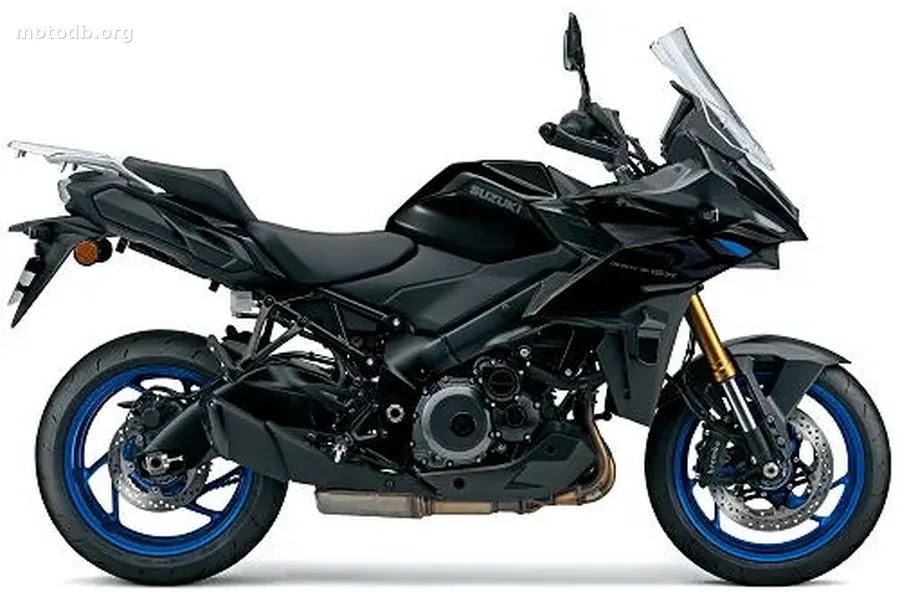
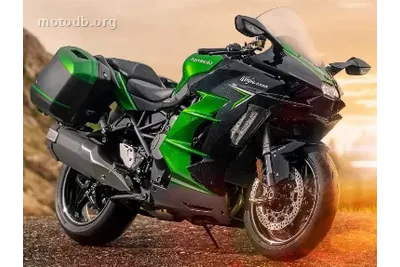
The Suzuki GSX-S1000GX receives subtle updates for 2026, including small winglets grafted onto the fairing for increased stability at high speeds. Kind of… for fashion too.
With its GSX-S1000GX, the Japanese manufacturer carves out a new segment from which it was previously absent. Most importantly, it offers riders a new way to experience the road on one of these machines.
Okay! But between us, frankly, what exactly is a “crossover”? In automotive terms, Wikipedia defines it as a “multi-segment vehicle (…) intended to benefit from the advantages presented by each of the two segments crossed.”
In the motorcycle world, Yamaha with its TDM 850 released in 1991 was the first manufacturer to pioneer this segment located at the crossroads (if we set aside the Yamaha TDR 250 released in 1988, already somewhat in this spirit, but with a very exclusive character linked to its 2-stroke engine). Indeed, the acronym TDM stood for Twin Dual-purpose Motorcycle (or a twin-cylinder dual-purpose motorcycle in French). As tall as an enduro bike, with the corresponding riding position, it was nevertheless designed 100% for the road.
Many manufacturers now offer models of this type in their lineup: without going through the entire history, let's start with Ducati and the Multistrada, born in 2003. Its family has recently been enriched with a V4 Grand Tourer version and a very sharp V4 RS of 180 hp! At KTM, the SMT 990 appeared in 2010. Withdrawn from the catalog for about ten years, it resurfaced in 890 version in 2023. At BMW, the 1000 and 900 XRs are of this ilk. The 170 hp of the large XR are boosted to 201 hp on the very sporty M version which appeared in 2024. In England, the same! The Tiger family had, until the release of the Tiger 800 in 2011, completely abandoned off-road riding in favor of the road from 2007, accentuating this point with the Tiger 1050 Sport in 2013. Among the Japanese, the Yamaha Tracer 9 and 7 bands, released respectively in 2015 and 2016, also look in the direction of this judicious mix that combines the dynamic qualities of a road bike with the upright riding position of an enduro bike. The same goes for Kawasaki with its Versys 650 and 1000, born in 2005 and 2012. Honda, having abandoned its Crossrunner (2011 – 2020) and Crosstourer (2012 – 2016), is no longer present in this segment except through its smaller NC 750 X (2012) and CB 500 X (2013). That said, the Japanese giant has recently offered a 19-inch front wheel instead of 21 inches on the Africa Twin A.S. for 2024, in order to optimize its road handling.
It remained for Suzuki, which offered kilometer eaters only two options: the road-focused GSX-S1000GT (as well as the Hayabusa for those in a hurry) or the V-Strom family trails, available in 1050, 800 and 650 cm3. The GSX-S1000GX therefore fills this gap by offering the best of both worlds: the sportiness and dynamic efficiency of the GSX-S1000, equipped with its large four-cylinder engine, and the natural and pleasant onboard life of the V-Strom family. Suzuki even goes so far as to define this newcomer as the “Ultimate Crossover Concept.” That’s it…
Now that the scene is set, the concept is defined, and we know what kind of machine we have in front of us, let's move on to its detailed examination.
The base of this GX is the well-known GSX-S1000 released in 2015, revised in 2018 and 2021. The large four-cylinder engine of 999 cm3 is borrowed from the GSX-R1000 models from 2005 to 2008. An engine that delivers 152 hp at 11,000 rpm and a torque of 10.8 mkg at 9,250 rpm. A powerhouse with a heart as big as that, nicely filled at mid-range, supple and docile at low revs but fierce and punchy at high revs! A model of the genre that refers to the blessed times of the large four-cylinder engines! To handle the power, its clutch is assisted by the SCAS (Suzuki Clutch Assist System) which both reduces lever effort and gently accompanies downshifts. The perfect ally of the bidirectional shifter mounted as standard and which allows you to shift gears in both directions without using the clutch.
Similarly, its frame, which is nothing other than the perimeter aluminum double cradle, is not in the least. It is mounted on silent blocks and its footrests are fitted with rubber.
To preserve its occupants from vibrations, its handlebars are mounted on silent blocks and its footrests are fitted with rubber. To make life sweet, it is equipped with an easy start system (Suzuki Easy Start System) and a low-speed assist to facilitate starts. A large luggage rack with large grab handles is also on the menu. Finally, its fuel tank has a generous capacity of 19 liters to devour the kilometers in complete serenity.
In terms of weight, it displays 232 kg in running order, significantly less than the V-Strom 1050 DE and almost the same tare as the GSX-S1000GT, weighing only 226 kg in running order.
In terms of price, the GSX-S1000GX had just started below 18,000 euros. A substantial sum, facing which Suzuki had to show more than convincing road and dynamic qualities. Suzuki's revamped pricing policy changes the game with a re-indexing below 16,000 euros.
Michaël Levivier - Photos manufacturer
Standard equipment
- Assistance au freinage : ABS
- Nombre de mode de conduite : 3
- Taille de l'écran TFT couleur : 16,51 cm / 6.5 pouces
- ABS Cornering
- Jantes aluminium
- Shifter
- Indicateur de vitesse engagée
- Régulateur de vitesse
- Bluetooth
- Prise USB
- Aide au démarrage
- Aide à la manoeuvre
- Contrôle de traction
- Pare brise réglable
- Suspensions réglables électroniquement
- Embrayage anti-dribble
- Centrale inertielle
Practical info
- La moto est accessible aux permis : A
- Pays de fabrication : Japon
Indicators & positioning
Similar bikes
M 1000 XR prototype
CBR 1000 RR Endurance TT Legends
Reviews & comments
No reviews yet. Be the first to share your opinion!