Key performance
Technical specifications
Engine
- Displacement
- 1064 cc
- Power
- 74.0 ch @ 6400 tr/min (54.0 kW)
- Torque
- 94.0 Nm @ 5000 tr/min
- Engine type
- V2, four-stroke
- Cooling
- Air
- Compression ratio
- 9.8 : 1
- Bore × stroke
- 92.0 x 80.0 mm (3.6 x 3.1 inches)
- Valves/cylinder
- 2
- Fuel system
- Injection
- Starter
- Electric
Chassis
- Frame
- Double berceau tubulaire en acier
- Gearbox
- 5-speed
- Final drive
- Shaft drive (cardan) (final drive)
- Front suspension
- Fourche téléhydraulique Ø 45 mm, déb : 140 mm
- Rear suspension
- 2 amortisseurs latéraux, déb : 96 mm
- Front wheel travel
- 124 mm (4.9 inches)
- Rear wheel travel
- 114 mm (4.5 inches)
Brakes
- Front brakes
- Dual disc
- Rear brakes
- Single disc
- Front tyre
- 110/90-VB18
- Rear tyre
- 140/80-VB17
Dimensions
- Seat height
- 770.00 mm
- Wheelbase
- 1560.00 mm
- Fuel capacity
- 19.00 L
- Dry weight
- 246.00 kg
- New price
- 9 490 €
Overview
When the budget stops where the pleasure begins, choices have to be made. Guzzi understood this, and rather than leaving the California EV to those who could afford it, the Mandello del Lario brand released a stripped-down version in 2001, priced at 9,490 euros: the Moto Guzzi California Jackal. Nearly 3,000 euros less than a fully optioned EV, achieved through surgical removals. Gone are the dual front brake disc, the center stand, the tubeless rims, the linked braking system, the cylinder guards, and a good portion of the chrome hardware that makes Italian customs shine at trade shows. What remains is the essentials.
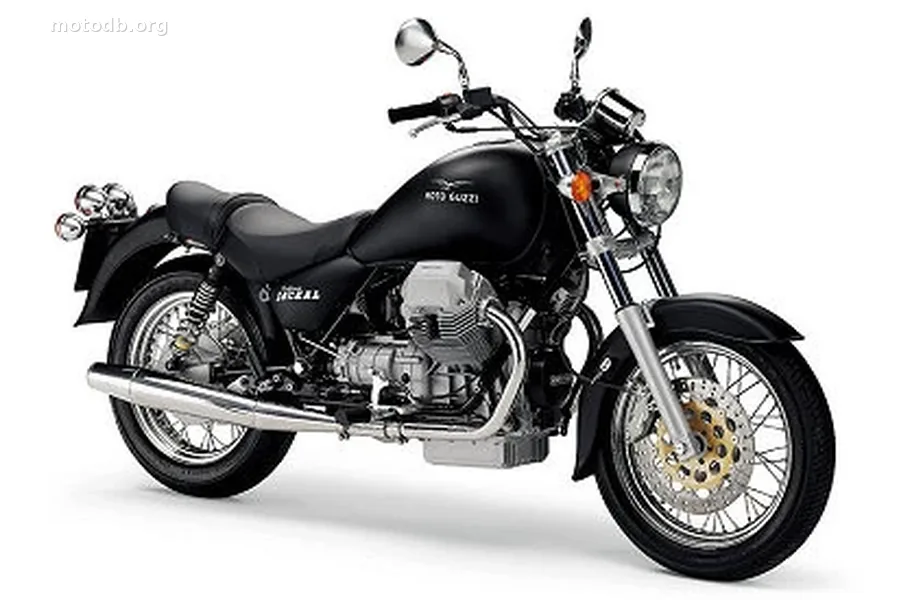
And the essentials, here, means a 1,064 cc transverse V-twin that pumps out 74 horsepower at 6,400 rpm and delivers 94 Nm of torque at 5,000 rpm. These figures don't tell the whole story. This engine, with its 92 mm bore and 80 mm stroke, has a character that Japanese four-cylinders simply don't know. It thumps, it vibrates, it communicates with both wheels in a way that café regulars struggle to describe without grinning like idiots. The shaft drive does the rest, silent and maintenance-free, even if the five-speed gearbox shows its age with a candor that can catch a new owner off guard.
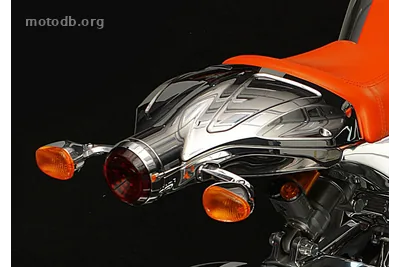
The Moto Guzzi California Jackal 2000/2001 weighs 246 kg dry with a seat height of 770 mm. For a cruiser of this size, the handling remains honest. The 45 mm fork and twin rear shocks do what's asked of them, without excessive ambition. The problem lies precisely at the rear: the finish of this part of the machine is clearly lacking, and comfort suffers on long distances. A demanding tourer will eventually order the California EV's shocks, and sometimes the seat too. The Jackal pushes toward customization not out of philosophy, but out of necessity.
The single front brake also deserves attention. In fine weather, on dry roads, it gets by. But during a firm emergency stop, the absence of the second disc makes itself known. It's not a deal-breaker — it's simply a point to address if you plan to use the bike beyond a Sunday ride. Compared to a Honda VTX or a Kawasaki Vulcan 1500 from the same era, both better equipped as standard, the Jackal can seem incomplete. But neither of them offers such a sharp identity, that transalpine character which neither the badge nor the displacement alone can manufacture.
The Moto Guzzi California Jackal targets the brand enthusiast on a tight budget, or the rider who prefers to start from a simple base and build it in their own image. This is not a motorcycle that suits everyone, and that is precisely why it will win over some riders for the long haul.
Practical info
- La moto est accessible aux permis : A
Reviews & comments
No reviews yet. Be the first to share your opinion!