Key performance
Technical specifications
Engine
- Displacement
- 1078 cc
- Power
- 95.0 ch @ 7 tr/min (69.9 kW)
- Torque
- 98.1 Nm @ 4 tr/min
- Engine type
- Bicylindre en L à 90°, 4 temps
- Cooling
- par air
- Bore × stroke
- 98 x 71.5 mm
- Valves/cylinder
- 2
- Fuel system
- injection
Chassis
- Frame
- type Omega en aluminium
- Gearbox
- boîte à 6 rapports
- Final drive
- Chaîne
- Rear suspension
- Mono-amortisseur, déb : 130 mm
Brakes
- Front brakes
- Freinage
- Rear brakes
- Freinage 1 disque
- Front tyre
- 120/70-17
- Rear tyre
- 180/55-17
Dimensions
- Fuel capacity
- 16.00 L
- Dry weight
- 168.00 kg
- New price
- 40 000 €
Overview
Twenty years. That's how long it took Bimota to realize the Tesi concept, from the sketches of the 1980s to this 3D iteration that pushes the idea to its limits. Twenty years to develop hub steering, a system where the forks disappear in favor of two front swingarms mounted on carbon fiber plates, and where Italian engineering philosophy reaches something resembling an obsession. This is not a motorcycle you buy to ride. It's a statement.
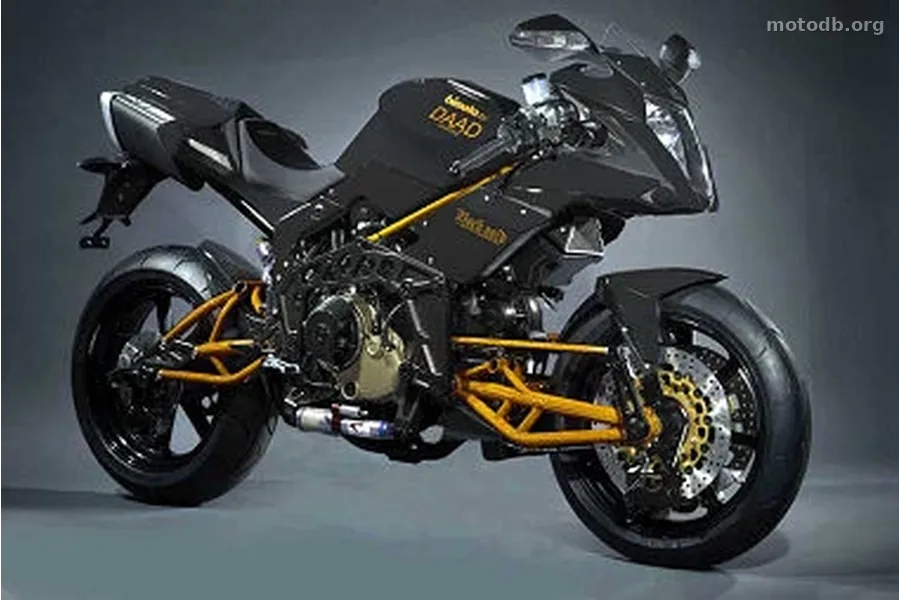
The Rock Gold doesn't even claim to be a series production model. Only one example exists, bearing frame number 00, designed not for a dealership but for the Milanese showroom of DAAD Dantone, a high-end fashion retailer that distributes Borsalino, Galliano, Pagano. The idea was simple: to dress a sales space with what the mechanical world produces that is most unexpected. The black and gold quilted finish echoes the brand's textile collections, and the whole forms an installation as much as a vehicle. At €40,000 for the standard Tesi 3D, one can easily imagine that this unique example exceeds any catalog value.
Under the bodywork, the 90-degree L-twin engine with a displacement of 1,078 cc develops 95 horsepower at 7,000 rpm and 98 Nm of torque from 4,000 rpm. Figures that seem almost modest compared to a Ducati 1098 of the time or an Aprilia RSV4 that was about to arrive, but Bimota has never played that card. The dry weight of 168 kilograms and the six-speed gearbox promise lively handling, and the announced top speed of 230 km/h is enough to demonstrate that the mechanics are not just an excuse. The Omega aluminum frame, the 120/70 tires at the front and 180/55 at the rear, the 16-liter tank: all of this remains within the sporty logic of an Italian machine with a track DNA.
But the real singularity of the Tesi 3D is its front architecture. Where each competitor plants a more or less sophisticated telescopic fork, Bimota maintains its hub steering, inherited from the work of Frederico Martini in the 1980s. The two swingarms fixed on either side of the frame cut a silhouette that confuses the eye accustomed to the genre's canons. One thinks sometimes of a kinetic sculpture as much as a speed tool. The Rock Gold pushes this aesthetic towards the register of decorative art, with its carbon fiber side plates and its livery that seems borrowed from a jewelry house rather than a competition brand.
This type of machine is not aimed at anyone in particular, and that is precisely what makes it coherent. Neither the beginner, nor the track rider, nor the long-distance rider constitute its target. It speaks to those who consider the motorcycle as an object of culture as much as of practice. Bimota has never sought to compete with Honda or Yamaha on the ground of volume; the brand from Rimini has always preferred to occupy a space apart, that of manufacturers who make radical choices and assume them to the end. The Rock Gold, unique numbered example zero zero, is the most absolute form of this state of mind. It has no direct competitor because it refuses the market. And it is perhaps the most Bimota decision that there is.
Practical info
- La moto est accessible aux permis : A
Indicators & positioning
Similar bikes
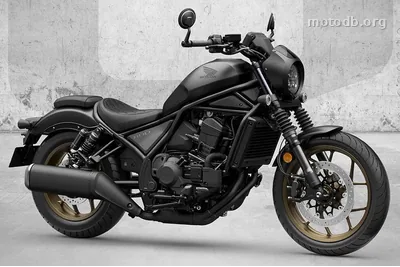
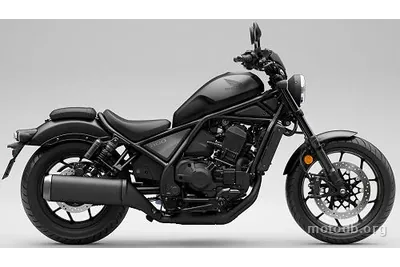
CMX 1100 Rebel DCT Special Editon
Reviews & comments
No reviews yet. Be the first to share your opinion!