Key performance
Technical specifications
Engine
- Displacement
- 445 cc
- Power
- 28.5 ch @ 6000 tr/min (21.0 kW)
- Torque
- 34.3 Nm @ 5500 tr/min
- Engine type
- Monocylindre, 4 temps
- Cooling
- par air
- Valves/cylinder
- 4
- Camshafts
- 1 ACT
- Fuel system
- injection
Chassis
- Frame
- Structures en tubes d'acier
- Gearbox
- boîte à 5 rapports
- Final drive
- Chaîne
- Front suspension
- fourche à balancier Ø 41 mm
- Rear suspension
- 2 amortisseurs latéraux
Brakes
- Front brakes
- Freinage
- Rear brakes
- Freinage 1 disque
Dimensions
- Fuel capacity
- 13.00 L
- Weight
- 342.00 kg
- New price
- 10 999 €
Overview
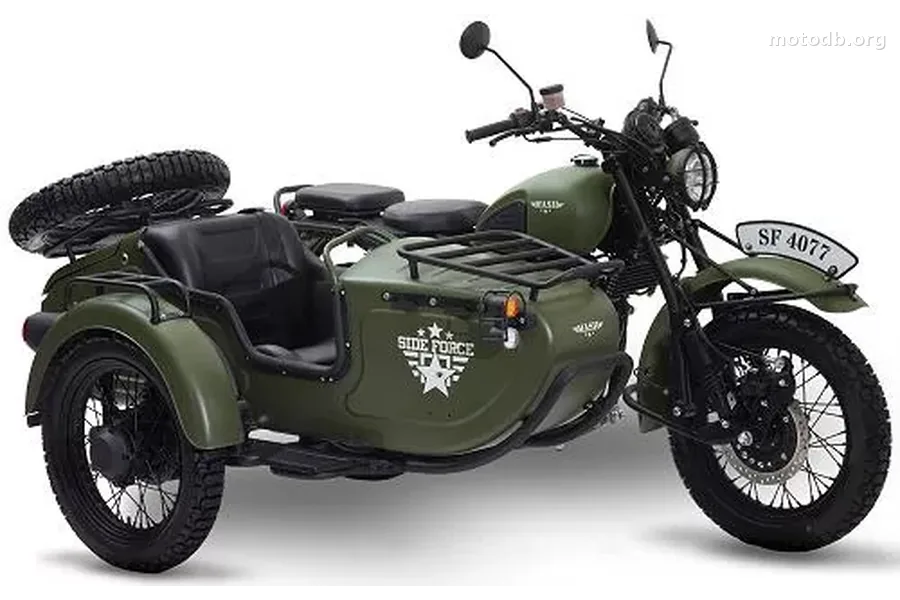
Imagine an American soldier from World War II who swapped his Rangers boots for a motorcycle saddle. That's roughly the impression the Side Force 445 gives at first glance. The Burgundian manufacturer from Beaune shifts gears with this new sidecar: out with the quiet Sunday ride, in with something decidedly more adventurous, somewhere between forest tracks and broken roads. The Family Side served coffee; this one wants to cross Siberia.
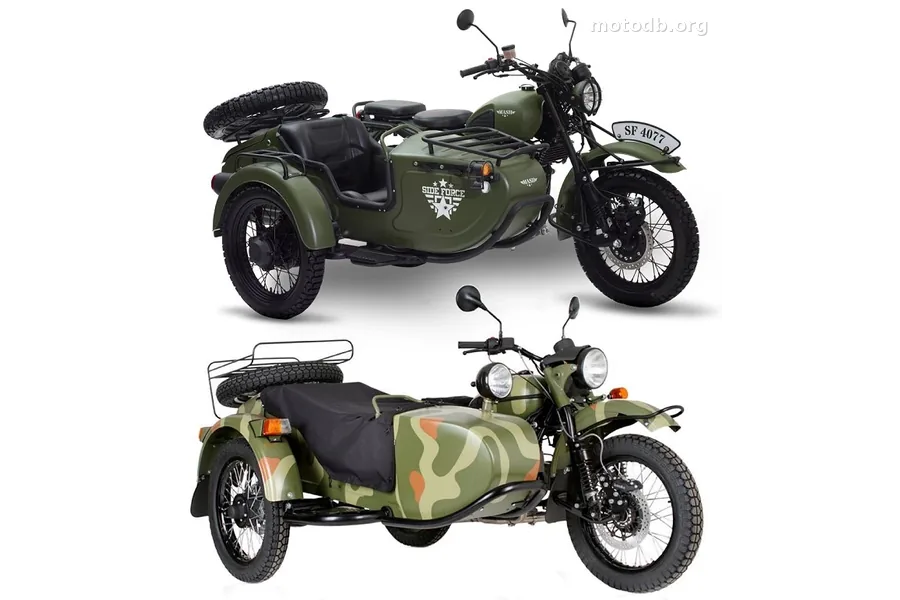
The influence is unmistakable. A 41 mm leading-link fork, knobby tires, Soviet tank-style khaki livery, a spare wheel strapped to the sidecar body, a sturdy bumper — the Side Force openly converses with the Ural Ranger, the famous Russian sidecar from Irbit. The comparison ends there on a mechanical level, but visually, the two machines look like brothers in arms. Waterproof ammo pouches on the sidecar flanks, a grille in front of the round headlight, a two-up Belle Époque-style split saddle, a faux plate on the front mudguard. Every detail tells a story. The problem is that some chapters lack coherence, particularly the small digital instrument cluster borrowed from the Force 400 roadster, which frankly clashes with this carefully cultivated military atmosphere.
Beneath the 13-liter tank beats the four-stroke single-cylinder displacing 445 cc, an evolution of the previous engine producing 28.5 hp at 6,000 rpm and 34.3 Nm of torque at 5,500 rpm. Euro 5 compliance is assured. That's not nothing, but it's clearly not enough. Mash would have liked to fit its more recent 650 cc single, except the steel tube frame left no room for it. The result: a mid-displacement powertrain on a machine that tips the scales at 342 kg fully loaded. The weight difference over the Family Side reaches 113 kg, and it shows from the very first hill. The claimed top speed is 110 km/h, but in practice, real-world conditions will cap things closer to 90 km/h.
Where does all that weight come from? The leading-link fork is structurally heavier than a conventional fork. Add to that two luggage racks, a spare wheel interchangeable with any sidecar wheel, a running board, lid struts, a bumper, and a fully metal sidecar body. The equipment list accounts for every kilogram. And it must be acknowledged that the leading-link fork delivers a genuine benefit in return: the ride is more accessible, more stable, and less physically demanding than a conventional system.
At €10,999, the Mash Side Force 445 is not aimed at the undecided or the impatient. It is a character machine, built for those who travel slowly and appreciate the scenery as much as the destination. The reverse gear, now operated via the front brake lever rather than a cumbersome central switch, and the oil cooler added in front of the engine demonstrate genuine development work. The direct competition remains the Ural — more powerful, more expensive, more iconic. The Side Force plays a different card: an accessible sidecar with considered looks and no international pretensions. For fans of country lanes and curious glances from café terraces, it's a proposition that holds up — as long as you're not in a hurry to crack 90 km/h.
Standard equipment
- Jantes à rayon
- Prise USB
Practical info
- La moto est accessible aux permis : A
Reviews & comments
No reviews yet. Be the first to share your opinion!