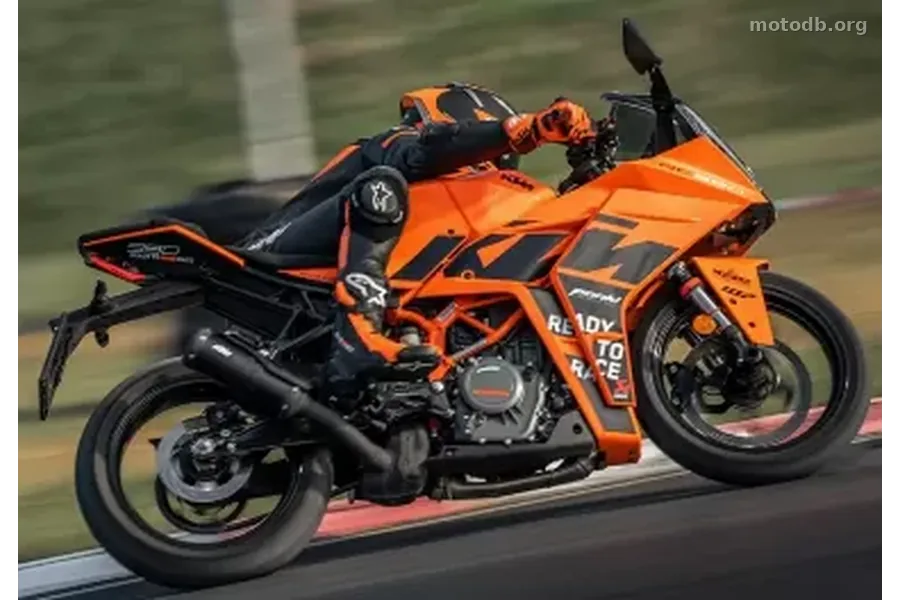
Key performance
Technical specifications
Engine
- Displacement
- 373 cc
- Power
- 44.0 ch @ 9000 tr/min (32.4 kW)
- Torque
- 38.2 Nm @ 7000 tr/min
- Engine type
- Monocylindre, 4 temps
- Cooling
- liquide
- Compression ratio
- 12.6 : 1
- Bore × stroke
- 89 x 60 mm
- Valves/cylinder
- 4
- Camshafts
- 2 ACT
- Fuel system
- Injection Ø 46 mm
Chassis
- Frame
- treillis en tubes d'acier
- Gearbox
- boîte à 6 rapports
- Final drive
- Chaîne
- Front suspension
- Fourche téléhydraulique inversée Ø 43 mm, déb : 120 mm
- Rear suspension
- Mono-amortisseur, déb : 150 mm
Brakes
- Front brakes
- Freinage 1 disque Ø 320 mm, étrier 4 pistons
- Rear brakes
- Freinage 1 disque Ø 230 mm, étrier simple piston
- Front tyre
- 110/70-17
- Front tyre pressure
- 2.00 bar
- Rear tyre
- 150/60-17
- Rear tyre pressure
- 2.00 bar
Dimensions
- Seat height
- 824.00 mm
- Fuel capacity
- 13.70 L
- Weight
- 164.00 kg
- Dry weight
- 155.00 kg
- New price
- 7 399 €
Overview
KTM knows how to combine sportiness with flair. When it comes to rally-raid, cross, enduro, and off-road riding, and Moto3, the brand has nothing to prove. For road use, there’s the Superduke 1290, one of the most powerful roadsters on the market. However, when it comes to sporty models, the Austrian firm has yet to produce a descendant of the former RC8.
That’s why the RC range defends the banner of sport with the 125 and the 390. Let’s not talk about the RC 890 C, a true track weapon but also rare, exclusive, and unusable on the road. What a strange gap there is between almost 1 liter of displacement in its “most powerful” sport model and its most mellow roadster. But the RC 390 doesn’t see it that way. It intends to hold the power in its category and show its best side.
Above all, it immediately presents its ambitions with a major overhaul. You couldn’t say it’s a facelift; the all-new bodywork showcases significant internal work. Less distinctive, still sporty, the fairing somewhat blends into the “visual norm” of the category. The superimposed side panels form a pleasant relief while ensuring a greater presence for the RC 390. The lower section is less covered than before, and the rear frame is sleeker. Even the strange seat (a single block with the rear tail) has conformed to a more classic design.
KTM has also transformed the unusual lenticular gaze of the RC models. The optics now resemble those of the Adventure models, in a simplified manner. The windshield changes shape but retains its characteristic of covering the entire fork. As if to show that it has more potential than one might think, its volumes have increased – making it appear like a motorcycle of a higher category. It’s not just about “making a splash” but also about aerodynamic optimization. To show its rider that it’s committed to sharing emotions for a long time, the fuel tank has grown by 4.2 liters – now 13.7 liters.
But what the average RC wants is to eat up the track. It secretly dreams of championships, like the SuperSport 300. Therefore, it has worked to ensure that its fairing can be easily removed and replaced with a poly. Then, limit the weight. Or rather, its weight gain. The first generation of RC 390 weighed 147 kilograms – the new one weighs 155. Even though efforts have not been spared: the frame, now with a bolted rear loop, has changed design but above all gained 1.5 kg. The Bybre brakes allow a weight reduction of 960 grams. The most impressive aspect is the wheels. No less than 3.4 kg have been shaved off; and since this mass disappears from the unsprung mass, it’s a benefit for agility.
The engine has not evolved much technically, but optimizations are present. Euro5 required the grafting of an even more imposing (and certainly heavy) silencer chamber. The single-cylinder can counter the constraints with a responsive feel. More torque and power are available. The larger airbox and a new mapping allow for a gain of 2 Nm, with the maximum power available a little earlier. The maximum power is still 44 horsepower, but it is reached at 9000 rpm instead of 9500.
The RC 390 can still rely on its short wheelbase for quick cornering; and also on better suspension. The 43 mm inverted fork benefits from Apex technology as well as compression and rebound settings. Each workshop can adjust on 30 positions, easily with the small wheels at the top of the tubes. Same Apex certification for the rear mono-shock, which offers adjustment of preload and rebound.
Renewed in many respects, the self-proclaimed track bike offers under the nose of its rider adjustable handlebars on 10 mm, a better-studied ergonomics, and a much nicer TFT color screen than the old mini-crystal liquid tablet. It also borrows technology from the family, normally installed in much more powerful models. This motorcycle gains traction control, active in curves if you please! ABS is also present and has a Supermoto mode to cut off the rear and thus play with the slide. For the quickshifter, you’ll have to go through the options corner.
The KTM RC 390 is on alert. Those who remember the glory days of 600 SuperSports will have difficulty understanding such a desire for the track from a 400. But it’s enough to look at the catalogs of the competition. A R6 for track use only, MV F3 and Daytona 675 that have disappeared, GSX-R only in other countries… The old ones will think of the VFR 400 NC 30 and ZXR 400… We still wring out, with less power, tight trajectories that will be of paramount importance with these small-displacement engines. A2, knees and elbows on the ground?!? The KTM is sweet-talking you, the bill is salty, and the single-cylinder is to be revved.
M.B - Photos constructeur
Standard equipment
- Assistance au freinage : ABS desconectable en curva
- Taille de l'écran TFT couleur : 12,70 cm / 5 pouces
- Jantes aluminium
- Indicateur de vitesse engagée
- Contrôle de traction
- Embrayage anti-dribble
Practical info
- Véhicule accessible au permis A2 ou bridable à 47.5ch / 35 Kw
- La moto est accessible aux permis : A, A2
Indicators & positioning
Similar bikes
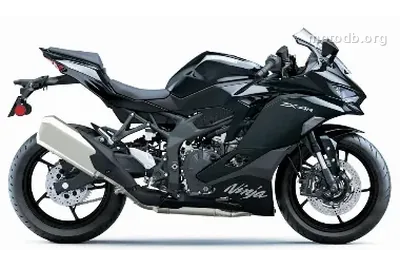
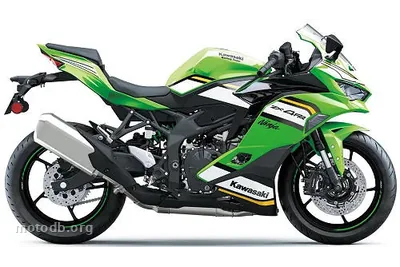
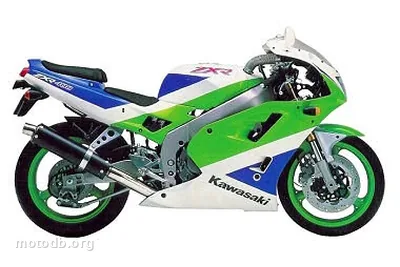
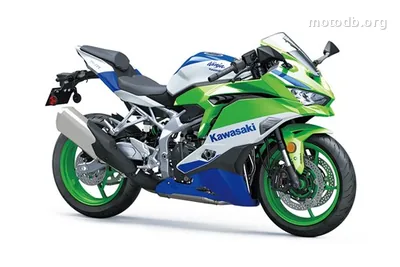
Ninja ZX-4RR 400 40ème Anniversaire
Reviews & comments
No reviews yet. Be the first to share your opinion!